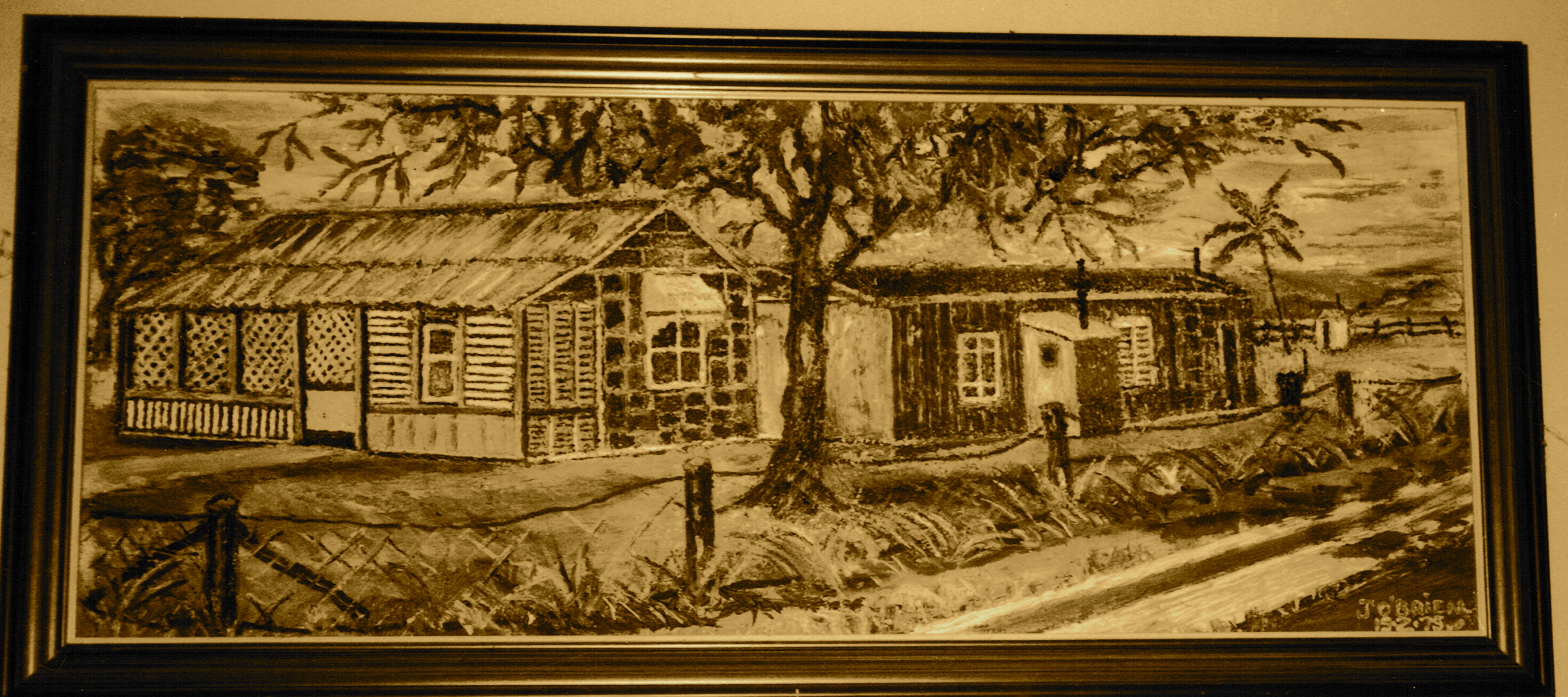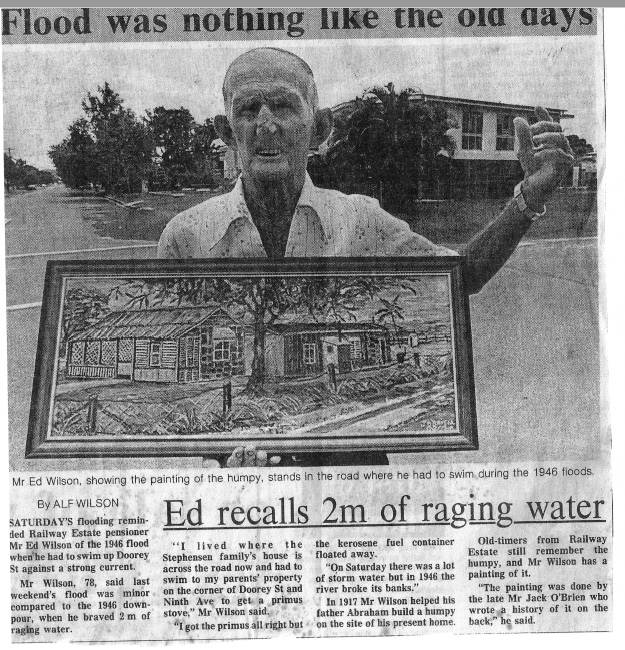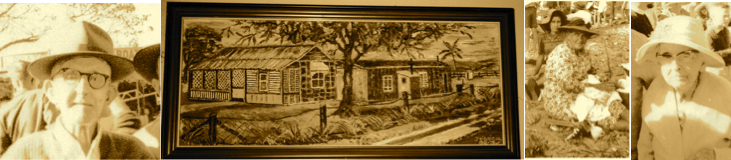
Lillian was the daughter of Abraham and Emily and Wilson, and recorded her some of her memories of her parents, their home and her life in general in an article for ‘Remember …. Writers in Townsville‘. The booklet contained a number of stories by older Townsville residents who talked about what life was like in Townsville in the first half of the 20th century (1900s – 1950s). Lillian’s story appearing in the booklet was the following:
Unable to do more than a waltz, Lillian Hatton learned specialized dance steps by mixing in the crowd that went to all the balls. Later she took part in exhibition dancing and won Townsville competitions.
Born, Lillian Wilson, she grew up in a sculpturesque house along a dirt road between the city and Ross River. Her father, Abraham, paid twenty pounds for the piece of land at 77 Ninth Avenue on the corner of Doorey Street in Railway Estate. “He could have had the next block as well but never had the extra ten pounds to pay for it,” Lillian said.
Her mother, Emily Coleman was born on a North Queensland Station where her father, a builder, had gone droving. The blacks threw spears that landed at the back door, Lillian was told. “Grandmother had to let fire with a rifle to frighten the blacks off.”
As a child, Lillian laughed at her mother’s stories. “Mum had a lovely lot of crockery ‘cause she came from a good home. She told me when they first went to Railway Estate, my father put up this little humpy with hessian walls. He oiled the hessian and she lived in that. There was bush and a dirt road, no houses. One day Mum walked to Garbutt, visiting and came home to find the goats had eaten the walls down. They’d smashed her crockery and she sat down in the middle of it and cried,” Lillian said.
Abraham Wilson was sixteen, when he arrived in Australia from Ireland. He played in brass bands when he was young and although talented, was a poor business man. “He was a wonderful clever man, a good house painter, and he could do beautiful oil paints,” Lillian said, “but he was too soft. People gave him a sob story and he’d do the job for half the price.”
Part of her home was built from tins. Lillian recalls how here brother Eddie was only a kid at school and each afternoon he walked with a wooden cart to South Townsville and collected benzine tins. After his day’s work, their father flattened these to build the house.
When Lillian and her four brothers Henry, Edward , Bill and Gordon were kids the floors were dirt. Their mother sprinkled water, swept and it was like cement. Her brother ended up putting in a cement floor.
Lillian said proudly, “Yes, we lived in that. My mother liked things pretty. Everyone who came inside was surprised. They said it was like a little doll’s house.
“I was only telling my brother about the other day,” Lillian said, “about a boy who was in my class at school. His family was well off. When I was only a little girl coming home from school I walked into our house (I suppose it was a pretty poor looking place) and this boy was there with his mates. They stood there and threw off at the house. I never forgot that.”
When she was older, Lillian was at Picnic Bay for the Thursday night dance. That boy, was a man and he asked could he take her home. She refused and thought, “What an insult!”
There was a saw mill and her mother told of the days when the water was deep and big ships came down the Ross River to pick up timber. “But now it’s full of silt – wants cleaning up – that’s why the mangroves take over.”
Oonoonaba had a few houses and Lillian and her mother walked there. On high tide they couldn’t get through because of the gullies filled with water. “We walked everywhere because we couldn’t afford the bus,” she said. Her father walked to and from his job as a house painter, every day of his life.
In 1946, flood waters flowed through the windows, over ther mother’s sewing machine and the stove. Cracks between the sheets of tin were filled with silt. They had stretcher beds, mattresses, dining table, and chairs stacked high. Her father had put his painter’s planks underneath the roof where there there was no ceiling and piled things on top.
Lillian worked long hours removing crockery from the mud. “Lots of it was broken,” she remembered.
Her first marriage was a mistake. “It was a disaster, I was too young,” Lillian said. “My mother just about reared my daughter while I was out working.”
While doing hem stitching and button holes for the Singer Machine Company in the war years, she found addresses of people overseas and sent food parcels. An officer in the Navy tried to talk her into joining the forces. She wanted to but couldn’t leave Gloria with her mother, it would have been too much for her.
“I can remember the end of the war, the excitement down at the railway station. All the stores closed their doors, there was dancing in the streets, everyone grabbed you, kissing one another, cars with tin cans tied on the back going up and down streets.”
The next job she had was with Holloman’s, a large store where she was in the china department. From there she went to Sydney for four years, worked for Berlei stitching corsets, and slipped into the dance crowd.
Since the age of nineteen, Lillian had been dancing. In Townsville, Ann Roberts was teaching and Ray Bird knew her very well. They went there on Thursday nights to help. She gave them the use of her hall on a Sunday night. Lillian won competitions for quickstep and waltzes. “You won your heat, then the semi finals and the finals. I was in my thirties when I won the main exhibition and danced until I was forty. It was beautiful,” she said.
A group travelled by rail motor for a ball where Lillian and Joe Wyllie, a teacher, did an exhibition of fox trot and tango. There was no pairing off with one another, they went as a partner. Once she asked Noel Buckby who lived in Ninth Avenue, ‘How about coming to the ball and partner me?’ and was waiting in her long evening dress when he turned up on his motor bike. Lillian suggested he might ring a taxi. She laughed about those times and said, “I loved dancing, but never had photos taken.”
So when she went to Sydney, Lillian found a crowd of ballroom dancers, and made friends quickly. She was partnered by a man who won second place in the Australian Championships.
About two years after returning to Townsville she met Jack Hatton at the Seaview dance. He was on holidays from New South Wales. “Jack could dance but he was not a good dancer,” Lillian said. He found a job on earthworks, building the Mount Stuart road. Classed as one of the best operators in Townsville, his machinery was hanging over the cliff half the time. Jack used to say, ‘A man came up for a holiday and got snagged’.
In their first years of marriage, Lillian went back home to Ninth Avenue, while Jack was in New Guinea for the Commonwealth Department of Works. They moved to several houses in Charters Towers Road, Tenth Avenue, Gladstone and Ninth Avenue again.
Finally Jack found a home while looking at earth moving machinery on Eleventh Avenue. He was talking to a man working on the site and when the bank refused their loan because they didn’t have the full deposit the stranger went guarantor for one thousand dollars on the relocated council house. They paid seven thousand dollars for house and land. Happy with their purchase and the help they’d received, they made it a comfortable home over twenty six years.
Jack liked fishing and in the sixties they travelled to Cape Tribulation with a boat on top of a utility he bought for two hundred dollars, and towing a poptop caravan. It was packed to the hilt. Jack said that Lillian always took everything but the stumps of the house. He liked his beer too, and when they got to Mossman she had a couple of cartons under her feet.
“We were told you couldn’t get anything up there,” Lillian said. They arrived to see a big house with a shop and gas. “We took everything and found we could bought anything we wanted,” she said. There were two other couples staying rainforest on the beach. At low tide they walked out to the reef and threw a line into deep water for fish.
When Lillian sent food parcels and tinned meat to England during the war, she received small gifts in return. She still has a cake of soap with no smell, from the The Great Exhibition 1851 to 1951 Festival of Britain, wrapped in a handkerchief. Two scarves she’s had since the war: one that her mother tied around her hair has the coronation scene; the other is brand new, depicting the romantic city of Venice. “Lots of things I throw out or I give away, I ‘m not a hoarder.” Lillian said.
And the most precious keepsake was given to her by one of Gloria’s boys. “Stephen played soccer at school. What a lovely thing for a little boy to do: he wrote a note and gave me one of his soccer badges. I’ve put a note in with it for him.” She had three grandsons – Terry, Stephen and Darren.
Lillian has lived through the triple tragedy of losing her husband Jack, daughter Gloria and grandson Terry who died from an asthma attack. He was well liked in soccer training and a plaque was placed at the Murray sports complex.
Lillian Hatton summed up her memories: “I’ve had a lot of unhappiness but on the whole I’ve enjoyed my life. The highlight was my dancing years.”
Appearing in: ‘I remember …… Writers in Townsville’
Printed by: WRITERS IN TOWNSVILLE
Falling Star Publishing Co
Box 5101 MSO Townsville 4810
Queensland Australia
ISBN NO: 0 9594303 1 8
Copyright: Belongs to the individual authors. With the authors permission, this material may be copied for non-profit making purposes