Joseph Raynor – Union membership

I’ve been doing some research for a while now into Joseph Raynor’s life circa 1899.  Just to recap – in Jan 1899, he applied for naturalisation and enrolled to vote.  Further details are here  and my research at the Queensland State Archives are here.

Why in January 1899 did Joseph apply for both?  I believe it is to do with his Union membership – so that the Union could gain votes in support of the Australian Labour Party.  I’ve already established that naturalisation was compulsory for being a member of the Union, as identified in the Brandt Case 1940 .

I know that later in life Joseph became a member of  the Waterside Workers Federation, but while he was employed on the SS Bobby Towns he would have been a member of the Seamen’s Union of Australia.

In 1899, the Labor Party was relatively young, forming circa 1891.   The Labor Party briefly were in Government in Queensland in     December 1899 for one week, which was the first time the Labor Party held office in the world.  So in 1899, it was likely compulsory for Joseph to join the Union.

In searching for the Seamen’s Union of Australia archive records, I discovered this site:

Australian Trade Union – Archives

Had a look at the Seamen’s Union records, but they only relate to Melbourne and Sydney branches.   I then looked up the Waterside Federation Records which  do date back to 1899 with the following description below.

Records including minutes and membership records of Bowen, Bunbury, Bundaberg, Burnie, Busselton, Devonport, Fremantle, Newcastle, Port Augusta, Port Huon, Rockhampton, Townsville, Triabunna, Urangan and Maryborough branches transferred to Federal Office.

These records are held at the ANU Archives – Noel Butlin Centre, Canberra.  

Reference:  Z387

The only relevant information that might relate to Joseph is some Minutes of meetings records held in boxes 14-16, and may not be of much use to this family’s research:

z387 - Anu Archives - Waterside federation records.jpeg


Building 2 (R G Menzies Building), Fellows Road, Australian National University, Canberra ACT 0200  – only opened on weekdays, so it will be a while till I get there and have a look.  Unless I find some better leads.


What was Joseph Raynor’s employment role on SS Bobby Towns?

I’ve been looking into SS Bobby Towns to see if I can find any records of Joseph Raynor’s employment on SS Bobby Towns, which might reveal his real name.  As every family member research Joseph’s ancestry knows, he is Sicilian by birth, so it is likely he changed his name.  Which makes it difficult to research his ancestry.

The SS Bobby Towns was a coastal steamer.    Rail did not reach North Queensland  until 1921 (Mackay) and did not reach Townsville until 1923.  Therefore transport in/out/ around North Queensland was via sea.

Cyclone Leonta – SS Bobby Towns

Joseph Raynor was a seaman  onboard SS Bobby Towns, and would have been onboard during Cyclone Leonta.

At Ross Creek – though initially not reported, there were some ‘shipping’ damages,

CYCLONE IN THE NORTH,
THE DISASTER AT TOWNSVILLE.
FURTHER DETAILS OF
DAMAGE.
SHIPPING EXPERIENCES.
THE STEAMERS WODONGA AND
BARCOO.
RELIEF MEASURES.
(From the Townsville “Bulletin” of
10th March.)
The only hint given on Sunday evening
of a coming disturbance was the fact that
the temperature rose considerably be-
tween 9 and 10 o’clock, the few following
hours being suffocatingly close and hot
and, although a little rain fell through the
small hours, only 10 points were registered
at 9 am. on Monday. At 10 -o’clock,
however, it soon became evident that a
startling change was imminent, but it was
not until about 11 o’clock that the possi-
bility of another cyclone dawned on the
people of the town. Many of the public,
who were more or less painfully acquaint-
ed with the circumstances of Mr. Wragges
“Sigma” of seven years ago, were loth to
believe that the forcible hints, given by the
weather had any connection with a repeti-
tion of that dreaded and ever to be remem-
bered cyclonic disturbance. Still anxious
inquiries were made about the rise and fall
of the barometer, and when at noon the
instrument stood at 29.150 people began to
look serious; but at the same time the re-
mark was frequently heard that there was
no occasion to trouble, because when
“Sigma” was raging the glass went down,
so it was said, to 28. In the meantime, how-
ever, the wind kept rising in velocity, and
the first hint that was given of the fact
that the disturbance was a dangerous one
was the destruction of a new plate-glass
window in one of Mr. Cowley’s new shops
in Flinders-street. Soon after this inci-
dent the well-known flagstaff of Messrs.
Aplin, Brown, and Crawshay, to which a
somewhat interesting history clings, came
down with a crash, and, business people
taking the hint, premises were speedily
closed, at all events, any goods exposed for
sale outside were quickly removed within.
Soon afterwards it was ascertained that the
residence of Mr. J. Tait, on Stanton Hill,
had been partially unroofed, and, as Mrs.
Tait was an invalid, and Mr. Tait away in
the South, much sympthy was expressed.
Then came the news that Messrs. Whalley
and Son’s store had been damaged; that
the roof had been carried away from the
Museum; that the iron was being stripped
from the roof of the new Church of the
Sacred Heart; and then things commenced
to look very serious indeed. By 1 o’clock
THE GLASS HAD FALLEN TO 28.912,
and then calamities began to follow in
quick order, although it was difficult to
obtain reliable information, owing to the
difficulty of getting about. To cross a street
was a work of difficulty, to say nothing of
danger, owing to sheets of galvanised iron
and other wreckage that were being car-
ried away by the force of the wind, as if
they were the merest trifles. And even
then, it never dawned on the business
people, who were speculating on matters
in Flinders-street, that things were even
worse in connection with buildings placed
in a more elevated position, or on the flats
of the North Ward, or at South Towns-
ville. Between 1 and 2 o’clock an awful
amount of devastation was caused amongst
private residences outside the main street,
it was thought that such fine brick build-
ings as the School of Arts, the new Cus-
tom-house, Messrs. Burns, Philp, and Co.’s
new premises, the new portion of the
Queen’s Hotel, &c, were capable of resist-
ing any disturbance ; but events proved
that such calculations were erroneous.
Apart, however, from the collapse, more or
less, of the more imposing buildings of
Townsville, many of the ordinary wooden
dwellings, whether of three rooms or of six,
simply melted away before the force of
the hurricane as if made of cardboard.
Under certain of the circumstances, it
was simply marvelous how so many people
escaped with their lives, and in the great
majority of cases, without injury. The good
luck that had scored so far in connection
with life was, unfortunately, fated to be
altered during the day, several individuals
falling, victims to the storm, particulars
of which will be detailed later on. At 2
p.m. the disturbance appeared to have
REACHED ITS HEIGHT,
the barometer making 28.640. At this
juncture of affairs, things which had been
bad before, became worse, and sheets of
iron, rafters, and other material that had
become detached from the buildings, float-
ed about in a way that constituted a seri-
ous menace to the public safety. At 2.15
matters were even worse, the reading
showing 28.586, and many buildings that
had hitherto withstood the force of the
gale had perforce to give way. Then, for-
tunately, the barometer commenced to rise,
and at 2.50 it stood at 28.612, and at 4.15,
29.118. Then some relief was experienced
in the matter of wind. It had started from
the north-west as the cause of the trouble,
but as the barometer rose it shifted to-
wards the east. At times during the day
the rain was fairly heavy, rendered blind-
ing by the force of the gale, and it is esti-
mated that the fall totalled about two,
inches. “Sigma,” so christened by Mr.
Clement Wragge, that devastated Towns-
ville in January, 1896, will probably never
be forgotten by the residents of the city ;
but in the future the nameless visitant of
the 9th March, 1903, is bound to be coupled
with it. It can be said of ” Sigma” that it
was heralded with all the meteorological
precision for which the Government
weather prophet was at that time famous.
But what could foresight do in such an
emergency, beyond giving useful warning
to shipping ? On the present occasion,
no warning came to hand, at all events in
time to be of any good ; and even if such
warning had been placarded all over the
town, what could any one, who is now suf-
fering, have done to avert the calamity ?
In looking up statistics in connection with
” Sigma,” it is on record that the barometer
on that occasion , fell only to 29.18, and
serious as the damage was then, it is much
to be feared that the losses now to be ac-
counted for will present a very much larger
bill of costs, not only in money, but in
life. Sigma was marked by both wind and
flood, but the evil that crept on Townsville
on the 9th of March was fortunately devoid
of the latter terrible cause of mischief. In
consequence of this there is luckily very
little to write about in connection with
troubles in shipping matters. It must not
be forgotten that, in attacking the Towns-
ville of to-day, as against the city of seven
years ago, the elements had a bigger and
more valuable foe to contend against ; and,
unfortunately, the elements have a nasty
habit of getting the best of the argument.
Before entering upon the tragic details of
the melancholy episode at the Townsville
District Hospital, and the minor particu-
lars, which also announce loss of life, in
connection with Townsvllle’s latest cy-
clone, it is only fitting that a word or two
should beo said of the extreme kindness
shown in very many instances to the
people in distress. The cyclone that visit-
ed Townsville yesterday was evidently
quite sufficient to prove ” That one touch
of Nature makes the whole world kin.”
The brief facts hitherto narrated have pos-
sibly not left on the imagination the ter-
rible picture that actually occurred, so it
may be mentioned here that hundreds of
PEOPLE WERE LEFT HOMELESS,
foodless, and miserable by the ” break-up
of the drought.” Then, to the everlasting
credit of the Good Samaritans of Towns-
ville, there came along a noble army of
willing assistants, amongst whom may be
mentioned Father Walsh and his adherents,
who opened the gates of the Sacred Heart
Church to all comers, and they were many;
Inspector Graham,w ho found room for
over 100 homeless individuals ; and Mr.
Botten, of the Townsville ” Bulletin,” who
kindly sheltered about fifty women and
children. Mr. Boyce, the Police Magistrate,
was equally kind ; so, too, among others ,
was Sub-inspector Quilter ; and amongst
the private citizens whose residences were
safe and handy, the name of Mr. Patience
may he mentioned.
TRAGIC SCENES.
When the cyclone was raging at its ut-
most severity the thoughts of all turned to
the hospital, and although fear was gener-
lly felt that it ¡must have suffered few were
prepared for the awful news of the disaster
which had occurred at the hospital.
When a representative of the “Bulletin”
visited the institution some time in the
afternoon the sight was appalling. Pa-
tients were huddled in every nook and
corner on the ground floors of the differ-
ent parts of the buildings ; refugees and
convalescents were, in the affinity of
misery, gathered together foodless, wet,
and yet strangely calm.
Shortly after 11 o’clock in the morning
the roof of the kitchen collapsed, and the
building was shortly afterwards levelled
to the ground. Dr. Bacot, fearing that the
roof of the Harvey Ward, a detached brick
two-storied building to the north of the
grounds, would be stripped, ordered the
removal of the fever patients, fourteen
or fifteen in number, who were in the top
ward, to the surgical ward. Not long after-
wards the roof, as feared, went whirling.
This was expected, but the disaster which
followed could not be anticipated. With-
out the slightest warning the exposed 14in.
brick walls collapsed, ‘he wooden ceiling
being carried bodily
BY THE TERRIBLE GUST
an distance of fully 80 yards. The heavy
brickwork falling on the second floor
crashed in, and the whole of the fore part
of the building collapsed, five or six pa-
tients being buried in the debris. The pa-
tients in this ward were chiefly either old
patients suffering from more or less in-
curable complaints, or were recovering
from loss serious injuries. There were
at this time in the ward fully seventeen
or eighteen patients, and it is remarkably
fortunate that the death toll was not
greater. There were two nurses in the
ward, Nurses Grant and Sinnott, the latter
having a miraculous escape. During all
this time the other numerous outbuildings
were being demolished, and there would
have been some excuse had the attention
of the staff been too distracted by the
serious threatenings elsewhere. But im-
mediately the terrible occurrence was re-
ported Dr. Bacot, nobly aided by the con-
valescent patients, began the work of res-
cue. The telephone system proving useless,
the doctor despatched messages to the
Brigade Office and to the police. The col-
lapse occurred somewhere between 1 and
2 o’clock in the afternoon, when the gale
had reached its culminating point. The
response was quick and purposeful. Lieu-
tenant-Colonel Chauvel, Lieutenant-Colonel
Tunbridge, Sub-inspector Quilter, with a
number of police and men of the Permanent
Force, arrived, and lent their aid to the
group which, under the direction of Dr.
Bacot, were working heroically to release
the buried men. The sad work realised the
natural fears of the rescuing party, dead
bodies being every now and again extracted
from the enormous heap of debris. The
work was effected, as can be imagined,
under great difficulties and with some dan-
ger from the flying sheets of iron. Three
dead bodies were recovered after arduous
toil, the names of these victims being
Charles Moores, Hugh M’Donald, and
Walter Evans. Evans may be said to have
been alive at the time of his recovery from
the heap of masonry, but he very shortly
afterwards breathed his last. The deceased
had recently come from New Guinea, and
was being treated for a bad arm. When
his body was extracted the lower portion
was found to have been
SMASHED INTO A PULP.
Hugh McDonald, another of the deceased,
was a fireman from one of the steamers,
and was being treated for a burned arm.
Moores, who was at the same time a pa-
tient and an employee of the institution,
just previous to the accident was talking
to Nurse Grant on the walk just in front
of the Harvey ward, and it is striking evi-
dence of the suddenness of the catastrophe
that both were victims of the fallen debris.
Moores was killed right out, while the de-
voted nurse suffered cruel injuries, sustain-
ing a broken leg and a fractured skull.
It is believed that another body was buried
in the ruins, the supposed victim being a
man named Birfoot, who was suffering
from a tumor on the arm, but in this case
there is some slight hope that, being able
to walk about, he had left the hospital
grounds. Among the other sufferers in the
Harvey ward were a little boy named Willie
Herrington, aged 8 years, and Thomas
Hopkins, about 25 or 26 years. In the
former case the poor little fellow was with-
drawn with his arm nearly severed, hang-
ing by but a strip of skin. Hopkins, who
was being treated for chronic rheumatism,
had both legs broken. It is also almost
certain that a patient named Kennedy
O’Brien, suffering from aneurism, lies
buried under the ruins. In this case death
is certain, and though some repugnance
may be felt at the fact that at least two
dead bodies are lying undiscovered, there is
no occasion for the slightest hope that
death has not intervened. In O’Brien’s case
it was only a
FORESTALLING OF AN EARLY DEATH,
and in any case the circumstances and the
overwhelming nature of the sudden disaster
rendered it impossible to do more than was
done. For some time it was feared that a
man named Rossi, an Italian miner, re-
cently from Croydon, had been killed, but
late in the afternoon he was recovered
alive, and but little injured. The fatalities
in this portion of the hospital grounds for
a time withdrew the attention of most
from the other buildings where the work
of devastation was proceeding. All the
outbuildings, including the Chinese ward
with five patients and the Asiatic ward
with one patient, were levelled to the
ground, or at least so destructively assailed
that hardly a stick was left standing. The
wardsman’s quarters shared a similar fate,
and the main building began to show signs
oft the effects of the fury of the gale. With
every gust at wind the iron of the roof
seemed to shrivel and loosen, and Dr.
Bacot, in the midst of his other duties,
found time to direct the removal of all
the female patients from the top story,
as warned by the fate of the Harvey ward,
he dreaded the unroofing and subsequent
demolition of the main building. The whole
of the veranda was stripped from this
building, and the charming elevated covered
way from the central hospital to the
Harvey ward was distributed in frag-
ments over the grounds, which present a
scene of unequalled destruction. The poin-
ciana trees, which the day before were in
luxuriant foliage, are completely stripped,
and everywhere unimaginable scenes of
wreck are to be viewed. The doctor’s
private room has suffered, as also the
operating-room and the room which had
been utilised for the treatment of out-
patients. An aggravation of the miseries
entailed was the arrival of a continual
stream of accident cases, the injuries all
due to the effects of the gale, being in
many cases very serious. Added to this
was the arrival of people in pitiful cir-
cumstances whose homes had been de-
stroyed —utterly demolished in many in-
stances and who were compelled to seek
the friendly shelter of the handiest public
institution. Of course
SHELTER WAS NOT REFUSED,
but with the kitchens destroyed and the
impossibility of cooking food, no sustenance
could he offered. Nurse Grant was not the
only sufferer among the staff, the gateman,
an old fellow tamed Michael Phielan, sus-
taining serious injuries, including broken
ribs and compound fracture of the skull.
The condition of affairs was pitiful, neither
patients nor staff through all this trying
time had been able to obtain any food since
breakfast, and more serious still the
typhoid patients are without milk or the
delicacies which are absolutely necessary to
their successful treatment. There are at
present between seventy and eighty indoor
patients at the hospital, and about twelve
of these are typhoid patients. Dr Bacot
expressed the opinion to a ” Bulletin” re-
presentative that it was absolutely neces-
sary that a tent hospital should be immedi-
ately erected in the grounds, and it was ap-
parent to any observer that some steps
should be taken both officially and private-
ly to abate the strain and distress existing
at the hospital. The collapse of the 14in.
brickwork at the Harvey ward is a serious
occurrence, for providing that the mortar
was good it provei that the exposed posi-
tion of the hospital demands either extra-
ordinarily strong buildings or a radical
change of site.
As to the damage inflicted, it is impos-
sible to speak, but Dr. Bacot considers it
to he enormous and estimates, roughly of
course, that it would cost £6000 to re-
habilitate the buildings to their former
condition. In the universal suffering it is
not surprising that numbers of otherwise
willing citizens engaged in the protection
of their own kin were unable to assist the
hospital sufferers, but us soon as the de-
plorable state of affairs became known,
Mr. W. Carroll sent some food supplies, and
is now engaged in organising some form of
relief in the nature required.
IT IS ESSENTIALLY NECESSARY
that assistance in the respect of food re-
quirements should be rendered to-day, and
perhaps for a day or two, more especially
in the nature of cooked foods, milk, &c.
But more is required in the immediate fu-
ture, as local aid must be inadequate in
such an unprecedented disaster. It is
scarcely necessary to state that, after such
an experience as Townsville went through
yesterday, telegraphic communication was
very quickly arrested. Still matters were
somewhat better than they were in the
time of “Sigma,” when the the city of
Cleveland Bay was almost immediately cut
off from everywhere. Yesterday, although
communication with many places was in-
terfered with, wires could be forwarded to
Brisbane up to 1 or 2 o’clock, and full ad-
vantage was taken of the fact. No Press
messages came through last night, but Mr.
Gulliver, the telegraph master, informed a
“Bulletin” representative yesterday even-
ing that the lines would probably be in
working order by this morning. (Then fol-
lows a list of the buildings damaged, par-
ticulars of which have already been sup-
plied in our telegraphic reports. )
AT THE WEST END.
At the West End, walking from the ceme-
tery townwards, it needed no second glance
to see the storm had played havoc in this
direction. It was to be seen that all shops
between the Sovereign and Paragon hotels
were more or less wrecked. Mr. Kiely, of
the first-mentioned hotel, reported his top
story a complete wreck, together with bal-
cony, &c. The Langham was more fortu-
nate, for the inmates had taken the precau-
tion to barricade both doors and windows
at an early period of the storm. The rail-
way property suffered considerably. The
maintenance-shed had some 35ft. of iron
blown off its end. The station itself lost
most of its roof, while the guards’ quarters
and cottages were utterly demolished, it
was here our representative heard of the
death of Mr. Thomson. While occupied in
repairing the roof of his house a squall
flung a piece of iron upon him, and, strik-
ing him on the head, it killed him almost
immediately.
Near to this point one caught sight of
Ross Creek.
A SHEET OF FURY-LASHED WAVES,
foam-crested. Glancing across the street
it was significant to see the row of shops
standing between the Metropolitan Hotel
and the Winton boarding-house, all more
or less wrecked. Disaster was to be seen,
look where one would. Turning into Stan-
ley-street, it was to see the more serious
damage of the day. The big School of Arts
Hall is open to the skies, while on one side
the brick wall is completely destroyed,
and the reading room is also wrecked. Tim-
ber from here was carried through the air,
crashing through the roof of a house oppo-
site, owned by Dr. M’Cabe. In the next
house, also damaged, was to be found Mrs.
Adjutant Foote, trembling for the safety of
an infant in arms. In Wills-street, general
wreckage was the order, Mr. J. Smith, con-
tractor, having lost three houses, one be-
ing completely blown down. The Catholic
Cathedral stands stripped of all its roof
iron, while one of the crosses hang sus-
pended from its mounting. Further on,
the Methodist Church was totally spoiled,
its walls alone standing, and some of those
are cracked. Proceeding onwards, one came
to St. James’s Cathedral. The building
gapes to the heavens. Entering it, one
noted pews upturned, prayer books and
communion table decorations strewn
around in confusion. This, although brave
attempts had been made to prevent greater
disaster. It took time to mount Melton
Hill, for here the wind took hurricane
force, and timber and iron hurtled through
the air. The Girls’ Collegiate School was
unroofed, so that the inmates gladly took
shelter under the hospitable roof of Mr.
Drybrough, who resides near by. Down
towards the North Ward, where another
fatality is reported, that of the death of
Mr. Martin Donohue, in Mitchell-street,
through flying debris, one viewed a strik-
ing picture. The low thunder of the storm
tossed sea, its feathered crests, and the
havoc to be seen in every landward direc-
tion, was deeply impressive. Houses dis-
mantled, houses askew and flues down—all
bespoke the power of the storm. Proceed-
ing, the Garrison Battery and its veranda
was even unroofed. In connection with
this, it may be interesting to state that
Mrs. Talbot and her fiveo children had a
narrow escape from serious danger. They
just cleared the building as the roof col-
lapsed, finding shelter at the Supreme
Court. This building has the jurors’ room
blown from its level. The Queen’s Hotel
has a big portion of roof off. The house
of Mr. P. F. Hanran, M.L.A., is also un-
roofed.
INCIDENTS OF THE CYCLONE.
With the telephonic and telegraphic ser-
vices completely disarranged and nearly
every resident of the town a sufferer by
the cyclone, some difficulty must naturally
be expected in the collection of a full re-
port of the extensive nature of the injuries
inflicted to life and property, but many
rumoured instances have been substantiated
in a degree. Rumours of exceptionally
serious happenings were of course current,
many of these embodying not facts but the
premising fears of the public. There has
been certainly no lack of fearful occur-
rences and distressful cases. Everywhere
within the radius of the town these were
visible—now a family with their poor
bundles seeking the shelter of stronger
buildings, then a female struggling against
the fanatic wind with an infant in her
arms and miraculously escaping injury
from the falling or wind-driven sheets of
iron which would have simply sliced a
human body in their violent career. In
the main street, where the damage was
less owing to the substantial nature of
the buildings and the low-lying locality,
there was less need for succour, and it
was here that an army of otherwise willing
workers was congregated, ignorant of the
requirements for assistance elsewhere. No
doubt the early disorganisation of the tele-
phone system militated against the noti-
fication of the circumstances, and there
was also not a little damage in progress
in every part of the town. The appear-
ance of the town—-and Flinders-street
suffered least—was extraordinary, sheets
of iron, branches of trees, wooden frame-
works, and sign boards floated about like
leaves, but in the higher portion of the
town
THE GRIM WORK OF THE GALE
was perceptible to an extent that would
have been grotesque had it not been so
terribly tragical. It was difficult, to realise
that death and harrowing suffering was
being experienced, but the facts were only
too real. Hundreds of cases of dreadful
occurrences are common talk, and it is too
certain that there is more or less truth
in them, as the authenticated reports are
only too numerous. In one instance, the
house of Mr. Tait, on Stanton Hill, col-
lapsed. Mr. Tait left on Saturday for
the South, and on the same day his wife,
the daughter of Mr. R. Rollwagen, gave
birth to an infant. The convalescent
mother and the infant remained in the
house until nearly 1 o’clock. The patients
were removed, luckily, as the building
threatened to collapse, which it did shortly
after the removal of the inmates.
Every hour brought fresh news, and it
was gratifying to hear of the sacrifice made
by individuals in aid of helpless sufferers.
Inspector Graham made an hospice of the
old gaol, where over sixty refugees were
given shelter, food, and bedding. Sub-
inspector Quilter, with a child sick in the
hospital and his house unroofed, stuck to
his duty under rather trying circumstances.
Engaged at the court until 1 o’clock, he
with Detective Fitzpatrick, went to the
hospital and took part in the relief work
there. While at the hospital he received
a letter, from the Acting Traffic Manager
informing him that in consequence of the
storm about twenty children, whose homes
were at Oonoonba or Cluden, had taken
shelter at the railway station. As there
was no chance of the little ones getting to
their homes it was a necessity that they
should be lodged for the night. The kindly-
natured Acting Traffic Manager pointed out
that the children were, wet through, and he
had only fourteen rugs and
HIS LITTLE GUESTS WERE HUNGRY.
But Sub-inspector Quilter, having finished
his task at the hospital, made as ample
arrangements as possible for the protec-
tion and comfort of the little derelicts.
With the advent of the gale all vehicular
traffic was compelled to take shelter, or to
pay the penalty of opposing an irresistible
force. All the cabs ceased running, and
many were completely wrecked, two or
three being overturned. The midday train
to the Towers was abandoned, and business
throughout the town ceased. The known
loss of life is serious, but the addition will
be material in after effects. At the hos-
pital the cruel conditions must affect the
result in numerous cases, while it can
unfortunately hardly be doubted that many
lives have been lost which will not be re-
corded for days. The effect of the fright
and exposure on delicate women and chil-
dren must naturally create irreparable and
permanent injury, and the succeeding desti-
tution at such a time of industrial depres-
sion is painful to contemplate. No attempt
can be made to award praise to the numer-
ous charitably-disposed persons who aided
and sheltered the sufferers. Every sound
or partially sound house contained refugee
neighbours, and early attempts were made
in many instances to repair the damage or
provide against further attacks of the
storm. The police and Defence Force
were willing and able volunteers, and
mention must be made of the willing
efforts of Constables Gurkian and Bailley,
Lieutenant-Colonel Tunbridge was a heavy
loser by the storm, but although his own
house was wrecked, he did not deviate from
his participation in the rescue work at the
hospital. Among his losses, severe as they
are, he counts as worst his official papers
and many interesting relics of the South
African campaign.
ON CASTLE HILL.
Strangely, buildings which were shelter-
ed under Castle Hill have suffered quite
as severely as those on the open flat. The
tremendous force of the gale may be
guessed at when it is stated that the large
fig trees in the Queen’s Park have literally
been slashed to pieces. Weird pranks were
played by the wind, branches of many of
the trees being actually tied in knots.
Gardens and shade trees in all directions
are levelled, and the scene is indeed heart-
rending. Fragments of grass torn up
from the soil, and leaves were blown with
such terrible force as to have fast adhered
to the woodwork that received the furious
battering. A newly-built cottage, owned
by Mr. Doig, in Alexandra-street, was
lifted completely off the stumps and thrown
into the yard, while a house on the ad-
joining allotment escaped without a
scratch. It would require column merely
to mention the properties which have
suffered serious damage. The full force
of the blow which wrecked the hospital
buildings was felt in Mitchell-street , which
is now only a sorrowful mass of twisted
iron and tumbled beams. Eyre-street,
from the Queen’s Park Hotel to the Or-
phange, was badly treated. The entire top
story of the hotel was carried off at the
height of the storm, and Mr. Short’s store
on the opposite corner crumbled up under
a mass of flying iron and woodwork from
the hospital. The residence of Mr. E. T.
Harris was scattered to the four winds of
heaven ; indeed, with the exception of the
old gaol—which proved a safe refuge in
the worst of the storm for many of the
homeless residents of the neighbourhood
hardly a stick has been left standing in
that spot. The plague hospital was
severely handled, and the Botanic Gar-
dens no longer merit the title. Mr. An-
derson’s fine bushhouse has been destroy-
ed, and the shrubs and trees in every
quarter torn and broken down in the most
pitiful fashion.
END OF THE STORM.
The tornado that came in with such fury
on Monday went out with mildness dur-
ing the night, and towards the morning
rain fell in torrents. By 10 o’clock in the
morning the weather had cleared up, and
nothing was left to remind one of the ter-
rible power of the cyclone but wrecks of
residences, shops, hotels, and public build-
ings. What with sheets of galvanised iron,
rafters, and other debris strewn about in
all directions, the streets, particularly the
lower end of Flinders-street, resembled a
town after a siege, when the bombardment
had been particularly effective. The gen-
eral consensus of opinion holds that “Sig-
ma” was not equal in violence to the latest
exhibition. At the time of ” Sigma” the
wind velocity was estimated at seventy-five
miles per hour, but on Monday this rate
was easily beaten. There is also a general
agreement that the financial loss to the
community as a whole, particularly the
suffering caused to private individuals, the
small house-owners and so on, is far more
widespread than in January, 1896. General
satisfaction is felt that no repetition of
the tremendous disaster that occurred to
the breakwaters of the harbour during
” Sigma”‘was recorded. The hotels at the
lower end of the town, particularly the
Queen’s and the Criterion, appear to have
been especially unfortunate. These build-
ings, facing the bay, apparently came in
for the full brunt of the hurricane. In the
first place the wind from the west played
havoc, and, when it shortly afterwards
veered to the east, the wrecks were com-
pleted by a direct frontal attack.


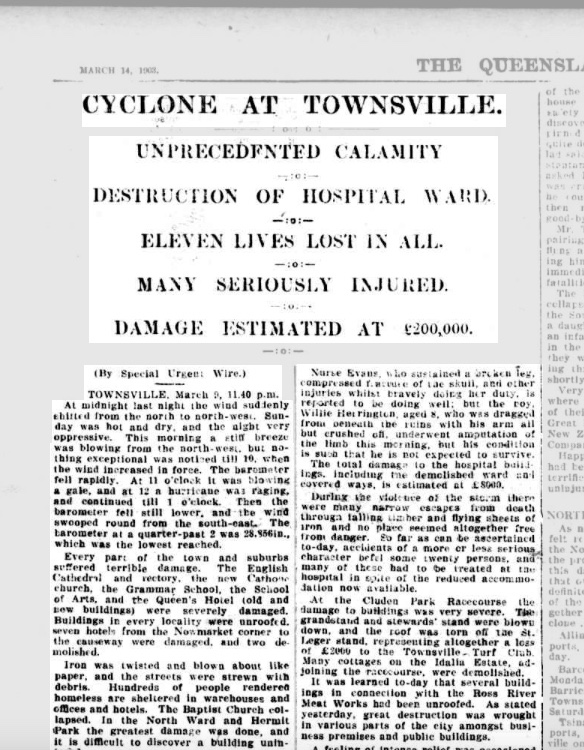
Cyclone Leonta – 9 March 1903

From the The Queenslander, 14 March 1903

Queenslander Sat 14 Mar 1903 P567 - Leonta

CYCLONE AT TOWNSVILLE.

UNPRECEDENTED CALAMITY
DESTRUCTION OF HOSPITAL WARD.
ELEVEN LIVES LOST IN ALL.
MANY SERIOUSLY INJURED.

DAMAGE ESTIMATED AT £200,000.

(By Special Urgent Wire.)
TOWNSVILLE, March 9, 11.40 p.m.
At midnight last night the wind suddenly hitter from the north to north-west. Sunday was hot and dry, and the night very oppressive. This morning a stiff breeze was blowing from the north-west, but nothing exceptional was noticed till 10, when the wind increased in force. The barometer fell rapidly. At 11 o’clock it was blowing a gale, and at 12 a hurricane was raging, and continued till 1 o’clock. Then the barometer fell still lower, and the wind swooped round from the south-east. The barometer at a quarter-past 2 was 28.956 in.,which was the lowest reached.
Every part of the town and suburbs suffered terrible damage. The English cathedral and rectory, the new Catholic church, the Grammar School, the School of Arts, and the Queen’s Hotel (old and new buildings) were severely damaged. Buildings in every locality were unroofed. Seven hotels from the Newmarket corner tothe causeway were damaged, and two demolished. Iron was twisted and blown about like paper, and the streets were strewn with debris.
Hundreds of people rendered homeless are sheltered in warehouses and offices and hotels. The Baptist Church collapsed. In the North Ward and Hermit Park the greatest damage was done, and it is difficult to discover a building uninjured.
Many awful instances of suffering are reported. Flinders-street was dangerous
from flying iron, and innumerable cases, of accident are at the hospital.  The Boys’ Grammar School is reported to have collapsed, and one boy is missing. Telephone and telegraph wires are hanging in the street.
By 4 o’clock the storm gradually abated. The rain has ceased ; in fact, it never was heavy. Ross Creek was like a surging sea. It is impossible to estimate the damage, but the
rescuers at the hospital include Colonels Chauvel, Tunbridge, Sub-inspector Quilter,
the police, and the Garrison Battery Artillery.
A heartrending disaster occurred at the hospital. At the Harvey ward, a two storied detached building, Dr. Bacot, fearing the destruction of the premises, ordered the removal of the typhoid patients from the top story. Shortly afterwards the roof was blown away. Then, when the gale was at its fiercest between 1 and 2 p.m., the 14in. brick wall collapsed, burying the patients on the ground floor, eight persons perishing in the ruins. All the outbuildings were levelled with the ground. No food was cookable at the hospital since  breakfast. The roof was blown off the Samaritan Ward, and the covered way was demolished. The verandahs are strewn all over the ten acres comprising the hospital ground.
The destruction is far in excess of that caused by ” Sigma.”
TOWNSVILLE, March 10.
The city is completely stunned by the disaster which overtook it on Monday afternoon, and (by the heavy losses involved. The destruction of private as well as public property has been terrible, andso many private houses have been destroyed that large numbers of people are homeless. Townsville this morning presented a most depressing appearance, and numbers of people were roaming about gazing at the demolished buildings, and the debris of galvanised iron, timber, and other material, and discussing the dreadful
experiences of the previous day. Additional horror was lent to the surroundings by the discovery of two bodies amongst the ruins of demolished houses, thus increasing the list of fatalities to eleven, no less than eight persons having perished in the collapse of the Harvey Ward of the Hospital.
The necessities of sufferers and refugees from Hermit Park and the North Ward and other portions of the city and suburbs early attracted attention, and the Mayor
(Alderman W. Ackers) called a meeting of the Municipal Council this morning to consider the steps which should be taken for the relief of distress.  The Mayor telegraphed to the Premier (Hon. R. Philp), asking for assistance ; and the Police Magistrate (Mr. Boyce) also
telegraphed to the head of his department, asking authority to render temporary assistance to those in distress, and to provide shelter for the homeless, who number some hundreds.
Both from the loss of life involved and from the destruction of property the collapse of the Harvey Ward of the hospital is the most serious event of the calamitous storm. The death roll amongst the unfortunate patients amounts, as already stated, to eight persons, and there is a fear that others may yet succumb to their injuries.
The victims were—Hugh McDonald. H. Burford, Kennedy, O’Brien, Charles Moores, William Oliver, Hans Thorensen, and Walter Evans.
Nurse Evans, who sustained a broken leg, compressed fracture of the skull, and other
injuries whilst bravely doing her duty, is reported to be doing well; but the boy Willie Herrington, aged 8 who was dragged from beneath the ruins with his arm all
but crushed off, underwent amputation of the limb this morning, but his condition is such that he is not expected to survive.
The total damage to the hospital buildings, including the demolished ward and covered ways is estimated at 8000 pounds.During the violence of the storm there were many narrow escapes from death through falling timber and flying sheets of iron and no place seemed altogether free from danger. So far as can be ascertained to-day, accidents of a more or less serious,character befit some twenty persons, and many or these had to be treated at the hospital in spite of the reduced accommdation now available.
At the Cluden Park Racecourse the damage to buildings was very severe. The grandstand and stewards’ stand were blown down, and the roof was torn off the St. Leger stand, representing altogether a loss or £2000 to the Townsville Turf Club. Many cottages on the Idalia Estate, adjoining the racecourse, were demolished.
It was learned to-day that several buildings in connection with the Ross River Meat Works had been unroofed. As stated yesterday, great destruction was wrought in various parts of the city amongst business promises and public buildings.
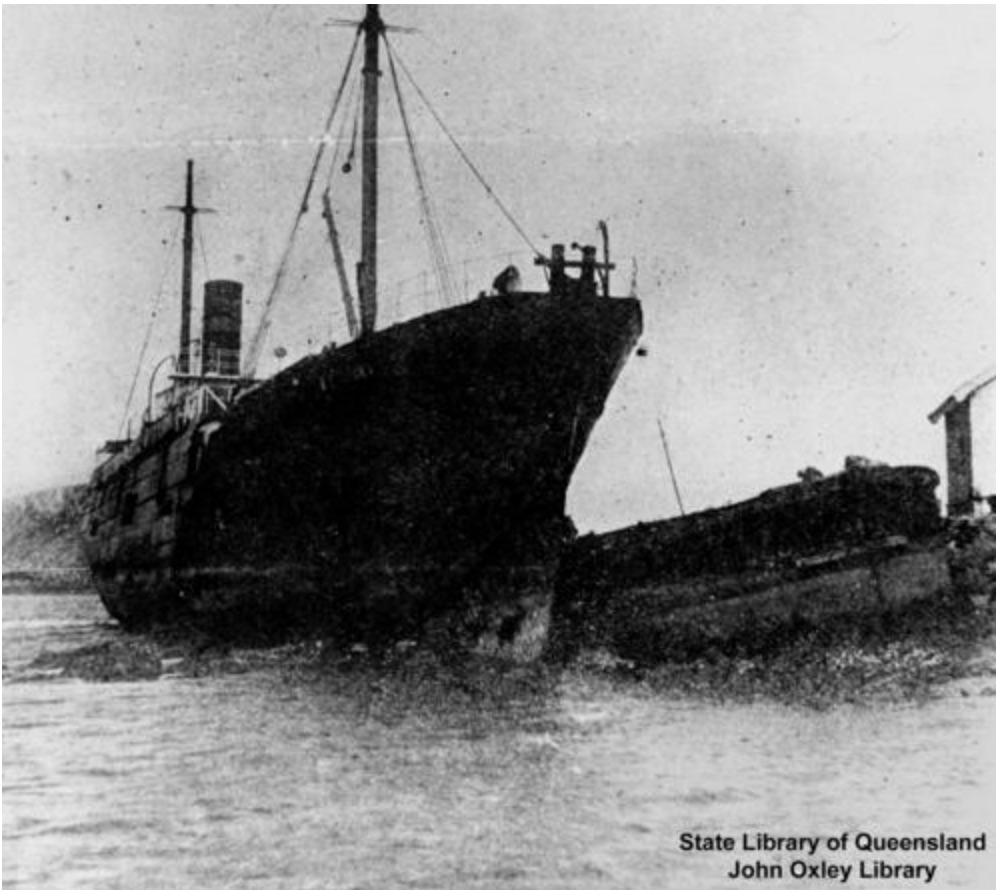
A feeling of Intense relief was occasioned by the intelligence that the harbour works, which have cost an enormous sum of money, had escaped without damage. The force of the gale, however, drove the steamers Wodonga and Barcoo from their moorings last night, and they both drifted on to a sandbank within the harbour, fortunately uninjured, so far as is known.
The Wodonga, it is said, lies in 3ft. of water, and the Barcoo, which is just at the stern of the other steamer, has her bow on a mud bank, whilst her stern remains afloat. When the Barcoo broke away she carried a portion of the wharf with her, tearing out the fastenings and beams to which she had been secured, so terrific was the force of the gale.
The steam tender Baratta, which, as already reported, was blown out to sea during the height of the storm, returned to Townsville this morning in safety. The lighter Alexandra is ashore on the rocks near the pilot station.

Steamer Alexandra blown on rocks after Leonta

Steamer Alexandra blown on the rocks after Leonta

Burns, Philp, and Co.’s coal hulk Moltke, with 600 tons of coal on board, has disappeared. It is supposed that she has sunk at her moorings. Three of the Harbour Board’s barges have sunk, and a labour schooner, which broke from her mooringsand was carried on to the rocks, was subsequently floated off, with very little damage.
The damage of property generally has been roughly estimated at £200,000 ; but the full extent of the destruction wrought cannot at present be stated. These figures are much lower than those given for the cyclone of 1896, and the loss of life, so far is known, has been somewhat less, being ten this year as against thirteen in the ” Sigma” disaster.


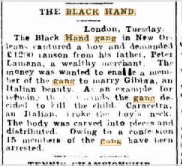
Joseph Raynor – The Black Hand Gang

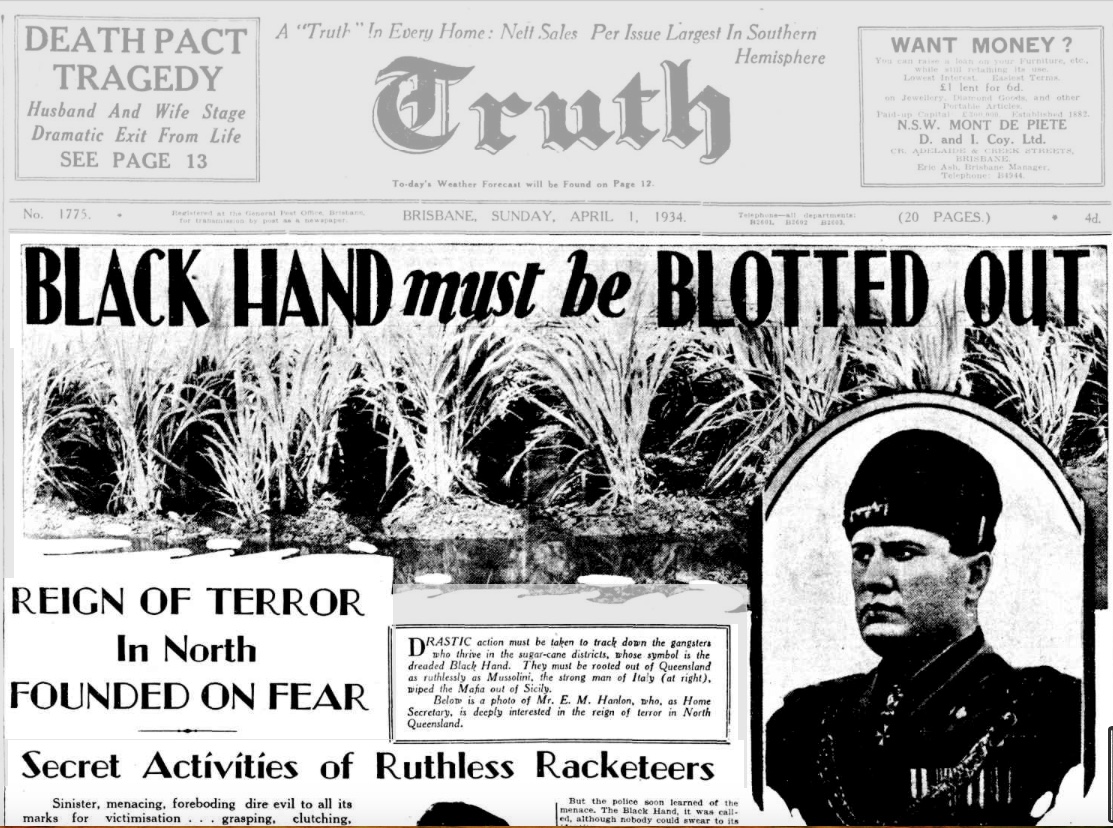
Black Hand must be blotted out

Above:  Front page News – Brisbane Newspaper – Truth (Sun 1 Apr 1934) Page 1

According to my grandmother (one of Joseph’s daughters), there were times when the children would be ‘shooed’ out the door, by the adults, when discussing ‘adult’ topics of concern.  Children were not allowed to hear ‘adult’ discussion.  This was during the 1920s, based on my Grandmother’s age at the time.  One such topic that would have the children ‘expelled’ immediately from the living room was any mention of the ‘Black Hand Gang’.

The black hand gang was allegedly a ‘mafia’ organisation operating out of Ingham.

According to the oral history I have heard, Joseph would ‘tremble’ at the mention of the black hand gang.

So I went looking and found some background on the ‘Black Hand Gang’.   I don’t think Joseph had personal contact, but his reaction to the mention of them was the main reason one (light-hearted) theory of the Raynor family on why Joseph changed his name.  The theory is that  Joseph was on the run from the Mafia in Messina Sicily, which was why he jumped ship in Australia, and changed his name.

No-one in the family seriously believes this is the case, it is simply yet another story (in jest) on why Joseph  changed his name, and ended up in Townsville.  

I found the following articles on the black hand gang:

ABC Radio National – Black Hand Gang Ingham – Part 1 (9 May 2016)

and

ABC Radio National – Black Hand Gang – Ingham – Part 2 (10 May 2016)

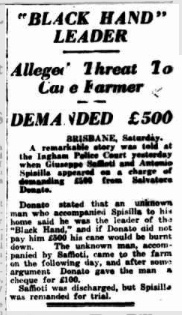
The following is another  newspaper article about the black hand gang operating out of Ingham (about 100 kilometres north of Townsville):
The Barrier Miner – Sat 3 Dec 1932 page 1

Black hand gang

BLACK HAND”

LEADER.

Alleged Threat To
Cane Farmer
 
DEMANDED £500
 
BRISBANE, Saturday.
 
A remarkable story was told at the Ingham Police Court yesterday when Giuseppe Saffioti and Antonio Spisilla appeared on a charge of demanding £500 from Salvatore
Donato.
 
Donato stated that an unknown man who accompanied Spisilla to his home said, he was the leader of the “Black Hand,” and if Donato did not pay him £500 his cane would be burnt down. The unknown man, accompanied by Saffioti, came to the farm on the following day, and after some argument, Donato gave the man a cheque for £100.
 
Saffioti was discharged, but Spisilla  was remanded for trial.
Brisbane Courier 5 May 1916 Page 7 - The Alleged Black Hand Gang
 The Black Hand gang were active in the Southern states as well, as this report (above) on some Black Hand members in Sydney (an internment camp during World War I), where some apparent members were trying to extort money from other wealthier inmates.
Evening Telegraph (Charters) 26 Jun 1907
The Black Hand gang was operating in the USA as well, as covered in the above newspaper article.
So was Joseph on the run from the Mafia in Sicily?  Probably fiction, but there was possibly an element of the mafia operating in North Queensland at the time.  He grew up in an area dominated by the Mafia, and probably would not have been happy to find an Italian organisation calling themselves the Black Hand Gang who were operating not too far from where he had settled.

1946 Floods – South Townsville

Morning Bulletin (Rockhampton) 6 Mar 1946 Page 1:

Morning Bulletin 6Mar1946 Page 1 - Flood in Townsville
FLOOD IN TOWNSVILLE GREATEST IN MEMORY : DAMAGE MANY THOUSANDS
Water 15 Ft Deep In Parts
TOWNSVILLE, March 5.-Residents of 60 years stated that the flood in Townsville was the greatest in memory, affecting areas previously re-garded as above any possibility of flooding. The damage done by the flood in the city will run into many thousands until the flood waters recede, as many houses in the Hermit Park area are still submerged. Some householders lost the greater part of their furniture, which was swept out of their houses. Officials, however, estimate the damage at £200,000 in the city area.
In parts of South Townsville the water was as high as 15 ft. above the road level. The Causeway Hotel, on the bank of the Ross River, had 30 inches of water over the bar counter.  With inches of silt and other flood deposits in their homes, many residents of suburban areas of Townsville today were unable to obtain town water with which to clean their houses.  
The water shortage has been caused not by any damage to the weirs, but by the submersion of the pumps which line the bank of the Ross River and which have been in water, mud and silt. The wet motors of the pumps will have to be replaced with dry motors before pumping can be resumed. The city is still without gas, which is not expected to be available until Wednesday.
More stories on the 1946 flood are here:    Flood was nothing like the old days…… and Ross Island history


Mudpicker Family – Blog update

I’ve been offline now for about three years since the last blog post, but I didn’t stop doing family history research – I just slowed down a bit as I didn’t get a lot of time.

I’m currently checking and updating various posts and information on the blog, including fixing any broken ‘links’ that may exist.  Once I’ve fixed all, I’ll  start posting about what I’ve found over the last three years (mostly online archival information).