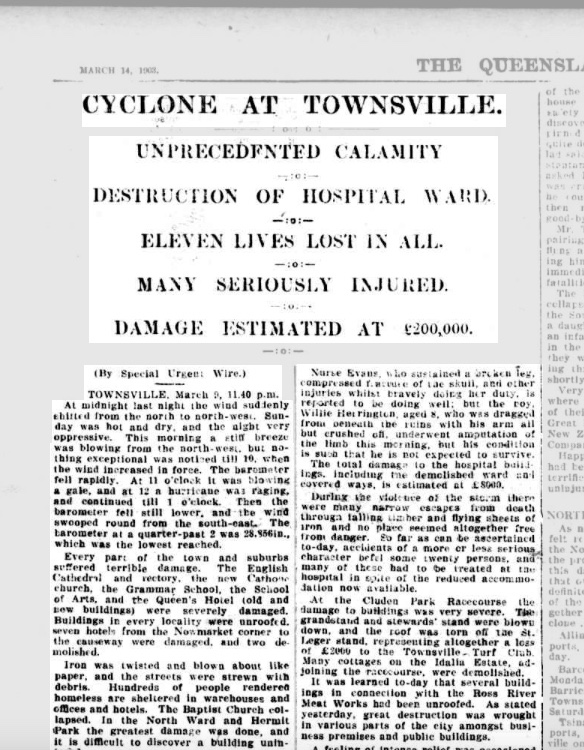
should be taken both officially and private-
ly to abate the strain and distress existing
at the hospital. The collapse of the 14in.
brickwork at the Harvey ward is a serious
occurrence, for providing that the mortar
was good it provei that the exposed posi-
tion of the hospital demands either extra-
ordinarily strong buildings or a radical
As to the damage inflicted, it is impos-
sible to speak, but Dr. Bacot considers it
to he enormous and estimates, roughly of
course, that it would cost £6000 to re-
habilitate the buildings to their former
condition. In the universal suffering it is
not surprising that numbers of otherwise
willing citizens engaged in the protection
of their own kin were unable to assist the
hospital sufferers, but us soon as the de-
plorable state of affairs became known,
Mr. W. Carroll sent some food supplies, and
is now engaged in organising some form of
relief in the nature required.
IT IS ESSENTIALLY NECESSARY
that assistance in the respect of food re-
quirements should be rendered to-day, and
perhaps for a day or two, more especially
in the nature of cooked foods, milk, &c.
But more is required in the immediate fu-
ture, as local aid must be inadequate in
such an unprecedented disaster. It is
scarcely necessary to state that, after such
an experience as Townsville went through
yesterday, telegraphic communication was
very quickly arrested. Still matters were
somewhat better than they were in the
time of “Sigma,” when the the city of
Cleveland Bay was almost immediately cut
off from everywhere. Yesterday, although
communication with many places was in-
terfered with, wires could be forwarded to
Brisbane up to 1 or 2 o’clock, and full ad-
vantage was taken of the fact. No Press
messages came through last night, but Mr.
Gulliver, the telegraph master, informed a
“Bulletin” representative yesterday even-
ing that the lines would probably be in
working order by this morning. (Then fol-
lows a list of the buildings damaged, par-
ticulars of which have already been sup-
plied in our telegraphic reports. )
At the West End, walking from the ceme-
tery townwards, it needed no second glance
to see the storm had played havoc in this
direction. It was to be seen that all shops
between the Sovereign and Paragon hotels
were more or less wrecked. Mr. Kiely, of
the first-mentioned hotel, reported his top
story a complete wreck, together with bal-
cony, &c. The Langham was more fortu-
nate, for the inmates had taken the precau-
tion to barricade both doors and windows
at an early period of the storm. The rail-
way property suffered considerably. The
maintenance-shed had some 35ft. of iron
blown off its end. The station itself lost
most of its roof, while the guards’ quarters
and cottages were utterly demolished, it
was here our representative heard of the
death of Mr. Thomson. While occupied in
repairing the roof of his house a squall
flung a piece of iron upon him, and, strik-
ing him on the head, it killed him almost
Near to this point one caught sight of
A SHEET OF FURY-LASHED WAVES,
foam-crested. Glancing across the street
it was significant to see the row of shops
standing between the Metropolitan Hotel
and the Winton boarding-house, all more
or less wrecked. Disaster was to be seen,
look where one would. Turning into Stan-
ley-street, it was to see the more serious
damage of the day. The big School of Arts
Hall is open to the skies, while on one side
the brick wall is completely destroyed,
and the reading room is also wrecked. Tim-
ber from here was carried through the air,
crashing through the roof of a house oppo-
site, owned by Dr. M’Cabe. In the next
house, also damaged, was to be found Mrs.
Adjutant Foote, trembling for the safety of
an infant in arms. In Wills-street, general
wreckage was the order, Mr. J. Smith, con-
tractor, having lost three houses, one be-
ing completely blown down. The Catholic
Cathedral stands stripped of all its roof
iron, while one of the crosses hang sus-
pended from its mounting. Further on,
the Methodist Church was totally spoiled,
its walls alone standing, and some of those
are cracked. Proceeding onwards, one came
to St. James’s Cathedral. The building
gapes to the heavens. Entering it, one
noted pews upturned, prayer books and
communion table decorations strewn
around in confusion. This, although brave
attempts had been made to prevent greater
disaster. It took time to mount Melton
Hill, for here the wind took hurricane
force, and timber and iron hurtled through
the air. The Girls’ Collegiate School was
unroofed, so that the inmates gladly took
shelter under the hospitable roof of Mr.
Drybrough, who resides near by. Down
towards the North Ward, where another
fatality is reported, that of the death of
Mr. Martin Donohue, in Mitchell-street,
through flying debris, one viewed a strik-
ing picture. The low thunder of the storm
tossed sea, its feathered crests, and the
havoc to be seen in every landward direc-
tion, was deeply impressive. Houses dis-
mantled, houses askew and flues down—all
bespoke the power of the storm. Proceed-
ing, the Garrison Battery and its veranda
was even unroofed. In connection with
this, it may be interesting to state that
Mrs. Talbot and her fiveo children had a
narrow escape from serious danger. They
just cleared the building as the roof col-
lapsed, finding shelter at the Supreme
Court. This building has the jurors’ room
blown from its level. The Queen’s Hotel
has a big portion of roof off. The house
of Mr. P. F. Hanran, M.L.A., is also un-
INCIDENTS OF THE CYCLONE.
With the telephonic and telegraphic ser-
vices completely disarranged and nearly
every resident of the town a sufferer by
the cyclone, some difficulty must naturally
be expected in the collection of a full re-
port of the extensive nature of the injuries
inflicted to life and property, but many
rumoured instances have been substantiated
in a degree. Rumours of exceptionally
serious happenings were of course current,
many of these embodying not facts but the
premising fears of the public. There has
been certainly no lack of fearful occur-
rences and distressful cases. Everywhere
within the radius of the town these were
visible—now a family with their poor
bundles seeking the shelter of stronger
buildings, then a female struggling against
the fanatic wind with an infant in her
arms and miraculously escaping injury
from the falling or wind-driven sheets of
iron which would have simply sliced a
human body in their violent career. In
the main street, where the damage was
less owing to the substantial nature of
the buildings and the low-lying locality,
there was less need for succour, and it
was here that an army of otherwise willing
workers was congregated, ignorant of the
requirements for assistance elsewhere. No
doubt the early disorganisation of the tele-
phone system militated against the noti-
fication of the circumstances, and there
was also not a little damage in progress
in every part of the town. The appear-
ance of the town—-and Flinders-street
suffered least—was extraordinary, sheets
of iron, branches of trees, wooden frame-
works, and sign boards floated about like
leaves, but in the higher portion of the
THE GRIM WORK OF THE GALE
was perceptible to an extent that would
have been grotesque had it not been so
terribly tragical. It was difficult, to realise
that death and harrowing suffering was
being experienced, but the facts were only
too real. Hundreds of cases of dreadful
occurrences are common talk, and it is too
certain that there is more or less truth
in them, as the authenticated reports are
only too numerous. In one instance, the
house of Mr. Tait, on Stanton Hill, col-
lapsed. Mr. Tait left on Saturday for
the South, and on the same day his wife,
the daughter of Mr. R. Rollwagen, gave
birth to an infant. The convalescent
mother and the infant remained in the
house until nearly 1 o’clock. The patients
were removed, luckily, as the building
threatened to collapse, which it did shortly
after the removal of the inmates.
Every hour brought fresh news, and it
was gratifying to hear of the sacrifice made
by individuals in aid of helpless sufferers.
Inspector Graham made an hospice of the
old gaol, where over sixty refugees were
given shelter, food, and bedding. Sub-
inspector Quilter, with a child sick in the