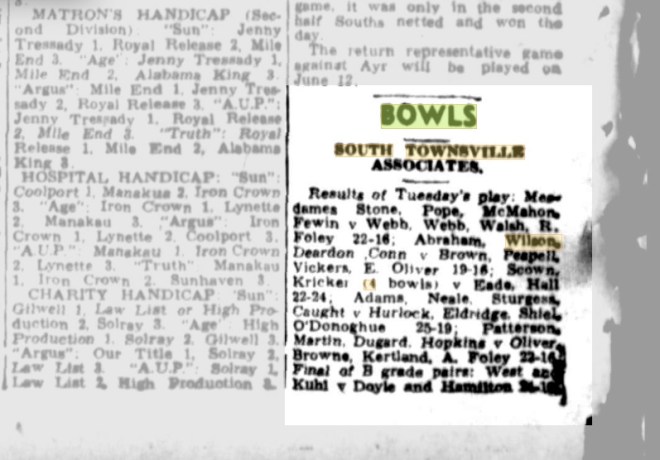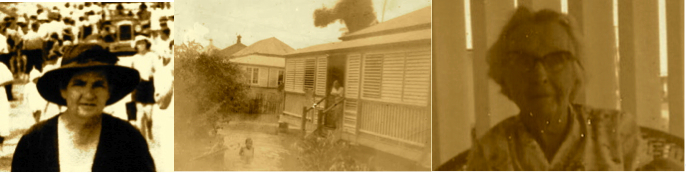
Joseph Raynor was naturalised 11 January 1899. I visited Queensland Archives hoping to get a copy of his naturalisation application, however it is missing. There is however a line in a naturalisation register confirming Joseph was naturalised at the Townsville Supreme Court on 11 Jan 1899.
Did Joseph change his name to Joseph Raynor when he was naturalised? According to Queensland Archives staff, it would have been simple for Joseph to change his name – he just declared his new name and that was it. The naturalisation process did not apparently require a strict identification process.
Why did Joseph apply for naturalisation? Did he need to have it to be in Australia?
I did a search of NLA Newspapers online and did a search of Naturalisations in Townsville, as reported in the Townsville Daily Bulletin. I came across this interesting article appearing in the Newspaper 13 January 1940:
The above reads:
THE BRANDT CASE.
(To the Editor)
Sir,— My attention was drawn to the Coroner’s Inquest into the circumstances surrounding the death of H. G. Brandt. The claim for naturalisation appeared in the Townsville Bulletin of 20/11/1939. On 24/11/1939 I was Instructed to summon him to attend the Branch executive meeting for 26/11/1939, which I did in the following letter:
24th. November, 1939
Mr H. Brandt,
Palmer-street,
South Townsville,
TOWNSVILLE.
Dear Sir,
I have the honour by direction to summon you to attend the Branch Executive Meeting, to be held on Sunday next, 26/11/1939 at 10am. Business: To consider the question of naturalisation in connection with your membership of the Waterside Workers’ Federation.
I am, Dear Sir,
Yours faithfully, (Signed)
ANTHONY OGDEN Secretary
Immediately after hearing of the tragedy, I attended at the Seaham Flats, and learned what happened, I attended the funeral officially next day. Afterwards I collected his wages from employers, obtained payment by my officials in advance, of what balance was due, after burial expenses had been decided. The amount was £9/7/6. Tbe Waterside Workers’ instructed me to do all that was necessary for Mrs. Brandt, and it was done. I never heard of anything like persecution of deceased because of his nationality. Because of not being naturalised, deceased was really incapable by rule, of being a member, but evidently such inelegibility was only known to himself, until published in the Townsville ‘Bulletin’. I think we can safely say that my organisation of Waterside Workers’ is absolutely innocent of any offence against the late H. G. Brandt.
ANTHONY OGDEN,
Secretary
A. D. SMITH.
President Townsville,
January 11, 1940
What was this about? It appears a condition of membership of the Waterside Workers Federation was that the member must be an Australian citizen (or British as it was then). However Mr Brandt was a member of the Waterside Workers Federation but had not been naturalised, and the Waterside Workers did not check this.
So what happened? A Coroner’s inquest had been reported in the Townsville Daily Bulletin 11 Jan 1940 (Page 3)
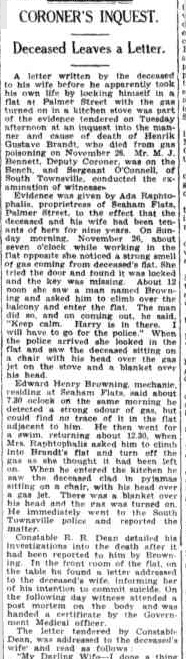
CORONER’S INQUEST.
Deceased Leaves a Letter.
A letter written by the deceased to his wife before he apparently took his own life by locking himself in a flat at Palmer Street with the gas turned on in a kitchen stove was part of the evidence tendered on Tuesday afternoon at an inquest into the manner and cause of death of Henrik Gustave Brandt, who died from gas poisoning on November 26. Mr. M. J. Bennett, Deputy Coroner, was on the Bench, and Sergeant O’Connell, of South Townsville, conducted the examination of witnesses.
Evidence was given by Ada Raphtophalls, proprietress of Seaham Flats, Palmer Street, to the effect that the deceased and his wife had been tenants of hers for nine years. On Sunday morning, November 26, about seven o’clock while working in the flat opposite she noticed a strong smell of gas coming from the deceased’s flat. She tried the door and found it was locked and the key was missing. About 12 noon she saw a man named Browning and asked him to climb over the balcony and enter the flat. The man did so, and on coming out, he said, ‘Keep calm. Harry is in there. I will have to go for the police.’
When the police arrived she looked in the flat and saw the deceased sitting on a chair with his head over the gas jet on the stove and a blanket over his head. Edward Henry Browning, mechanic, residing at Seaham Flats, said about 7.30 oclock on the same morning he detected a strong odour of gas. but could find no trace of it in the flat adjacent to him. He then went for a swim, returning about 12.30, when Mrs. Raphtophalls asked him to climb into Brandt’s flat and turn off the gas as she thought it had been left on. When he entered the kitchen he saw the deceased clad In pyjamas sitting on a chair, with his head over a gas jet. There was a blanket over his head and the gas was turned on. He immediately went to the South Townsville police and reported the matter.
Constable R. R. Dean detailed his investigations into the death after it had been reported to him by Browning. In the front room of the flat, on the table he found a letter addressed to the deceased’s wife, informing her of his intention to commit suicide. On the following day witness attended a post mortem on the body and was handed a certificate by the Government Medical officer.
What did the letter say?
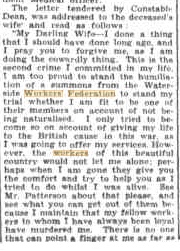
‘My Darling Wife— I done a thing that I should have done long ago, and I pray you to forgive me, as I am doing the cowardly thing. This is the second crime I committed in my life. I am too proud to stand the humiliation of a summons from the Waterside Workers’ Federation to stand my trial whether I am fit to be one or their members on account of not being naturalised. I only tried to become so on account of giving my life to the British cause in this war, as I was going to offer my services. However, the workers of this beautiful country would not let me alone; perhaps when I am gone they give you the comfort and try to help you as I tried to do whilst I was alive. See Mr. Patterson about that please, and see what you can get out of them because I maintain that my fellow workers to whom I have always been loyal have murdered me. There is no one that can point a finger at me at far as (continued next page)…….
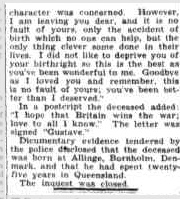
character was concerned. However, I am leaving you dear, and it is no fault of yours, only the accident of birth which no one can help, but the only thing clever some done in their lives. I did not like to deprive you of your birthright so this is the best as you’ve been wonderful to me. Goodbye as I loved you and remember, this is no fault of yours: you’ve been better than I deserved.’ In a postcript the deceased added: ‘I hope that Britain wins the war; love to all I know.’ The letter was signed ‘Gustave.’ Documentary evidence tendered by the police disclosed that the deceased was born at Allinge, Bornholm, Denmark, and that he had spent twenty five years in Queensland. The inquest was closed.
So this is probably why Joseph Raynor was naturalised – it was a requirement of his employment and compulsory membership of his Union (he would most likely have been a member of the Seaman Union while employed on the SS Bobby Towns).