Joseph Raynor – Union membership

I’ve been doing some research for a while now into Joseph Raynor’s life circa 1899.  Just to recap – in Jan 1899, he applied for naturalisation and enrolled to vote.  Further details are here  and my research at the Queensland State Archives are here.

Why in January 1899 did Joseph apply for both?  I believe it is to do with his Union membership – so that the Union could gain votes in support of the Australian Labour Party.  I’ve already established that naturalisation was compulsory for being a member of the Union, as identified in the Brandt Case 1940 .

I know that later in life Joseph became a member of  the Waterside Workers Federation, but while he was employed on the SS Bobby Towns he would have been a member of the Seamen’s Union of Australia.

In 1899, the Labor Party was relatively young, forming circa 1891.   The Labor Party briefly were in Government in Queensland in     December 1899 for one week, which was the first time the Labor Party held office in the world.  So in 1899, it was likely compulsory for Joseph to join the Union.

In searching for the Seamen’s Union of Australia archive records, I discovered this site:

Australian Trade Union – Archives

Had a look at the Seamen’s Union records, but they only relate to Melbourne and Sydney branches.   I then looked up the Waterside Federation Records which  do date back to 1899 with the following description below.

Records including minutes and membership records of Bowen, Bunbury, Bundaberg, Burnie, Busselton, Devonport, Fremantle, Newcastle, Port Augusta, Port Huon, Rockhampton, Townsville, Triabunna, Urangan and Maryborough branches transferred to Federal Office.

These records are held at the ANU Archives – Noel Butlin Centre, Canberra.  

Reference:  Z387

The only relevant information that might relate to Joseph is some Minutes of meetings records held in boxes 14-16, and may not be of much use to this family’s research:

z387 - Anu Archives - Waterside federation records.jpeg


Building 2 (R G Menzies Building), Fellows Road, Australian National University, Canberra ACT 0200  – only opened on weekdays, so it will be a while till I get there and have a look.  Unless I find some better leads.


Joseph Raynor – The Black Hand Gang

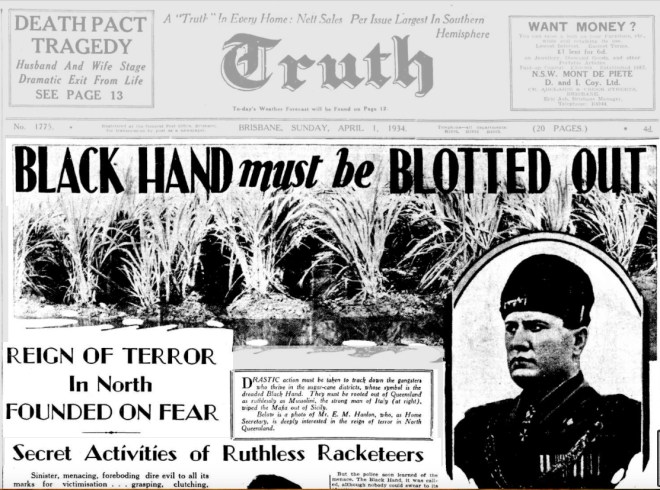
Black Hand must be blotted out

Above:  Front page News – Brisbane Newspaper – Truth (Sun 1 Apr 1934) Page 1

According to my grandmother (one of Joseph’s daughters), there were times when the children would be ‘shooed’ out the door, by the adults, when discussing ‘adult’ topics of concern.  Children were not allowed to hear ‘adult’ discussion.  This was during the 1920s, based on my Grandmother’s age at the time.  One such topic that would have the children ‘expelled’ immediately from the living room was any mention of the ‘Black Hand Gang’.

The black hand gang was allegedly a ‘mafia’ organisation operating out of Ingham.

According to the oral history I have heard, Joseph would ‘tremble’ at the mention of the black hand gang.

So I went looking and found some background on the ‘Black Hand Gang’.   I don’t think Joseph had personal contact, but his reaction to the mention of them was the main reason one (light-hearted) theory of the Raynor family on why Joseph changed his name.  The theory is that  Joseph was on the run from the Mafia in Messina Sicily, which was why he jumped ship in Australia, and changed his name.

No-one in the family seriously believes this is the case, it is simply yet another story (in jest) on why Joseph  changed his name, and ended up in Townsville.  

I found the following articles on the black hand gang:

ABC Radio National – Black Hand Gang Ingham – Part 1 (9 May 2016)

and

ABC Radio National – Black Hand Gang – Ingham – Part 2 (10 May 2016)

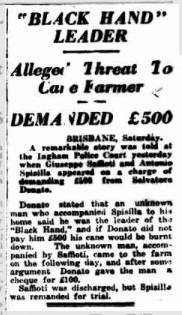
The following is another  newspaper article about the black hand gang operating out of Ingham (about 100 kilometres north of Townsville):
The Barrier Miner – Sat 3 Dec 1932 page 1

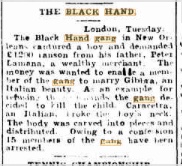
Black hand gang

BLACK HAND”

LEADER.

Alleged Threat To
Cane Farmer
 
DEMANDED £500
 
BRISBANE, Saturday.
 
A remarkable story was told at the Ingham Police Court yesterday when Giuseppe Saffioti and Antonio Spisilla appeared on a charge of demanding £500 from Salvatore
Donato.
 
Donato stated that an unknown man who accompanied Spisilla to his home said, he was the leader of the “Black Hand,” and if Donato did not pay him £500 his cane would be burnt down. The unknown man, accompanied by Saffioti, came to the farm on the following day, and after some argument, Donato gave the man a cheque for £100.
 
Saffioti was discharged, but Spisilla  was remanded for trial.
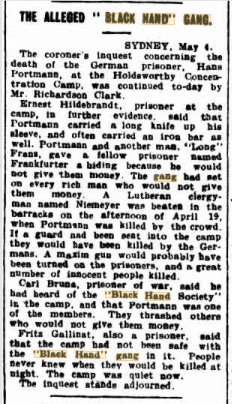
Brisbane Courier 5 May 1916 Page 7 - The Alleged Black Hand Gang
 The Black Hand gang were active in the Southern states as well, as this report (above) on some Black Hand members in Sydney (an internment camp during World War I), where some apparent members were trying to extort money from other wealthier inmates.
Evening Telegraph (Charters) 26 Jun 1907
The Black Hand gang was operating in the USA as well, as covered in the above newspaper article.
So was Joseph on the run from the Mafia in Sicily?  Probably fiction, but there was possibly an element of the mafia operating in North Queensland at the time.  He grew up in an area dominated by the Mafia, and probably would not have been happy to find an Italian organisation calling themselves the Black Hand Gang who were operating not too far from where he had settled.

Cyclone Sigma


From the Newspaper ‘The Queenslander’ dated 14 Mar 1903.

Cyclone Sigma hit Townsville 26 January 1896, with devastating effect.  Below is a recount, quoted from ‘The Queenslander’ Newspaper:

The cyclone “Sigma” broke over Townsville with most disastrous effects on Sun-day, 26th January, 1896. Timely warning was given by the meteorological office ofthe advent of violent disturbances, and most of the townspeople were prepared for something unusual, when the wind, which had been blowing strongly for a couple of days, gradually increased in strength, till at midnight on Saturday, 25tJanuary, it advanced in cyclonic form. The wind blew persistently from the south, be ing accompanied at times with heavy rain, which, under the influence of the gale, found its way into houses hitherto considered absolutely weatherproof. A very heavy sea was running, waves broke over the eastern end of the jetty, and even inside the harbour the waves were of a dangerous size and strength. Even these conditions were light, when compared with those of Sunday and Monday. Between 6 and 7 o’clock on Sunday morning the Bay presented an alarming appearance, high waves beat upon the beach, and frequently overwhelmed 500ft. to 600ft. of the eastern jetty, pouring over the structure into the harbour in irresistible volume. The intervals between the gusts became less frequent, and the rain was almost continuous. Every gully and watercourse carried a roaring torrent. In the early morning Cape Cleveland advised that the
velocity of the wind registered 11, but a higher velocity was reached in the afternoon.

The harbour works suffered severely. The mischief to the eastern jetty was most extensive, and along about 1600 ft. of it, the height was reduced by 5ft. or 6ft., the cement coping and portions of the base being demolished. Four gaps were made  on the seaward side of the jetty, between the wharf and the shore. On the outer arm there was a large gap near the bend beyond the end of the concrete parapet. The jetty was levelled down for several feet, and the lighthouse end swept away. The western breakwater was damaged in several places, and about 200 ft. at the end was levelled to about low-water mark. The vessels wrecked were the Alexandra, Ada Dent, Star of Hope, Lalla Rookh, Nebo, Florence Elliott, Heather Belle,Presto, Dugong, Nautilus, two barges, and the steamer Ellen. The Leura was washed broadside on to the breakwater, and the Aramac was grounded for ten hours on Bramble Reef.

The town presented a wrecked appearance, houses being unroofed, and in some cases lifted bodily off the blocks. In many instances there was a total collapse. The School of Arts was wrecked, and the baths completely swept away. The Imperial and  Criterion Hotels were unroofed, and hardly a house escaped damage. The streets were strewn with galvanised iron from the roofs of the houses. The lighthouses on both jetties disappeared. Ross Creek was in strong flood, and Hermit Park and neighbourhood were flooded. The railway goods shed was unroofed, and the line was under water as far as the eye could reach. The gas works were flooded. The hospital was much damaged, and had hardly a dry corner. On Ross Island the Church of England was completely wrecked, the Oddfellows Hall was utterly demolished and scores of cottages were shifted and unroofed .Thirteen lives were lost during the gale, including those of Mrs. Hunt and  infant, Mrs. Grimman, and the Misses Rowe  (2), who were drowned in Ross Creek bythe upsetting of a boat. One section of Ross Creek Bridge sank 3ft .

The rainfall between 9 a.m. and 9.50 p.m.on the 26th was 7.7 in., and between the24th and 28th totalled 26.72 in. The barometer fell to 29.19 in. The damage to Townsville was estimated at half-a-million sterling.


Isabella Shiels – how she earned a living in Townsville

I’ve been wondering how Isabella earned a living when John died.  It turns out she worked as a Laundress.

I found the information on the QLD State Archives website (I searched under Images) and was looking at old photos when I came across the Townsville Orphanage Register files – which are scanned in as images.  isabella admitted two of her daughters, Annabella and Eliza, to the Orphanage in 16 Oct1886 (following her earlier admission of daughters Margaret and Annabella 6 Aug 1884 – 16 Apr 1886).  On the admission form, Isabella’s occupation is listed as ‘Laundress’.  So that’s it then – that is how she made a living -obviously not enough to support 5 daughters.

Joseph Raynor – insolvency 17 June 1899

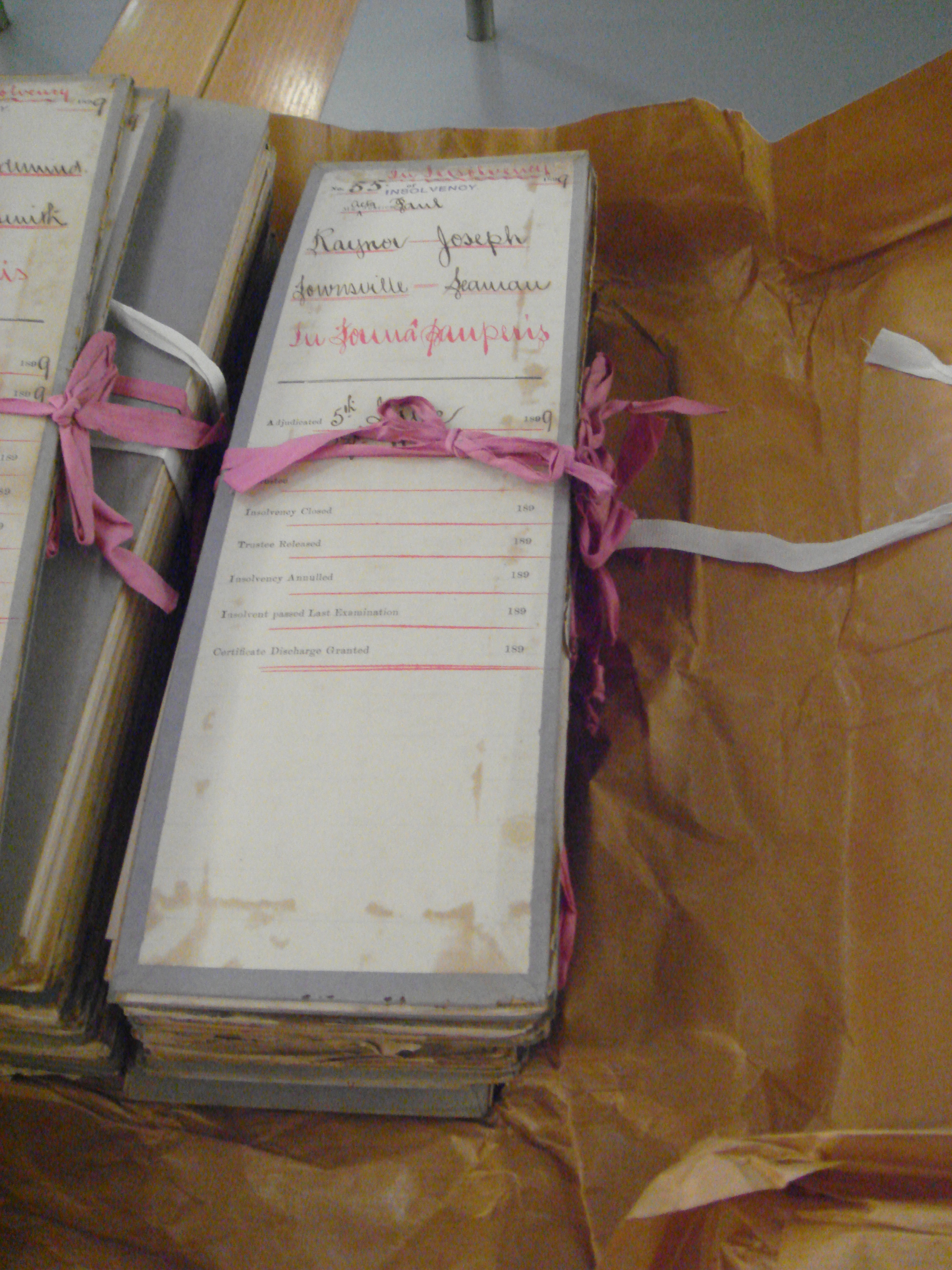
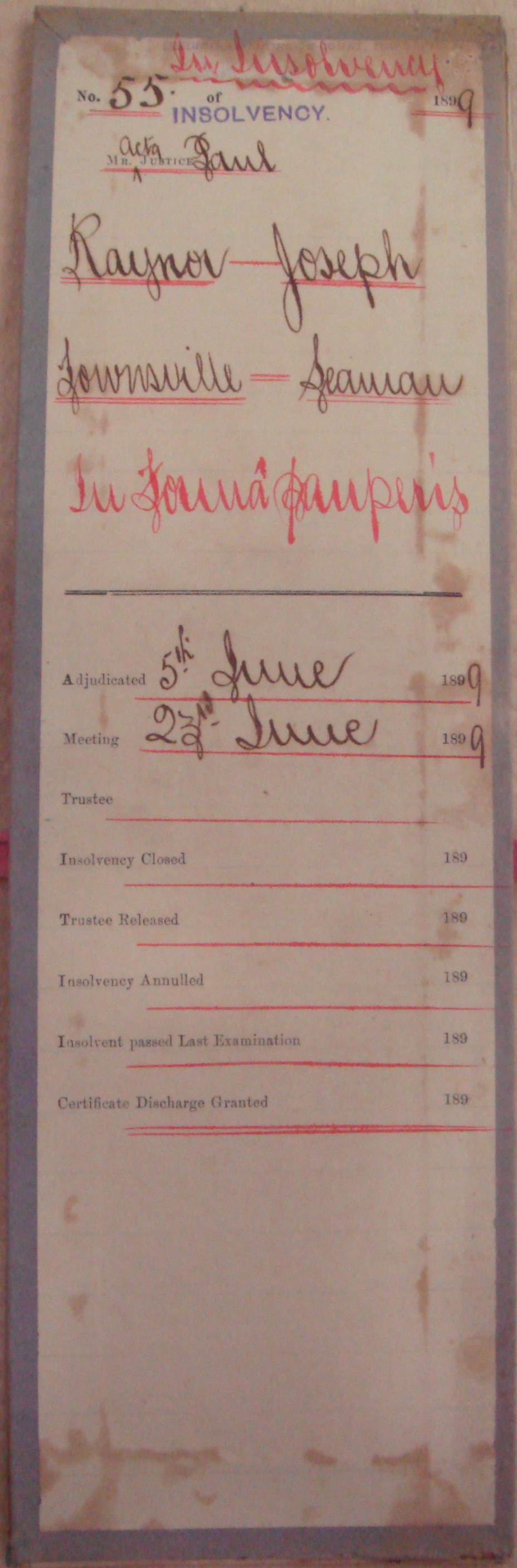
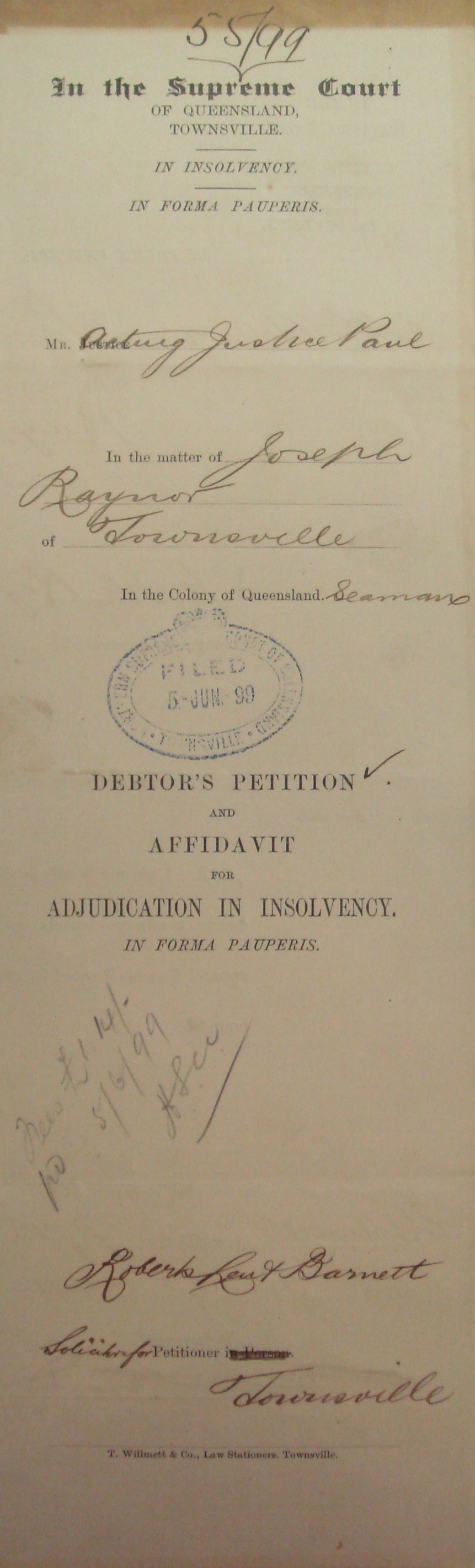
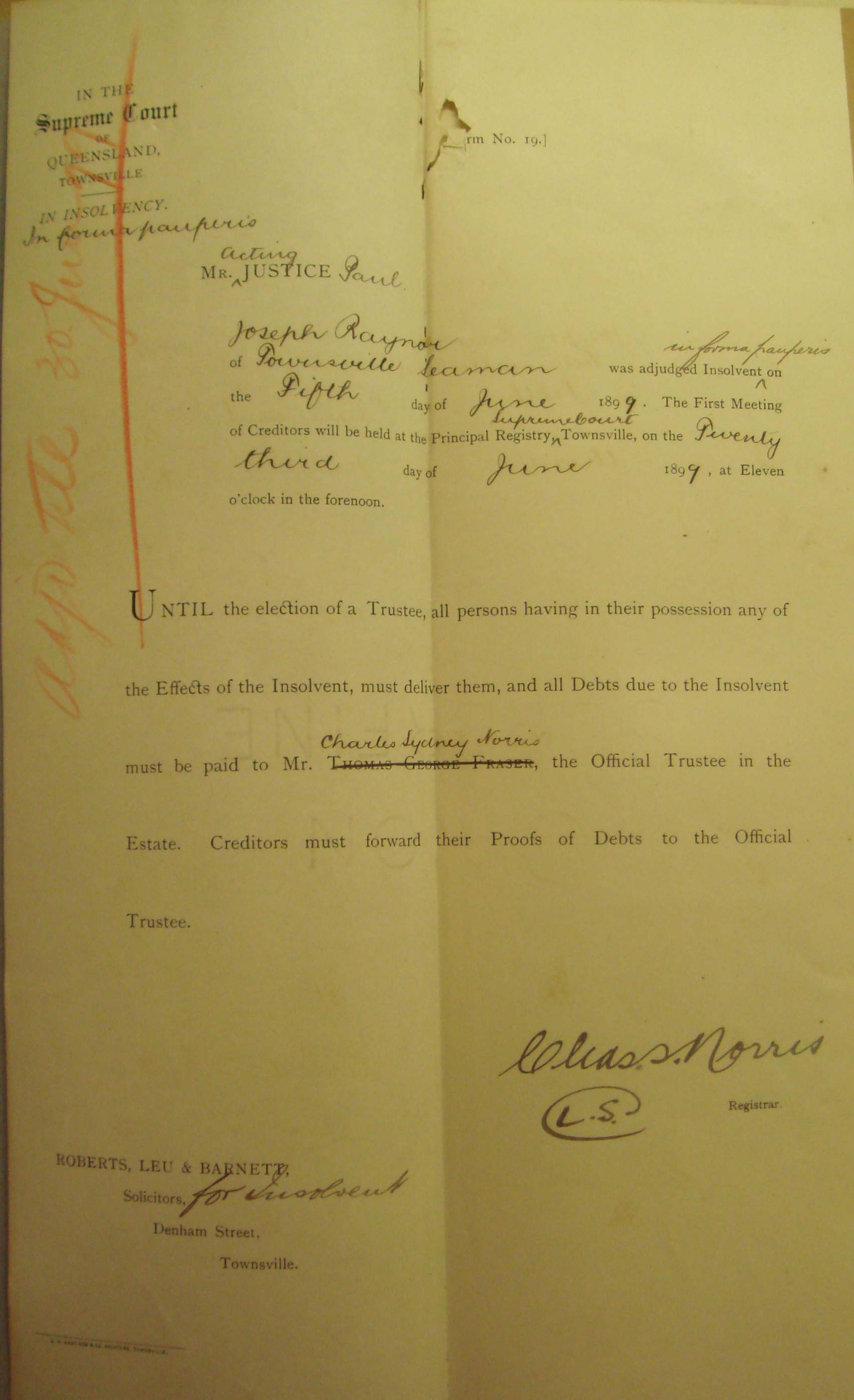
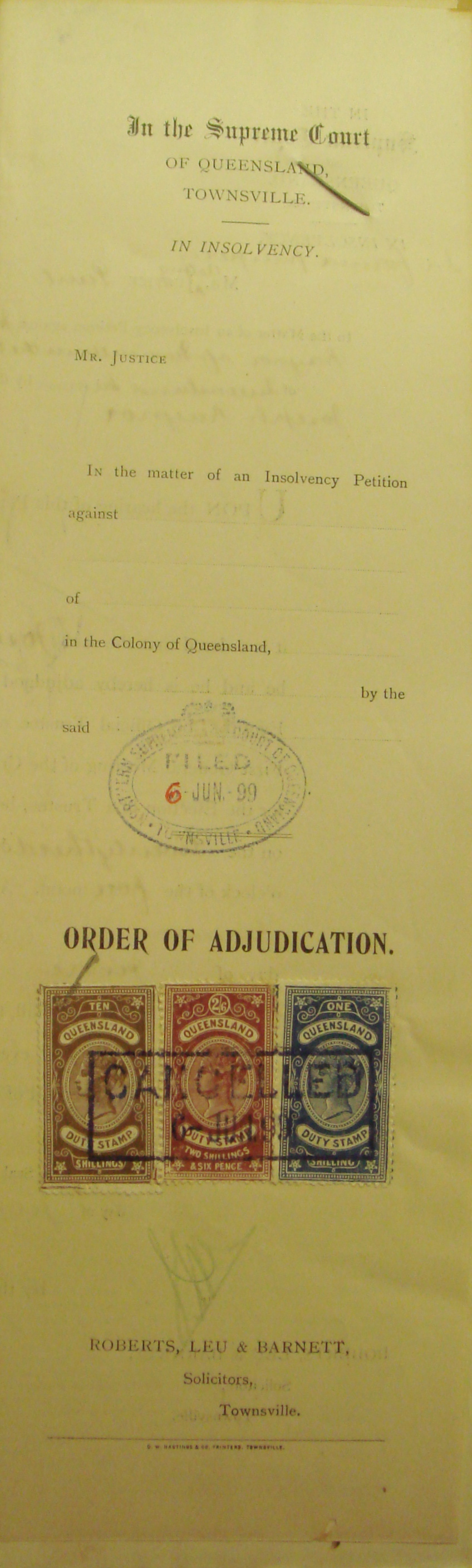
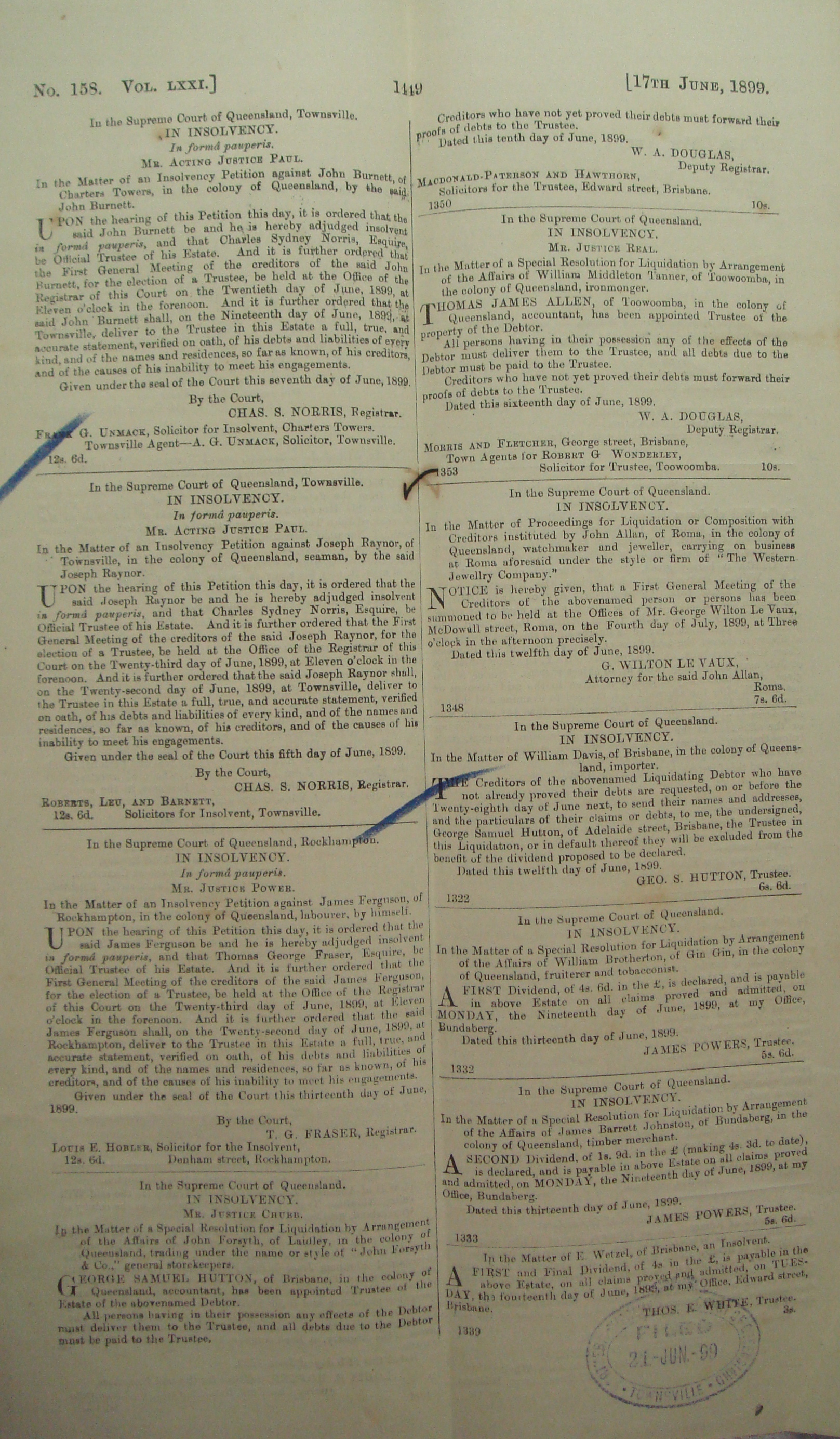
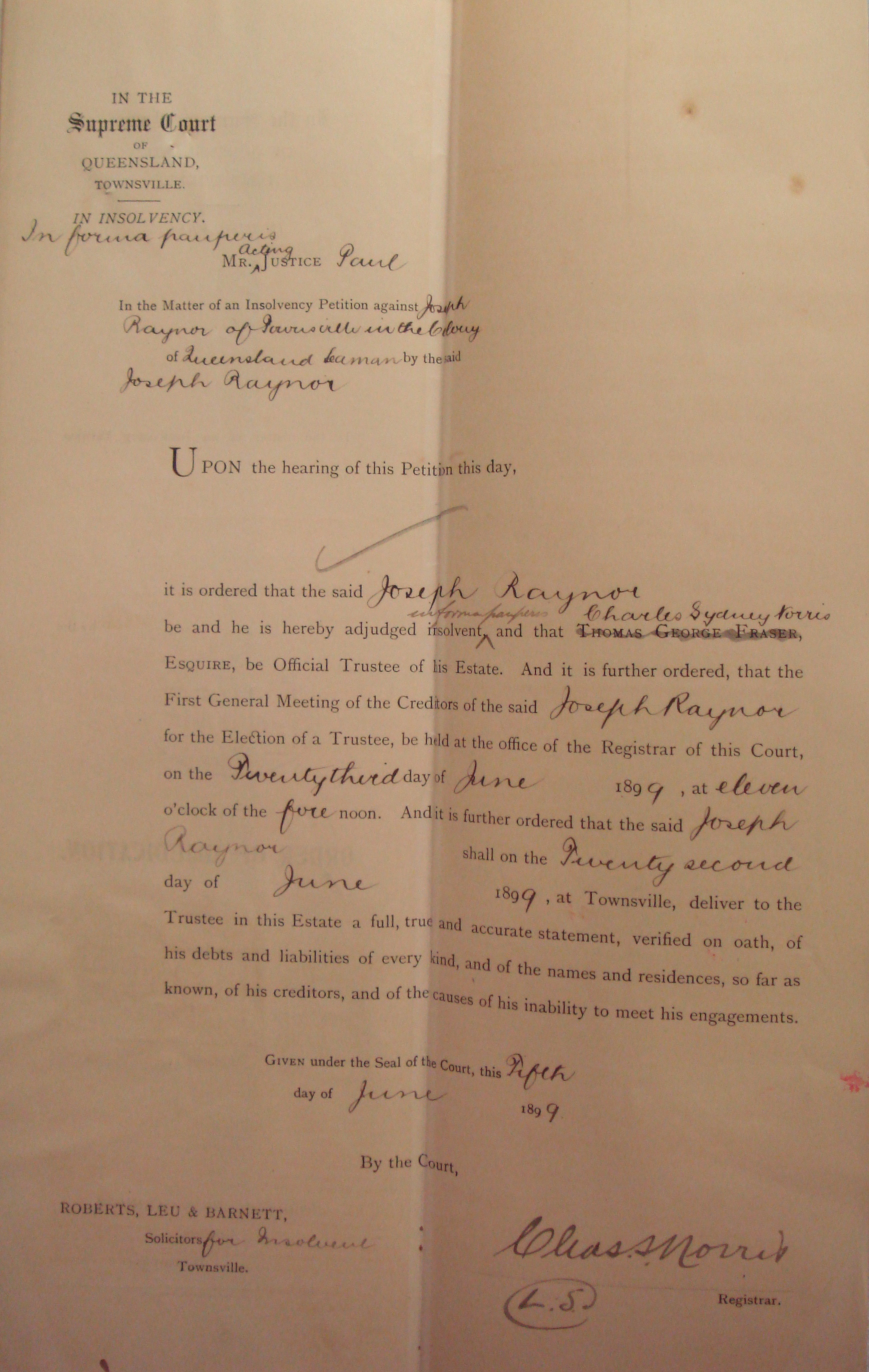
Joseph Raynor was declared bankrupt 17 June 1899.  I viewed Joseph’s insolvency file at QLD Archive, hoping to find clues to his earlier life, particularly in Sicily.  Unfortunately the Archives file didn’t reveal any new information, except that he was actually declared ‘informa pauperis’ which I assumes means he has no chance of repaying whatever debts he had.

I’m a bit perplexed on why the court would state he could not repay his debts, given he was probably by then already employed as a Seaman on SS Bobby Towns.

Nevertheless, this is the first record of Joseph’s life, therefore it was interesting to see, especially as Joseph signed one of the letters in the file.

Below are the photos  I took of the file ( every page on the file is included below):

Bankruptcy file

Bankruptcy file cover

Affadavit 5 June 1899

Insolvency letter

Cover of insolvency notice

Gazettal notice of insolvency

Letter 23 June 1899

I’ve updated the post on Joseph Raynor’s will & other stuff

Just letting everyone know that over the weekend I updated the post relating to Joseph Raynor’s Will.  

I’m also reviewing the earlier posts – I wrote some of them in a rush and left out details that I could have included – including the few photos I have (Note I only have copies of copies – no originals, so unfortunately these are not the best quality).

I’m also working on the rest of the website – I’m going to try and put some links to the various geneology sites I’ve been looking at (once I work out how to insert links).


Back online

I’ve not done any posts for the last 12 months, as I temporarily stopped research on the family history.  I’m now finally able to get back into it.

At the time I stopped posting, I was researching three  issues:

(1)  Joseph Raynor – looking for clues on what Joseph might have been living and doing prior to getting his job on the SS Bobby Towns.  So I’ve been looking at the history of the SS Bobby Towns, the Seaman Union.

(2)  Joseph Raynor’s brother – there is a photo of Joseph Raynor and his brother – who was the brother?  Where was the photo taken?  It appears to be a professional photo, taken in a studio?  If so, it might be stored in Archives somewhere, and perhaps show the name of the brother?  So I’ve been looking on the internet on any information relating to Townsville photograph studios that operated in the early 1900s.

(3) Christopher Wilson – father of Abraham Wilson – when and where exactly did he die in Ireland?  It is known he died in a shipyard accident somewhere around Belfast.  If I can find the date of death, I might be able to get a copy of his death certificate.  Then we might have some information on Christopher’s birth, parents and further family ancestors.

I don’t have any answers on the above yet.

Joseph Raynor’s Will

Last year I was able to view Joseph Raynor’s Will, held at Queensland Archives.  All Wills can be accessed 75 years after the person’s death.  I was very excited to discover that his will was being held there, and especially that we could  actually get to see it!  What secrets will it reveal, did he leave any clues on his sicilian family?  One of the QLD Archive staff alerted us to the existence of wills held in QLD Archives, so the personal visit proved useful.   I had not anticipated that Joseph would have had a will – given he lived a very poor existence.   I had originally planned to just see Joseph’s bankruptcy file which I had found out was held in QLD archives via their online index databases.

Firstly the big moment – the QLD Archive staff retrieved the file and left it on a shelf for our collection and viewing.  Everything in QLD Archives is treated with extreme care, so as not to damage old documents.  We followed the instructions and carefully picked up Joseph’s estate file and took it to a desk for viewing.  I remember being very careful as I untied the ribbons holding the estate file together, I did not want to accidentally damage or lose any document in there.

The will file had a surprising amount of documents attached, so I decided I would take  photos of the entire file for later reading – given time was short and I may not have enough time to read everything in the file.

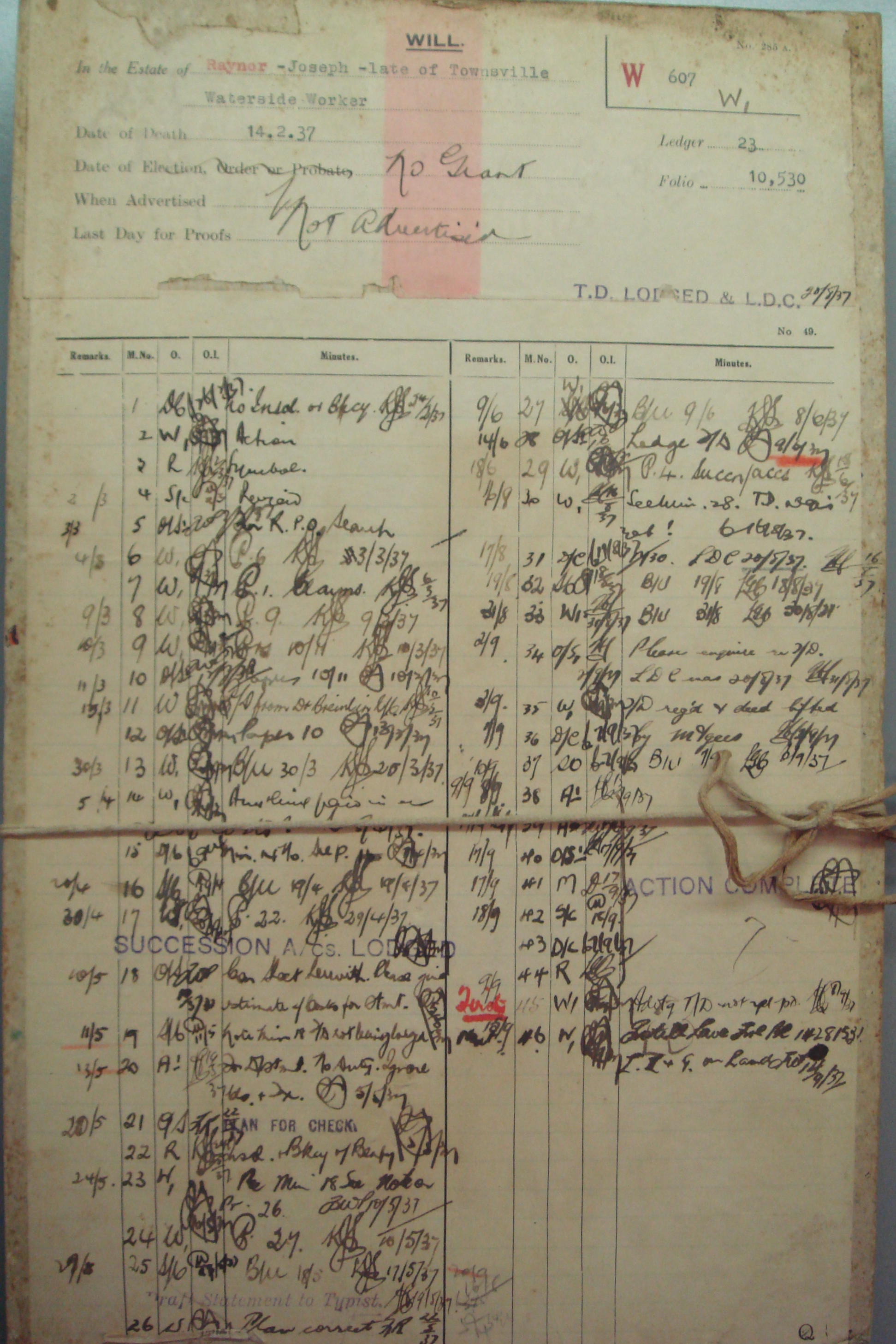
This was the cover document to the will.  I think it was a covering document to a number of other wills – but we only had Joseph’s file for viewing:
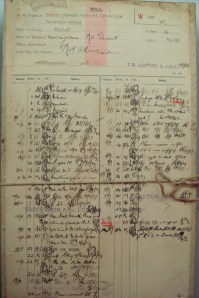
Will cover

So what was in the will file?

In rough date/interest order:

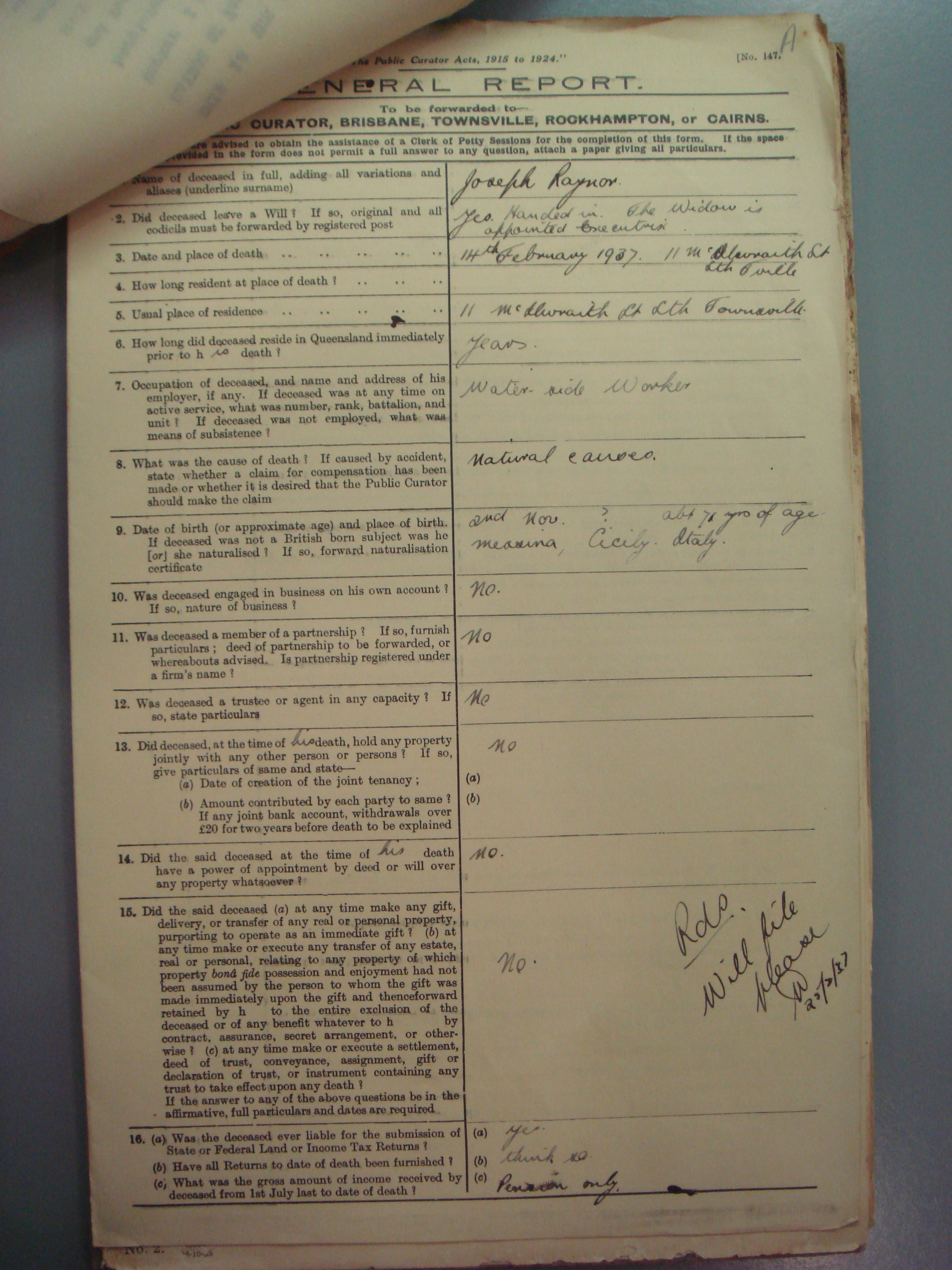
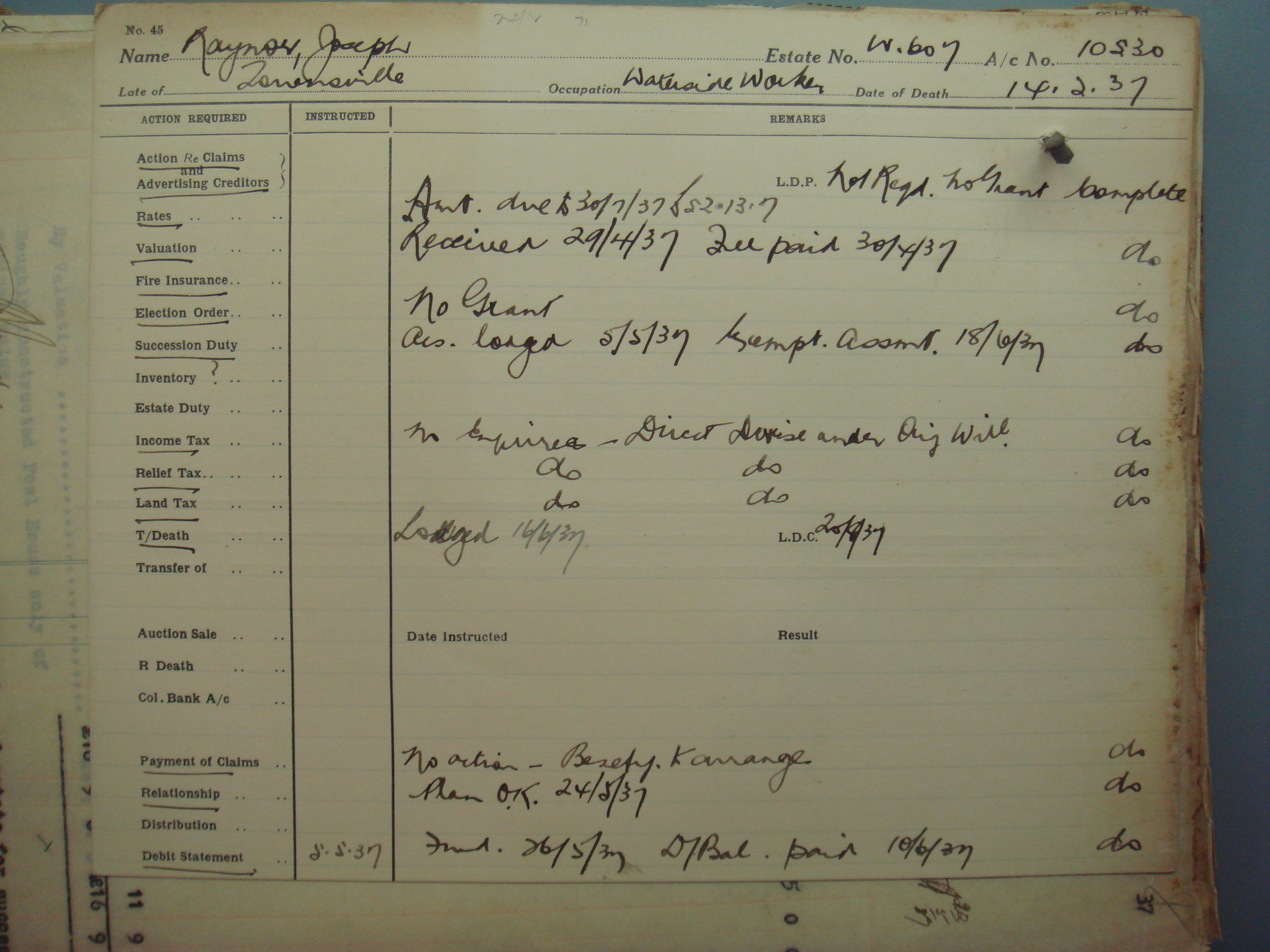
Mary Jane’s report of Joseph Raynor’s death on 14 February 1937:
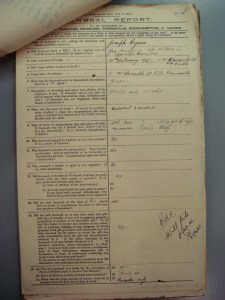
Estate docs - report of death

I noted in the above Mary knew Joseph’s birthday – 2 November, but was unsure about the year of birth (marked with a question mark above).  Given Joseph’s age was listed as 71 years, this would mean his date of birth is actually 2 November 1865, not 1866 as is commonly stated in our family records (I will update my posts to reflect his).

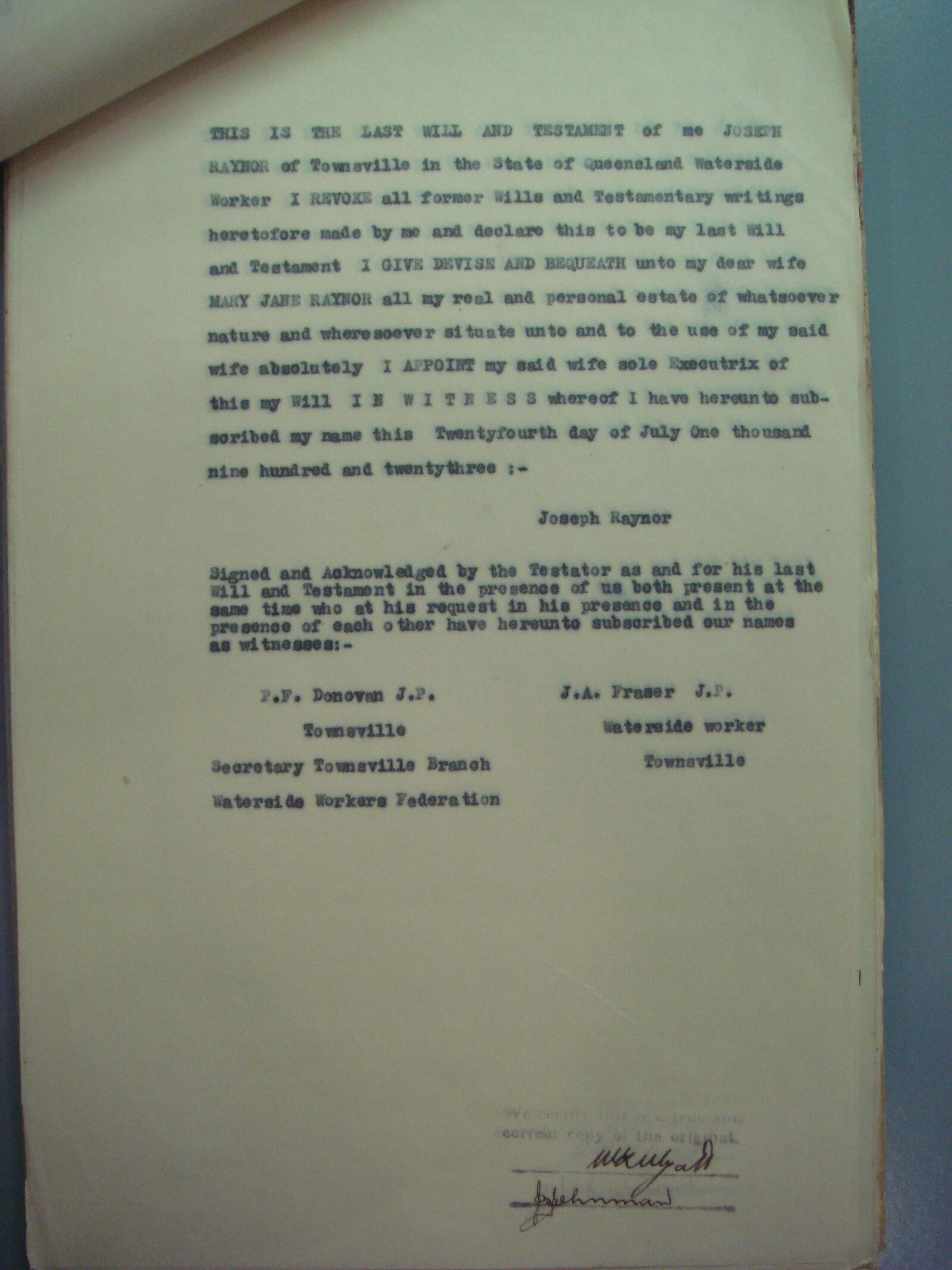
Joseph’s will dated 24 July 1923.  Interestingly the will held is not personally signed by Joseph, or the witnesses.  I had a thorough look for a signed will but this was the only copy of the will provided.
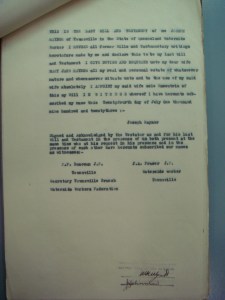
DSC02304


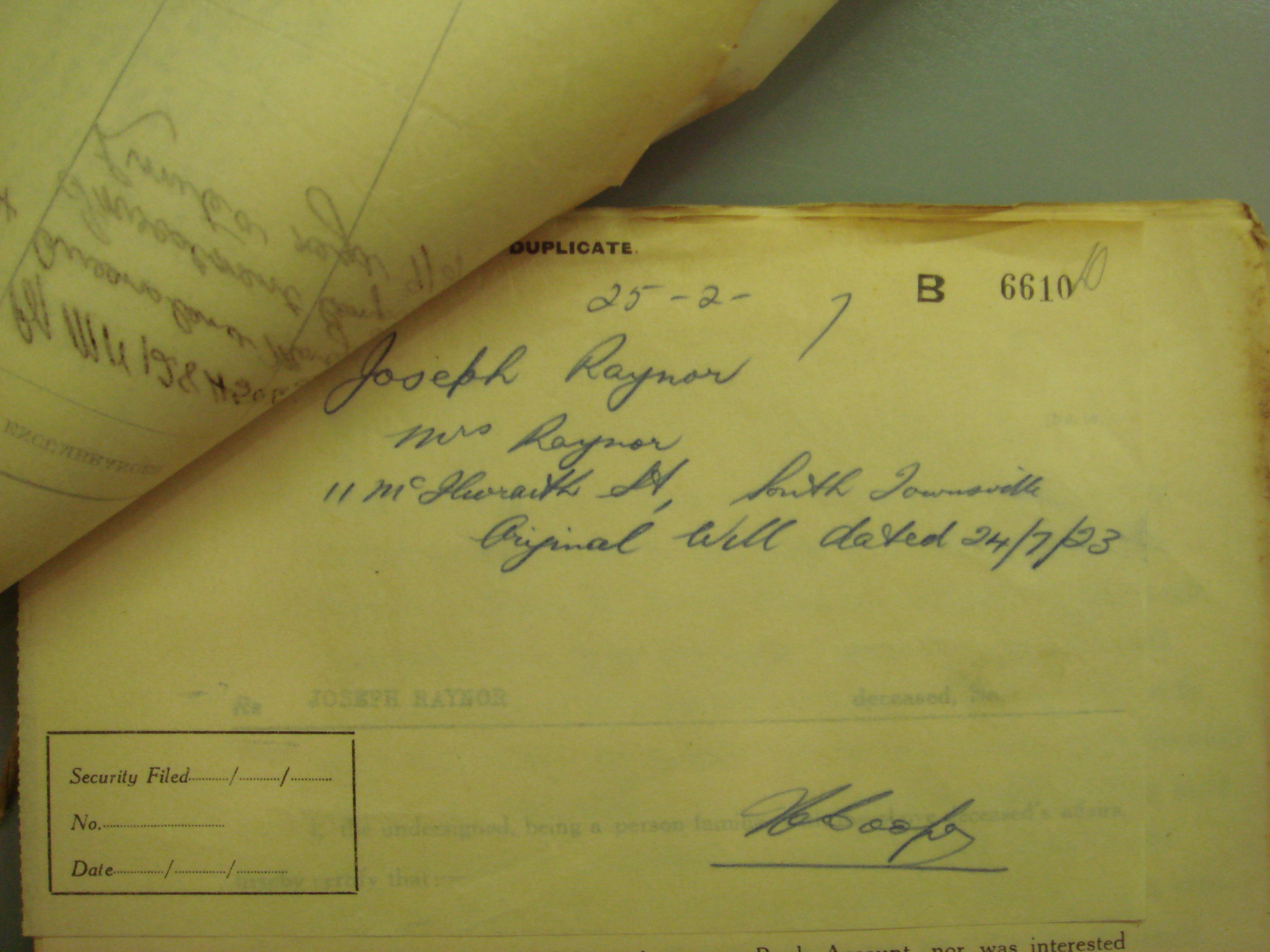
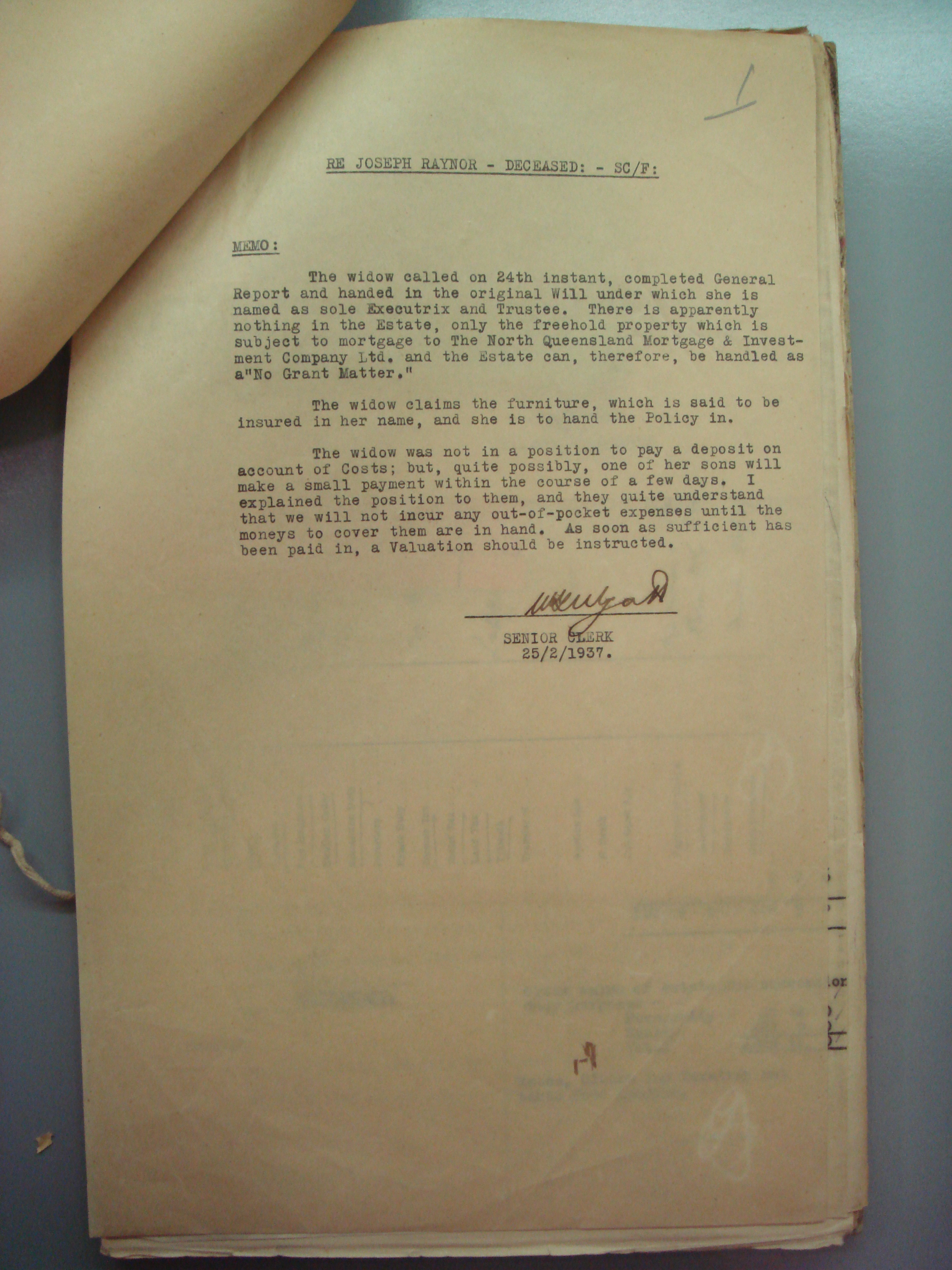
On 25 February 1937, 11 days after Joseph had passed away, Mary Jane visited the public curator and provided a copy of the will.  While Joseph died broke, he still had an estate to bequeath.  She could not afford a lawyer to handle the estate so she visited the public curator who discussed with her what needed to be done, and gave her a receipt for the will:
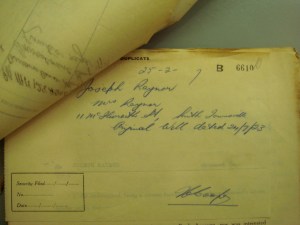
Estate docs - receipt of will

There was some discussion about the costs of the public curator – he would not proceed with the estate until Mary paid a deposit for the curator’s costs:
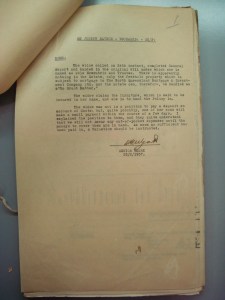
Folio 1

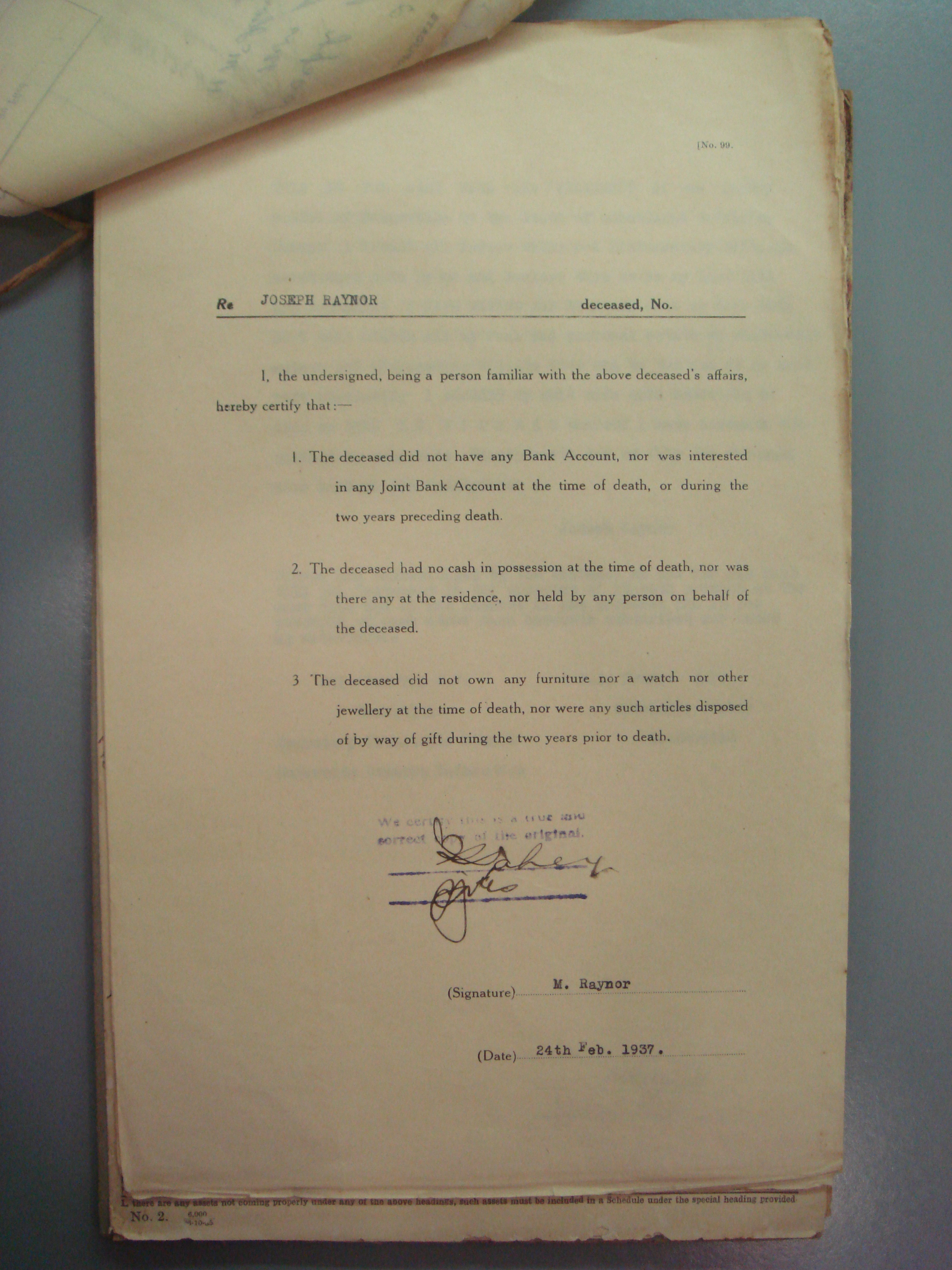
At the time Joseph died, he was as poor as the proverbial church mouse.  Mary made a declaration to this effect:
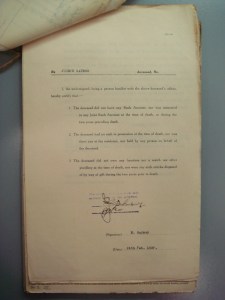
Estate docs - Mrs Raynor declaration

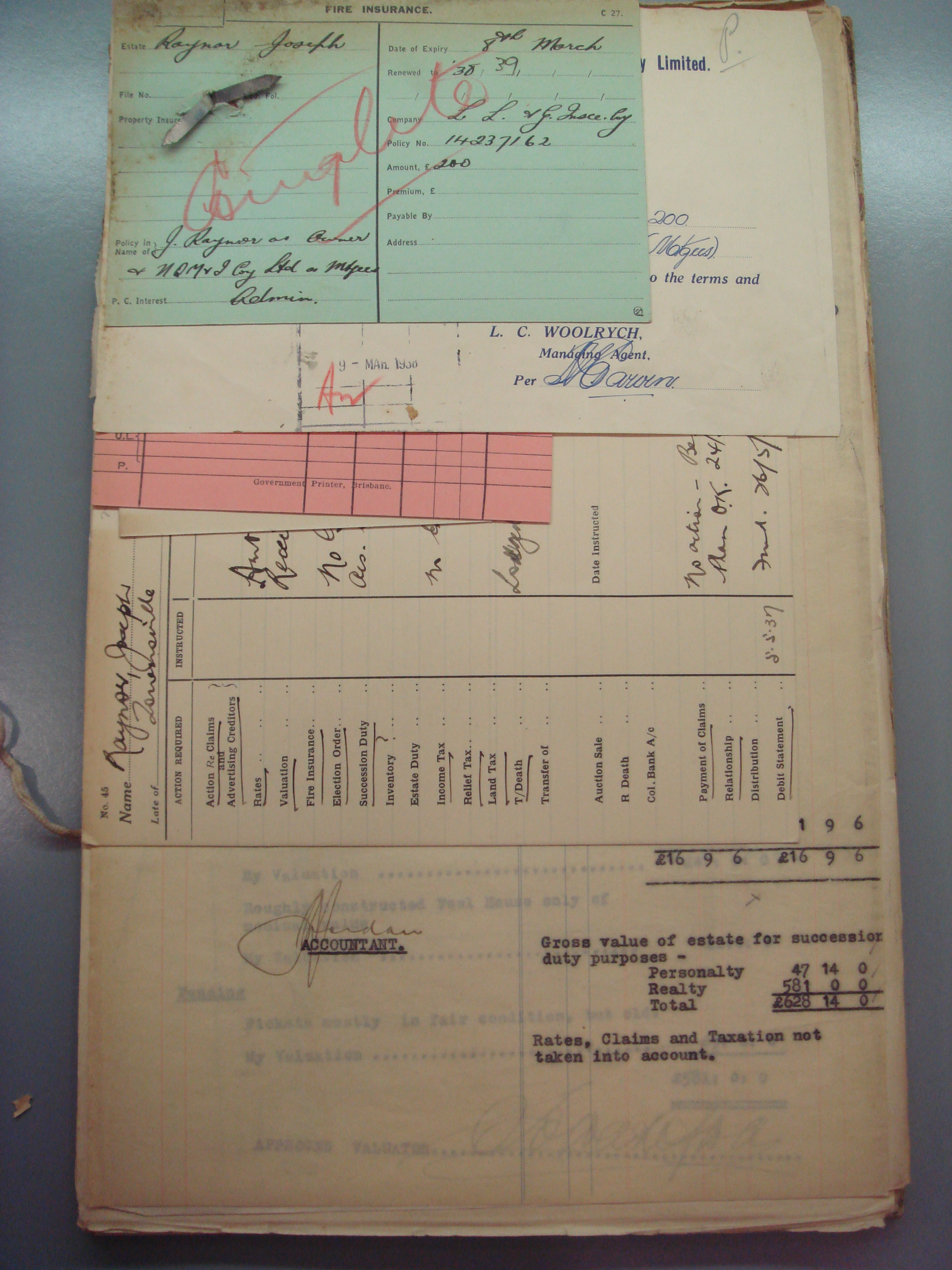
He had no bank account (always paid wages in cash and never made any savings), no jewellery (not even a watch!) and owned nothing other than the mortgage on his house (the property was in his name).

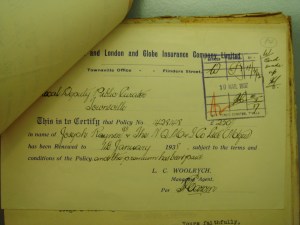
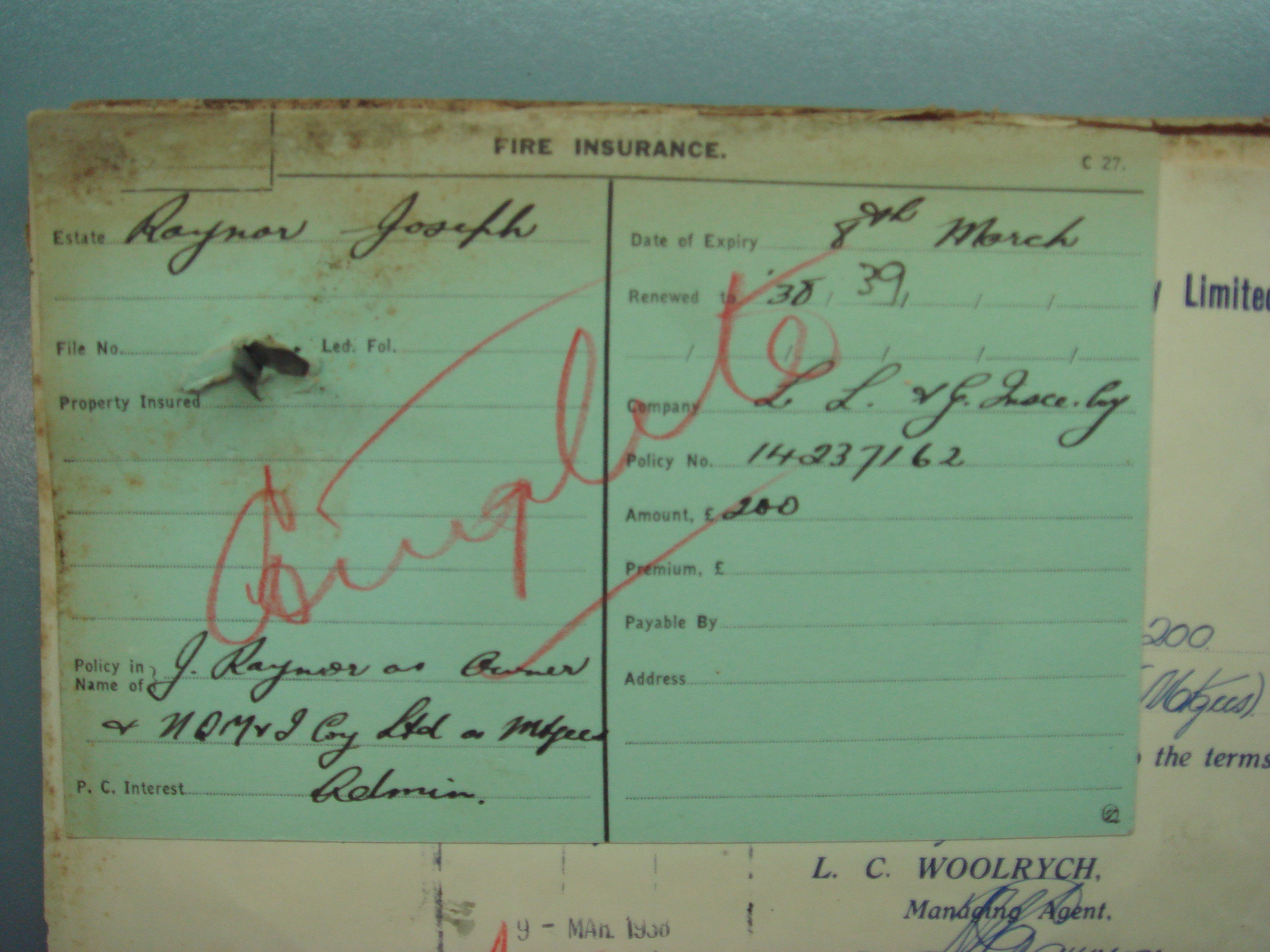
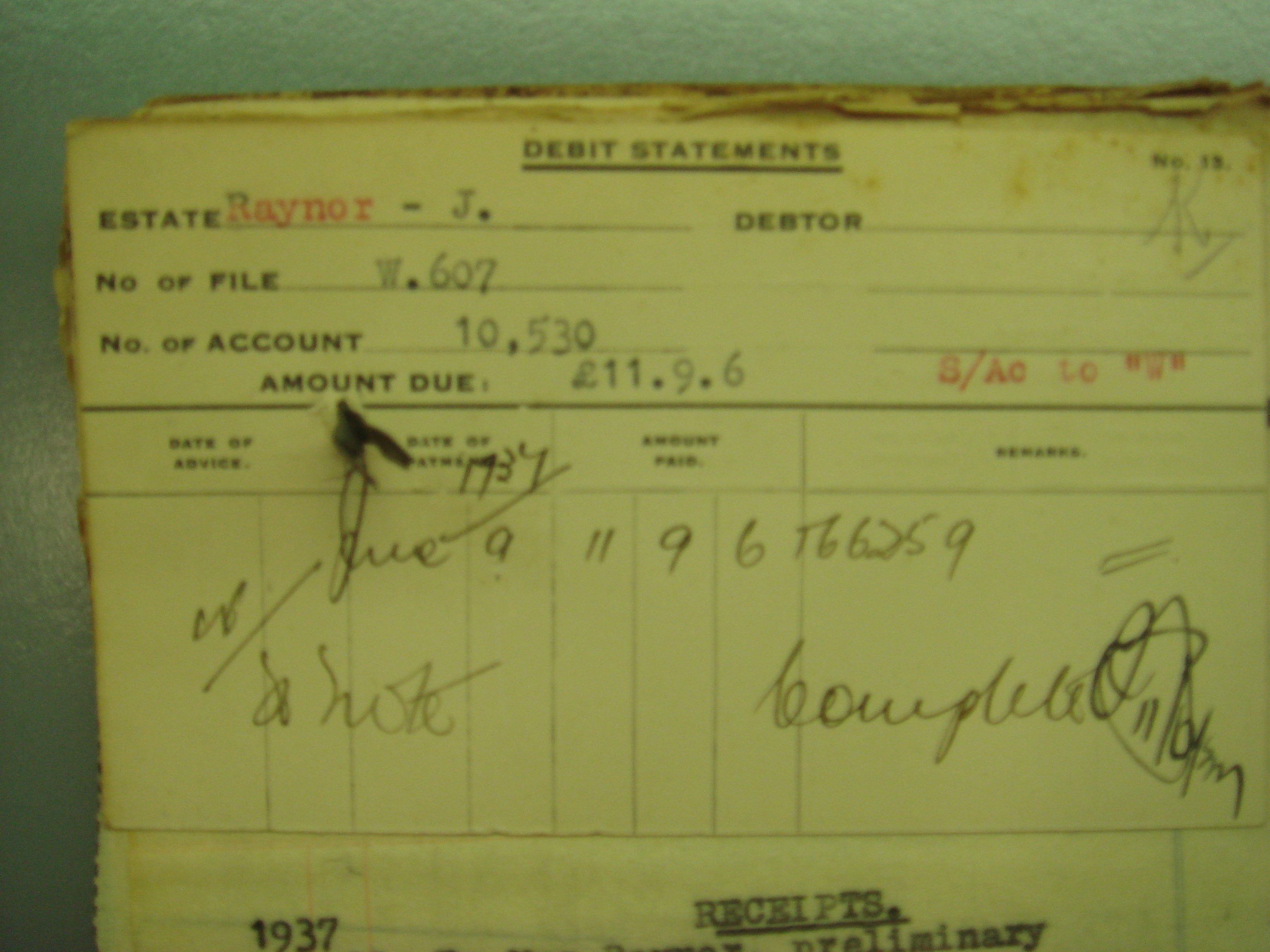
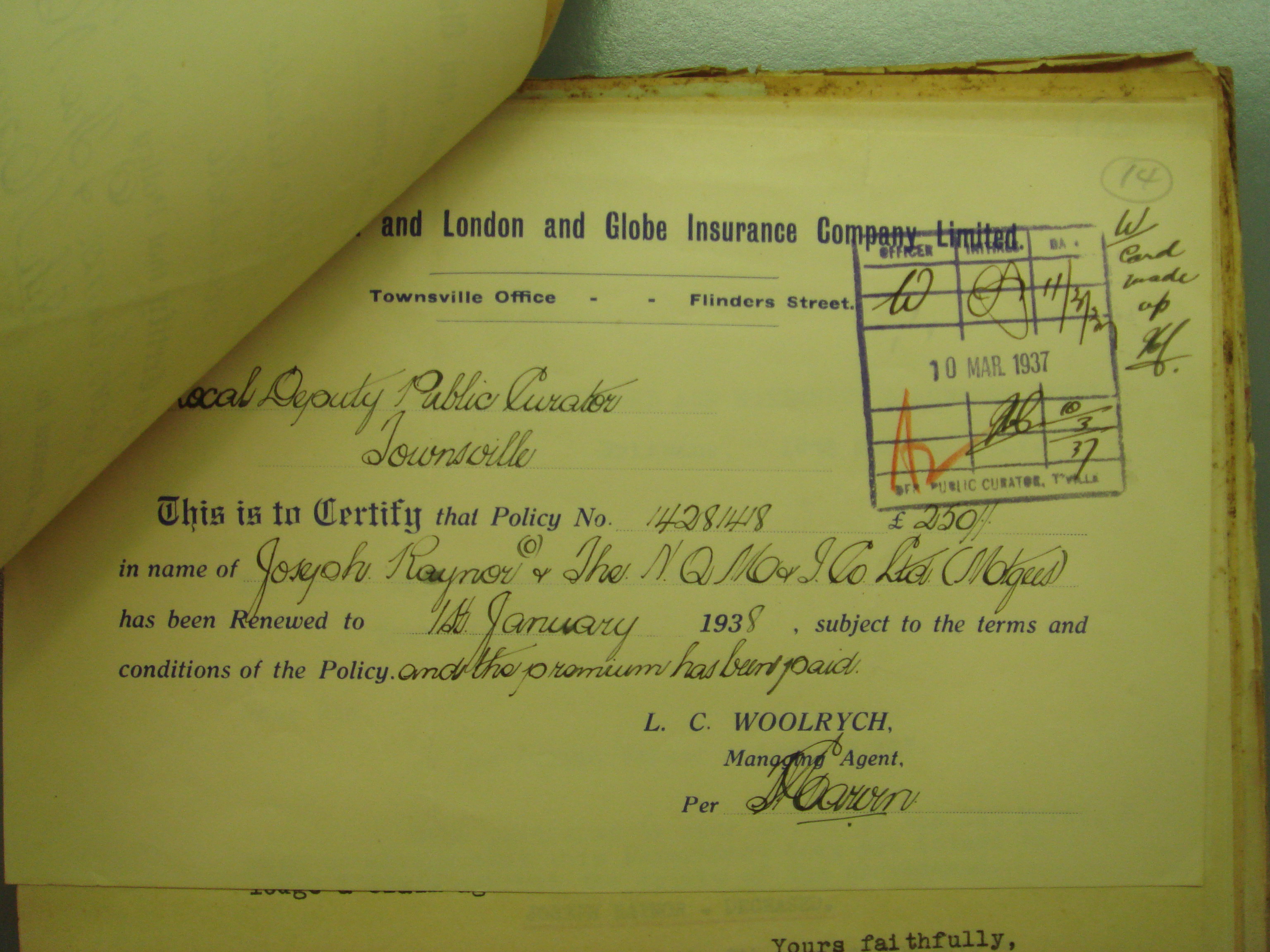
He also had some debts, mostly associated with overdue payments for the house – insurance, rates, and the mortgage payment:
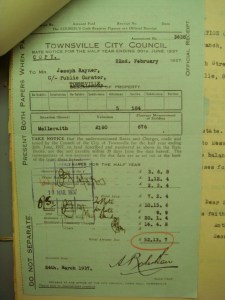
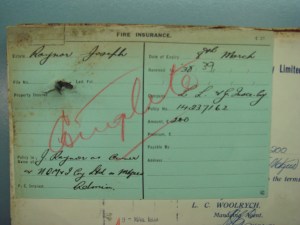
Folio 10

Estate docs - fire insurance

Estate docs - mortgage payment

Folio 14

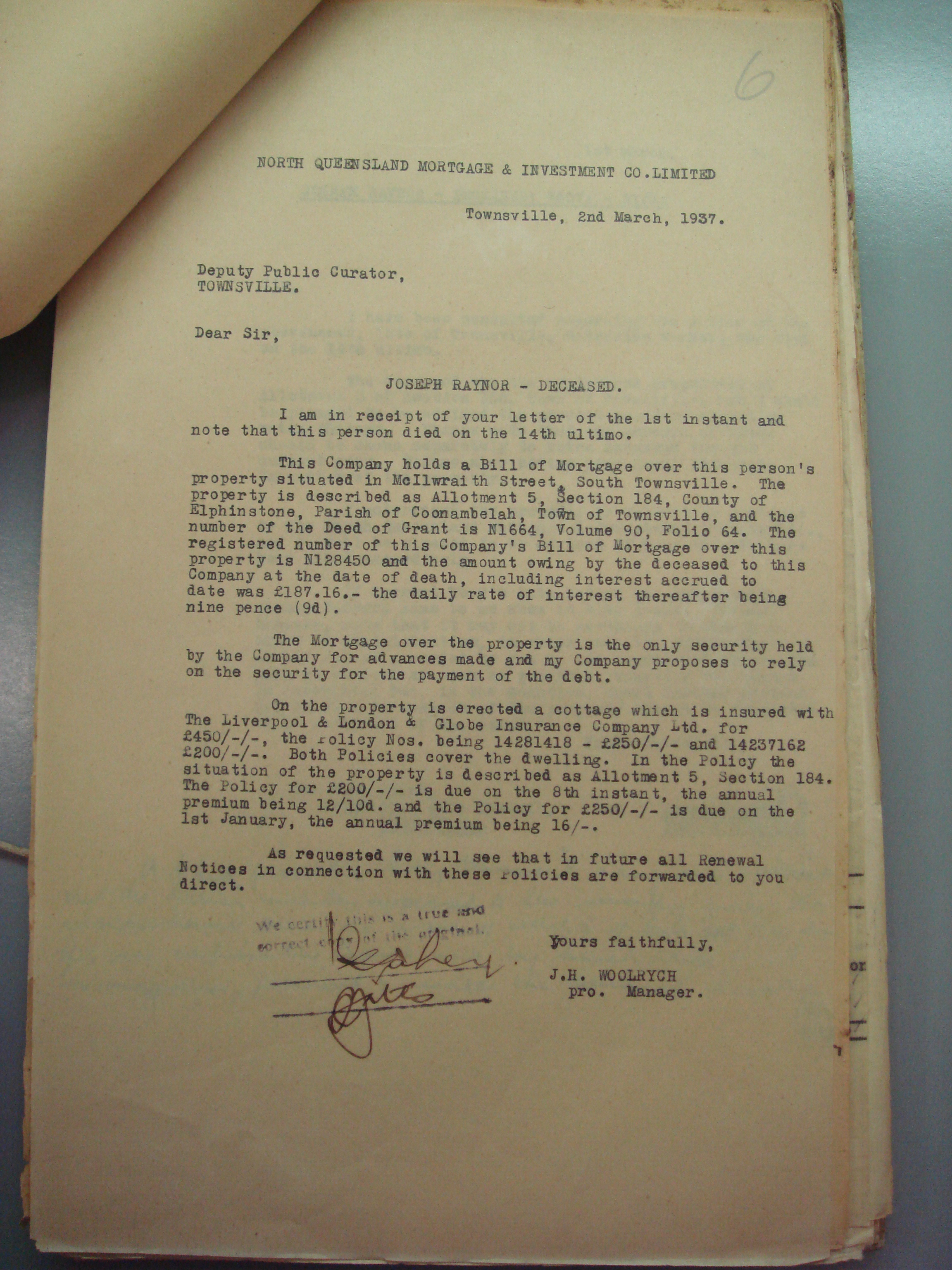
Below is a letter explaining insurance of the house – and the amounts outstanding:
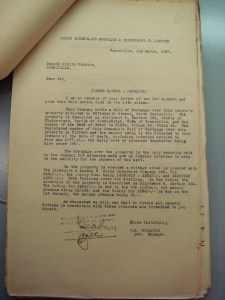
Folio 6

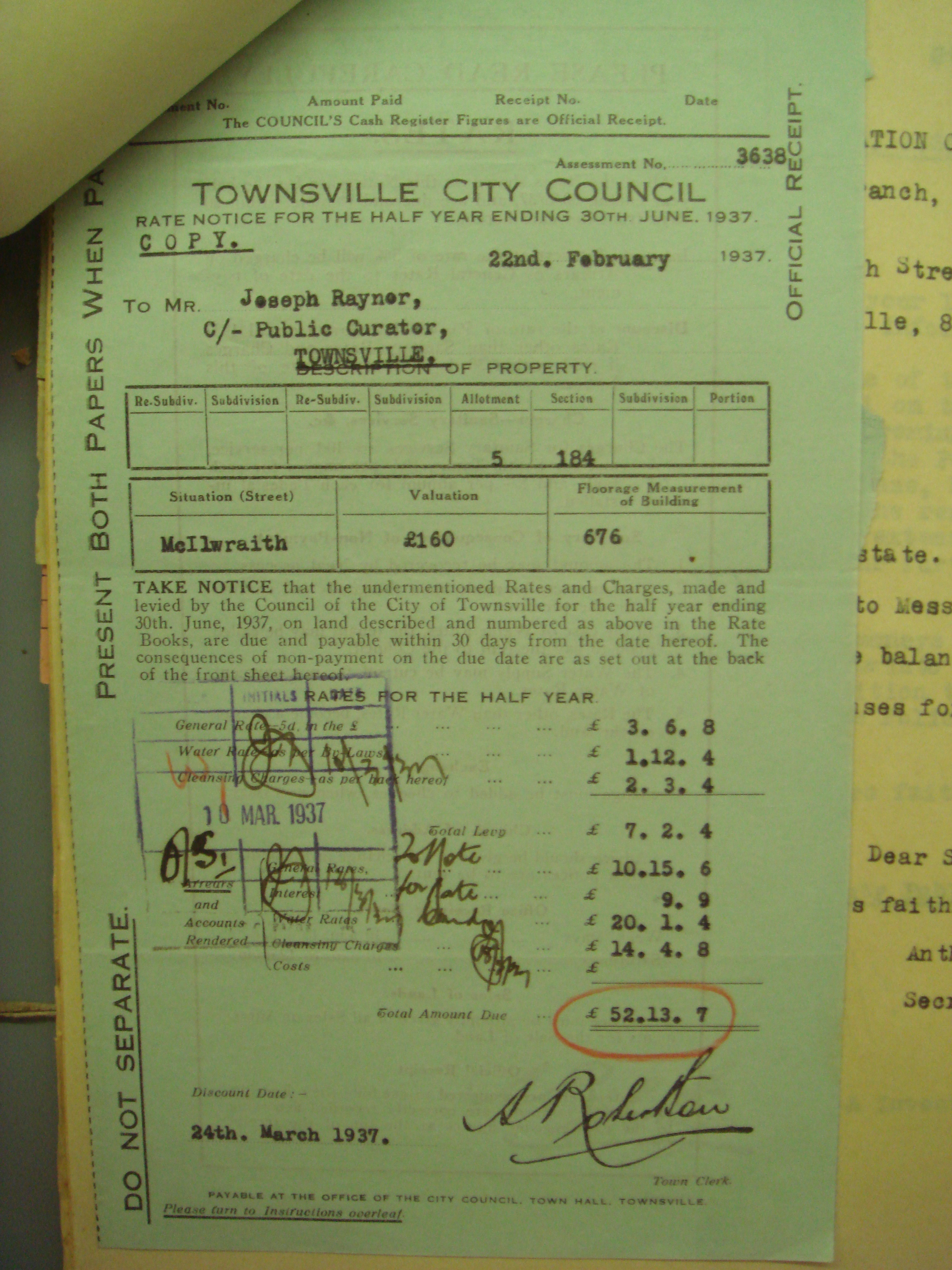
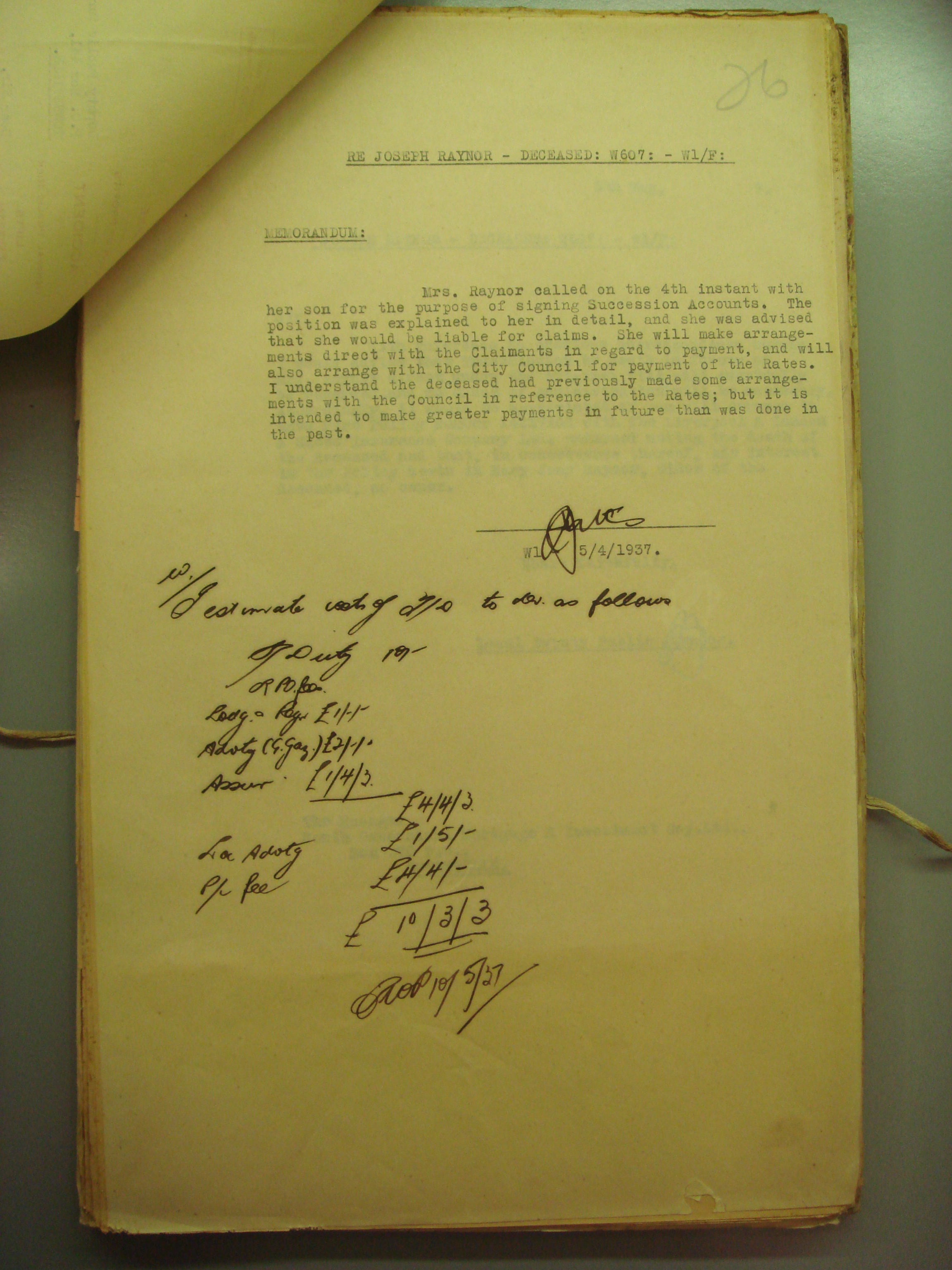
Joseph had not kept up payments on Council rates up to date, and the letter below states Mary agrees to pay more in future to keep rates up to date.   At the time of Joseph’s death he owed approximately 52 pounds – which was a lot of money in those days – so he was very behind in rates payments.
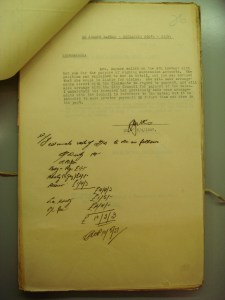
Folio 26

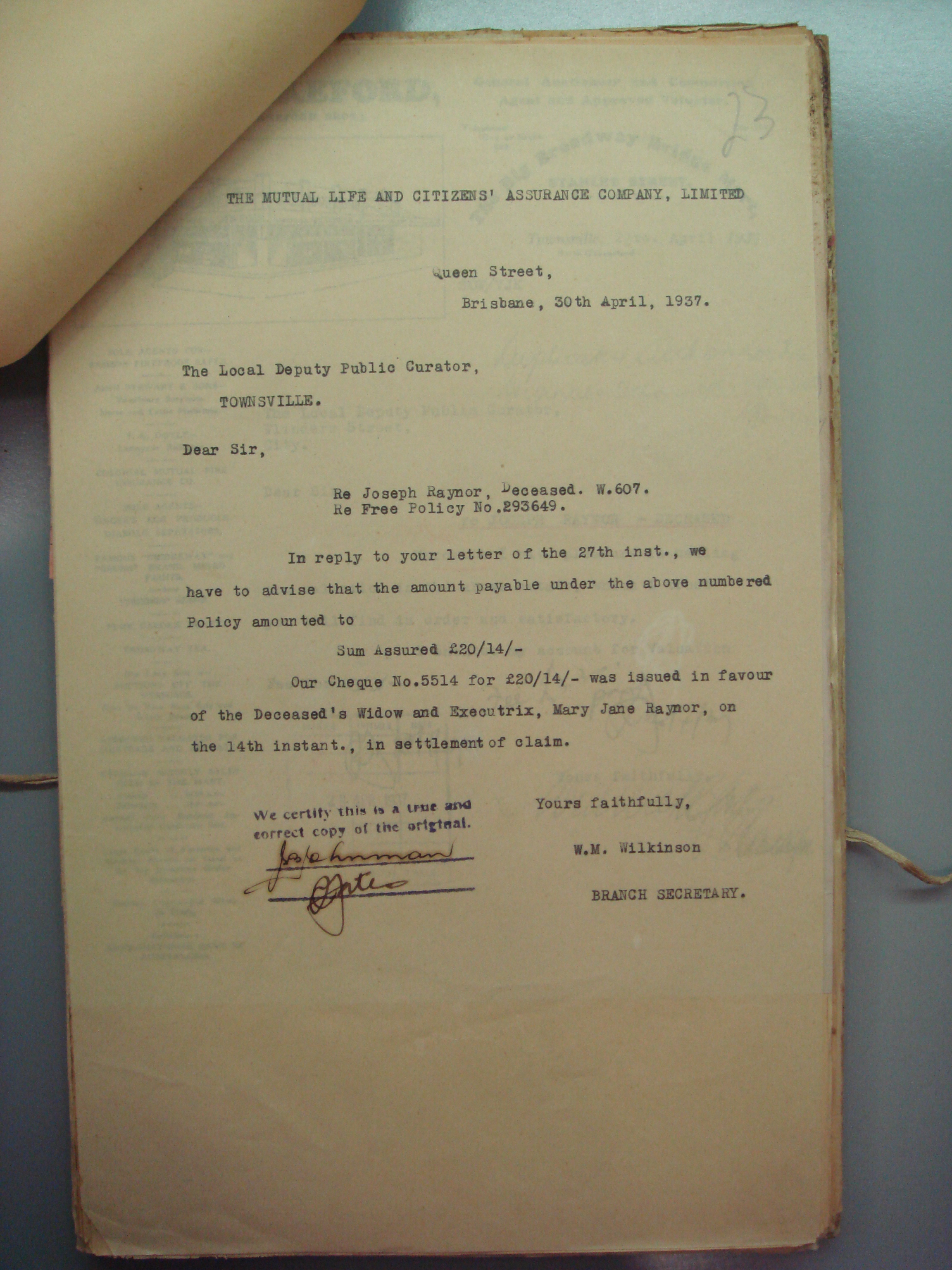
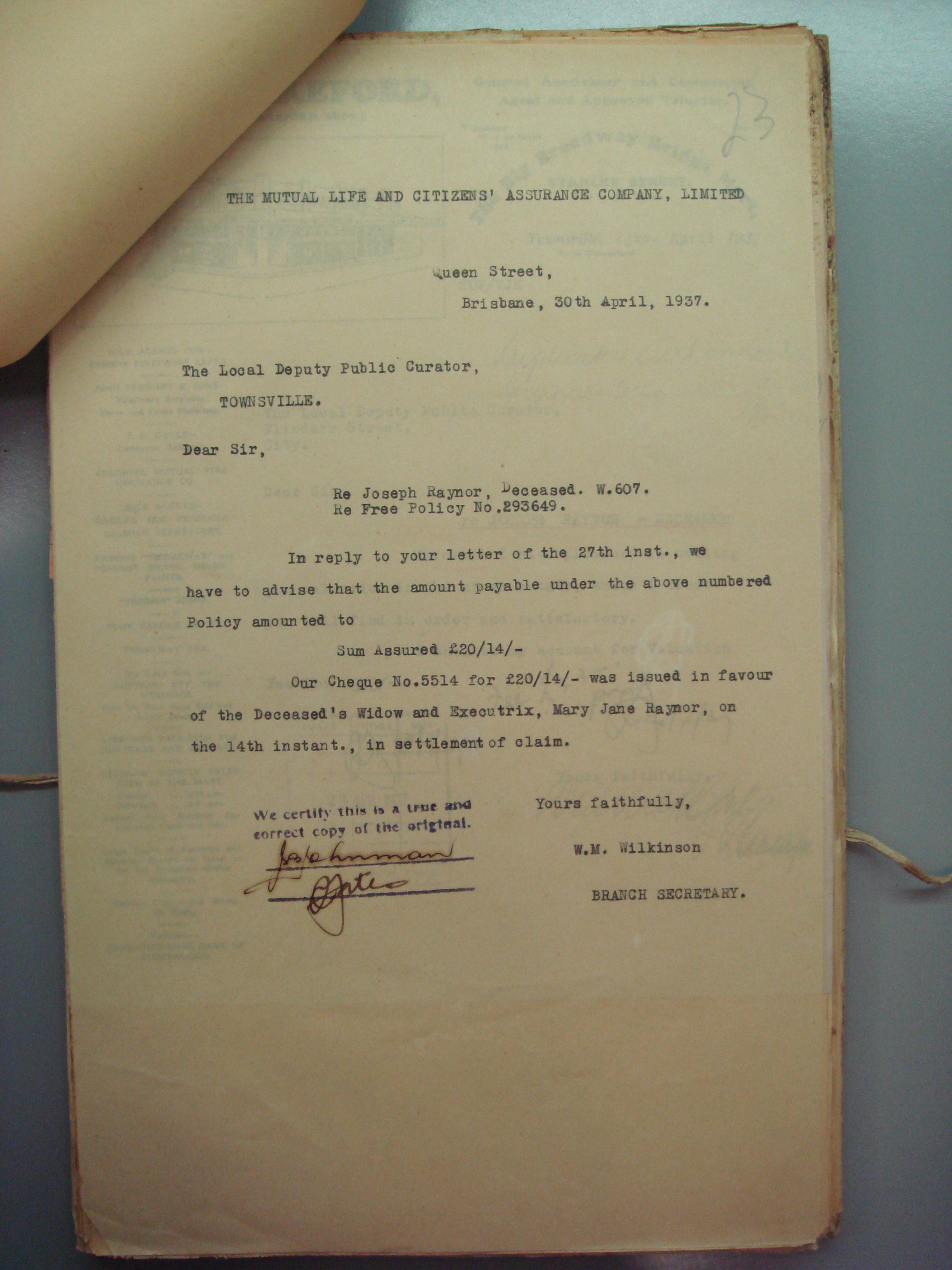
On the plus side, Joseph’s estate had a couple of small payments received:
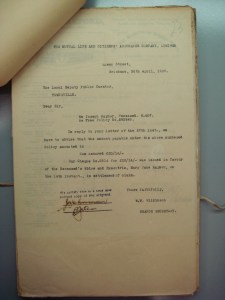
Folio 23

The above  is a life insurance payout of approximately 20 pounds.

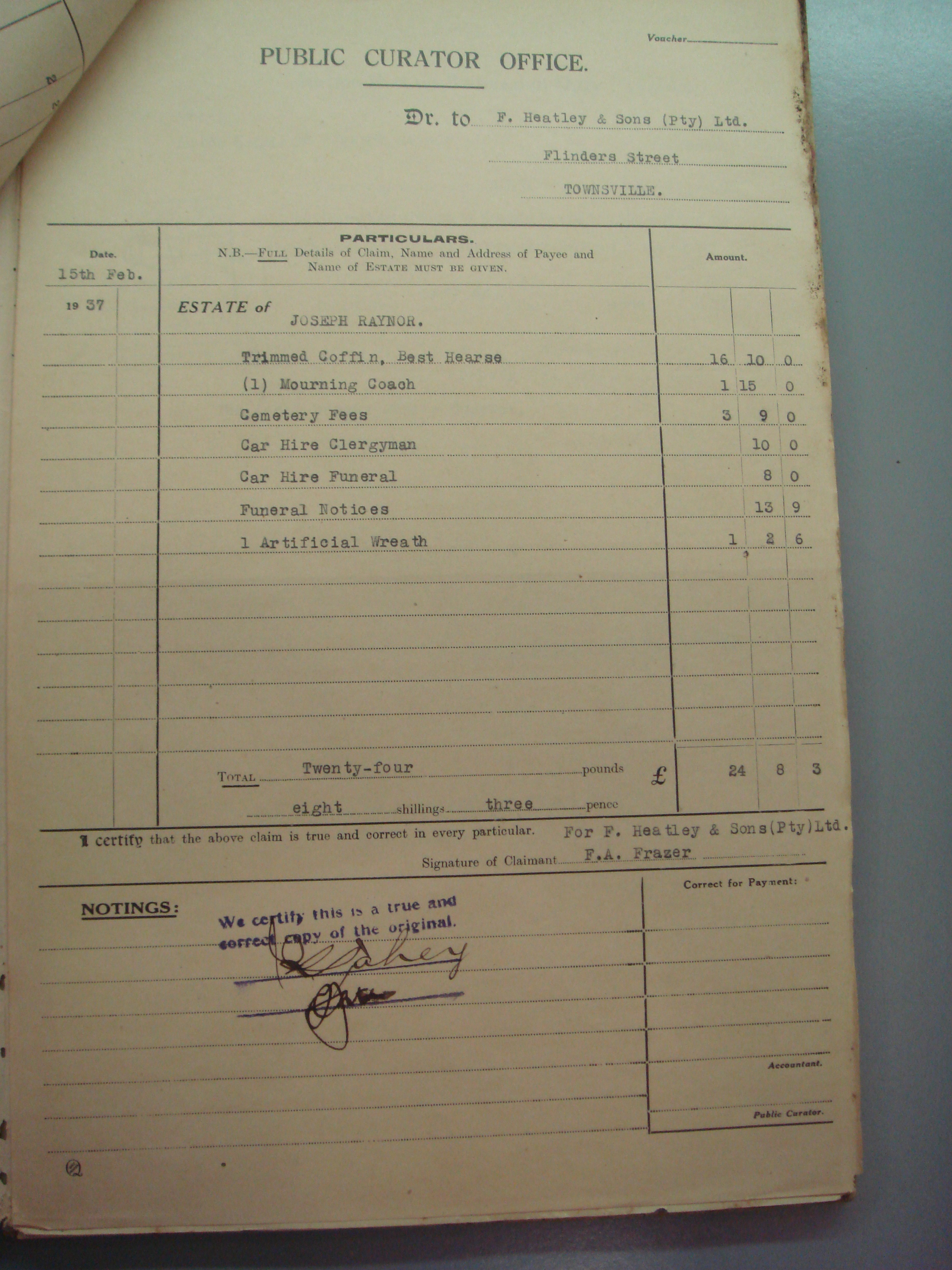
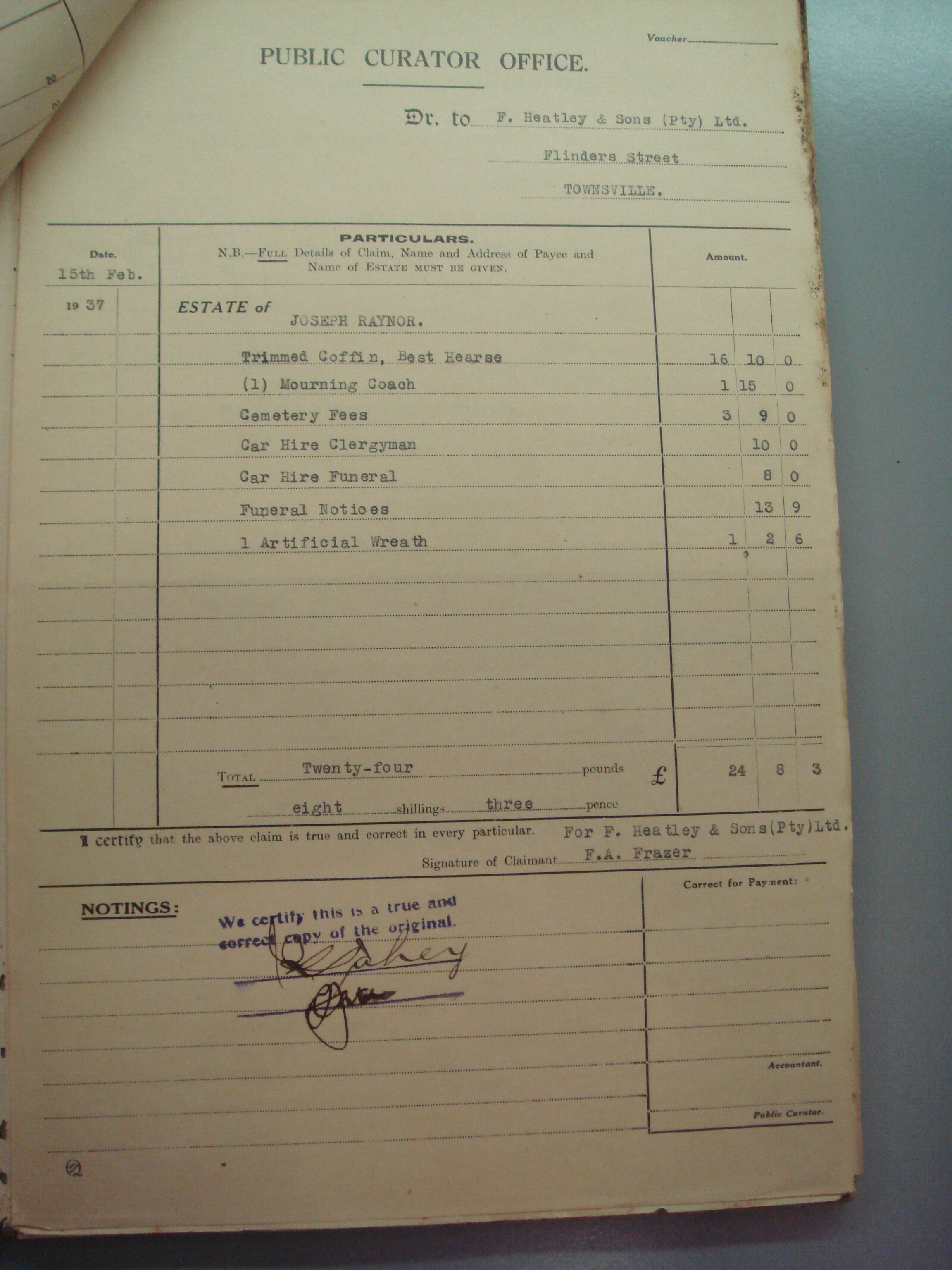
The Waterside Workers Union, who probably made Joseph take out the life insurance policy (if not his employers) also arranged Joseph’s Will and paid for his funeral.  Joseph’s estate was paid 27 pounds, of which 24 pounds was spent on the funeral:
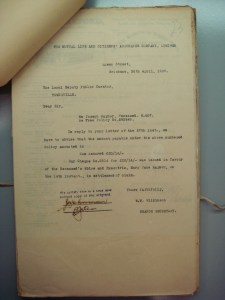
Folio 23

Estate docs - funeral costs

Mary received the difference of funeral expenses versus Workers Waterside Federation payout for funeral (27 pounds for funeral, minus 24 pounds plus for funeral meant Mary received approx 2.5 pounds).

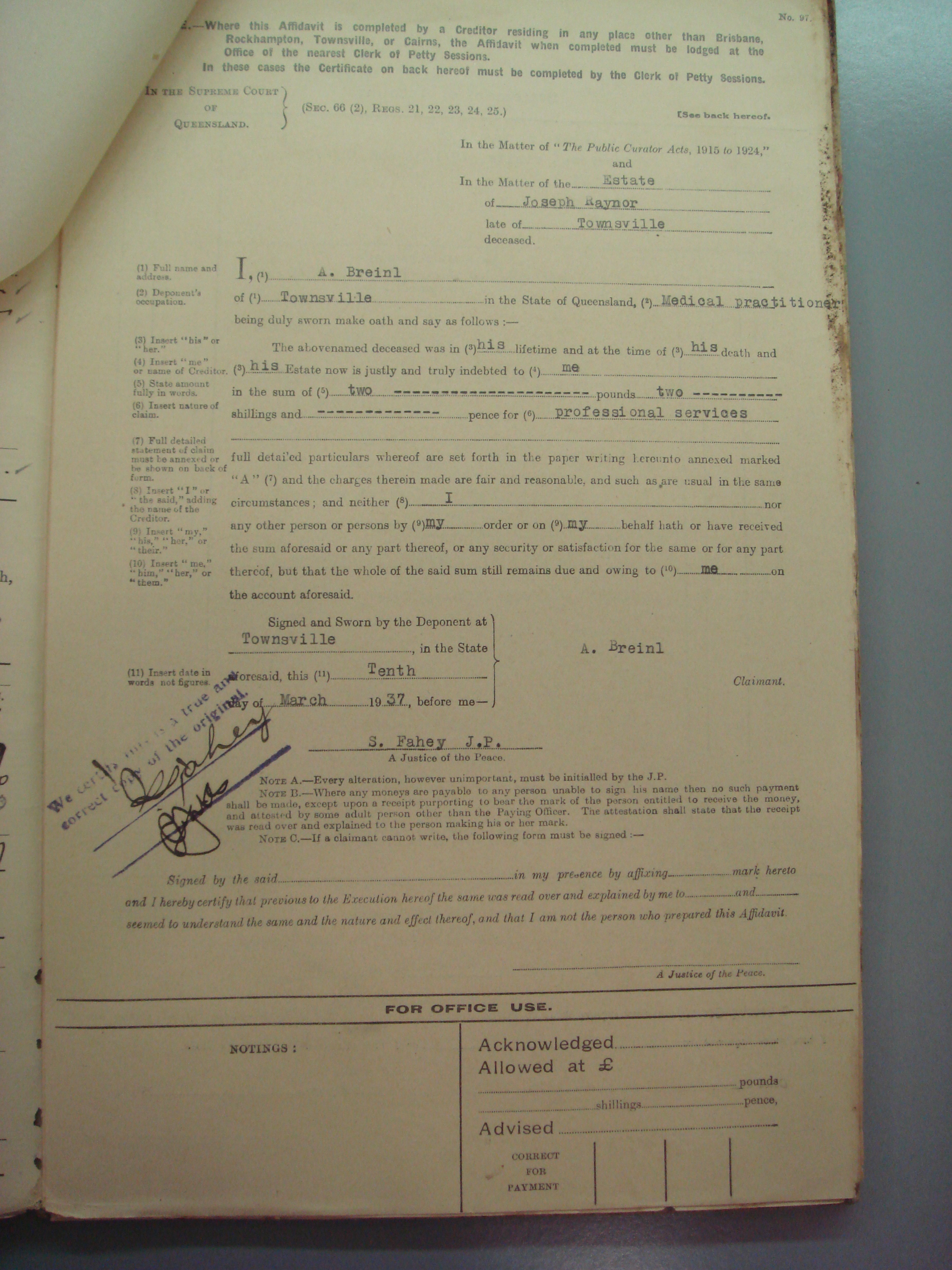
However Joseph also had a couple of creditors:
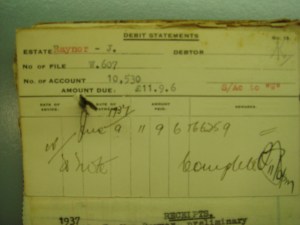
Estate docs - Dr A Breinl claim on the estate

The above was a claim by Dr A Breinl for medical treatment provided.  I am unsure if the medical was before Joseph’s death or perhaps a visit to the Raynor home to confirm Joseph had passed away.

The other creditor was funeral expenses – which was paid by the Waterside Workers Union (possibly the Curator paid the expenses, but the funds were provided by the Union).

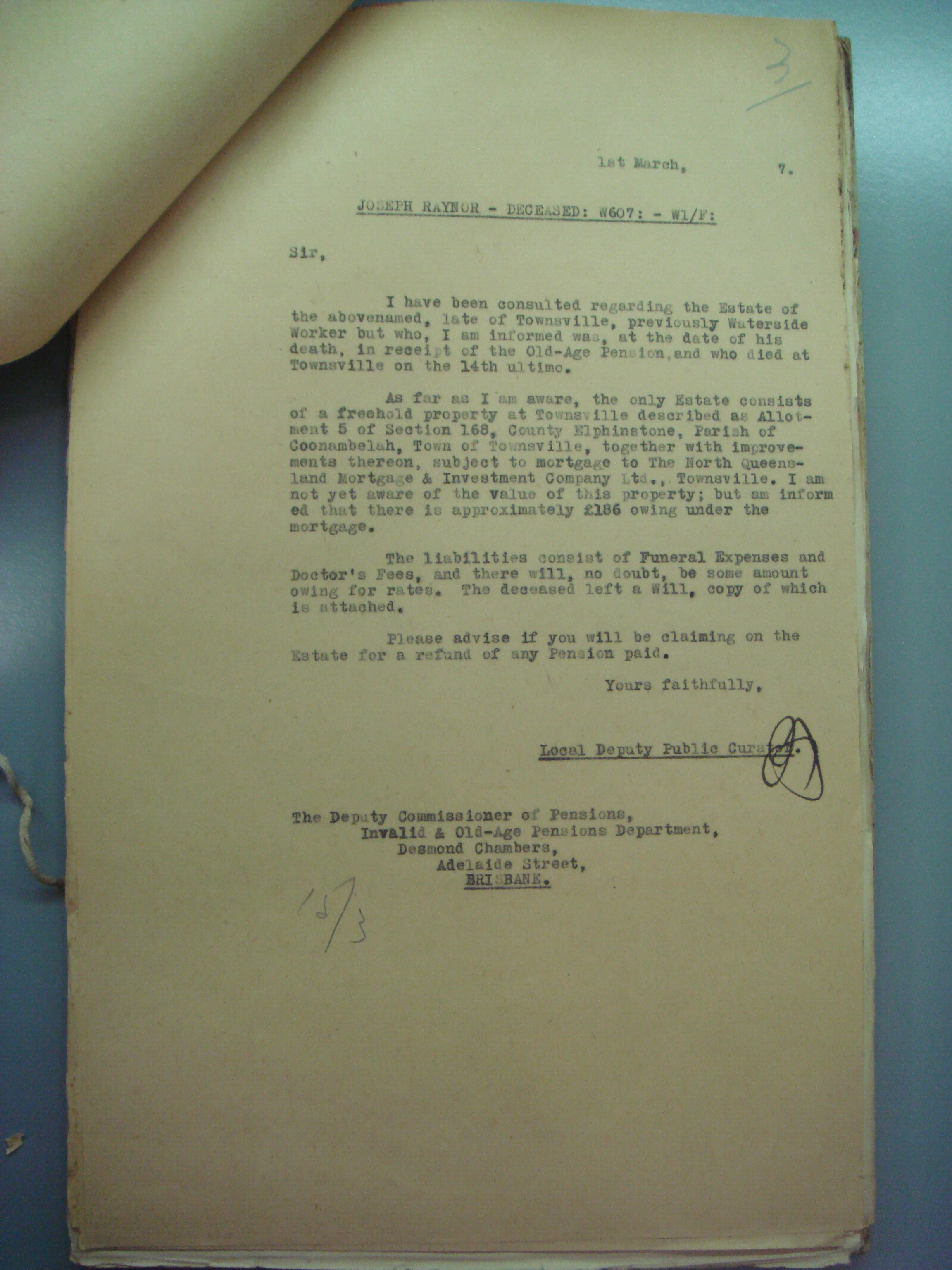
It appears Joseph might have  been sent an Aged pension cheque after his death.  The public curator wrote to the Aged pension office to ask if they intended to submit a claim on the estate for recovery of monies owing:
Folio 3

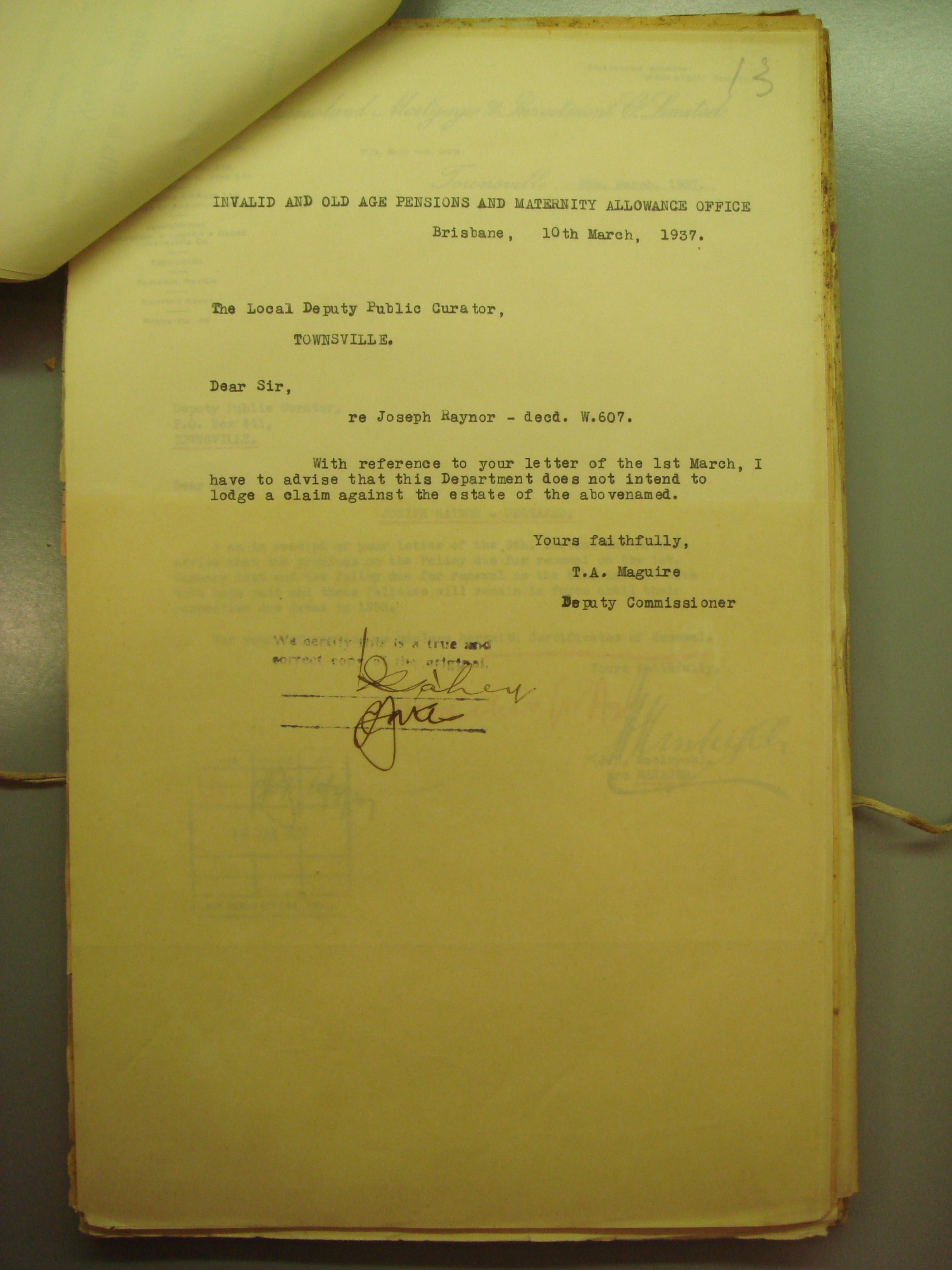
The Aged pension replied 10 March 1937 advising they would not lodge a claim:
Folio 13

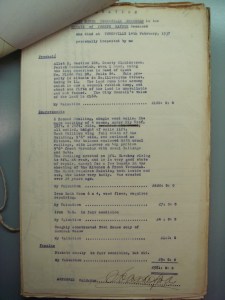
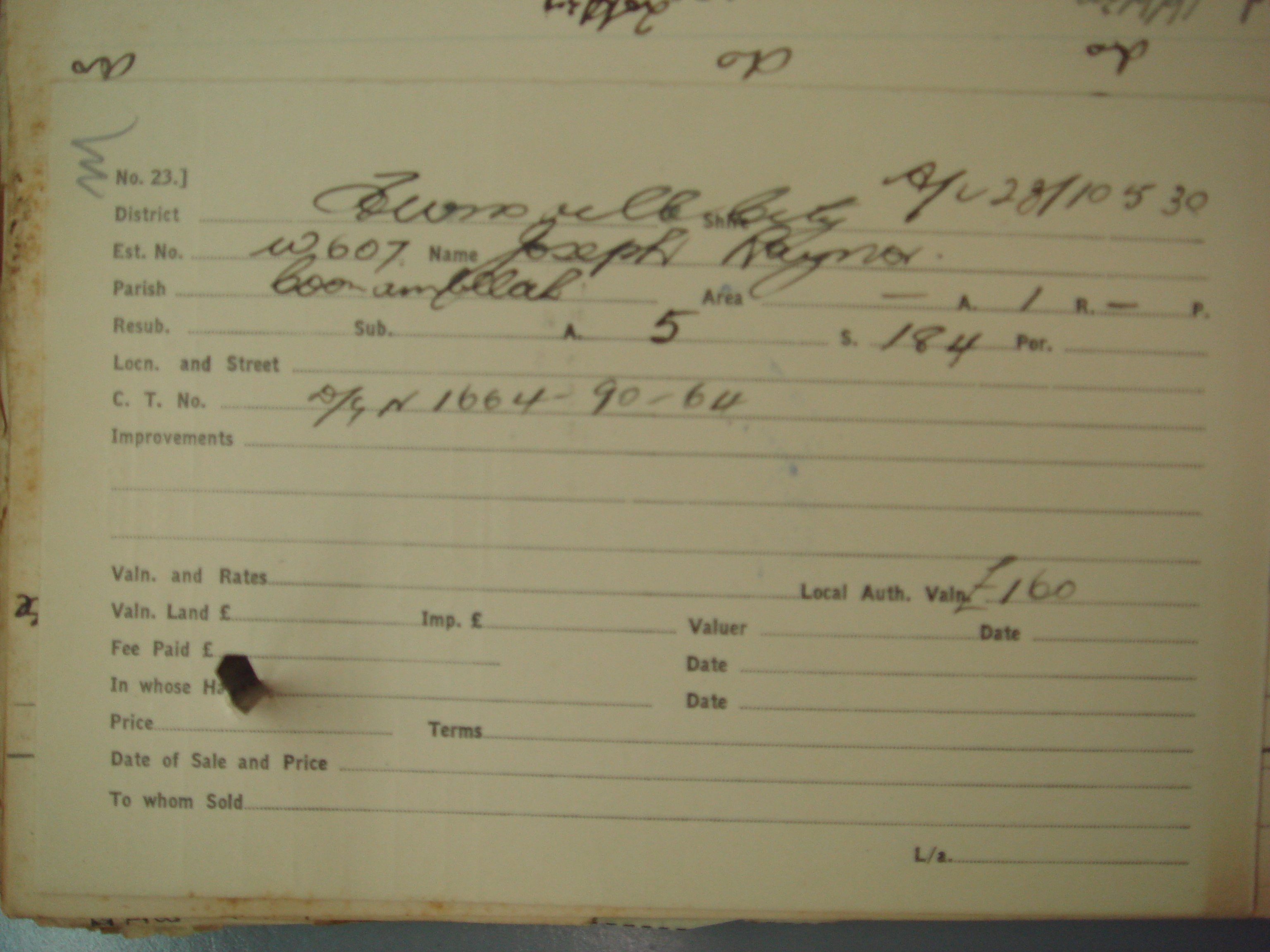
As Mary was the sole beneficiary of the estate, the home at 11 McIlwraith St would be transferred into her name.  This required a valuation which was arranged by the curator:
Estate docs - home valuation

The valuation fees (above)

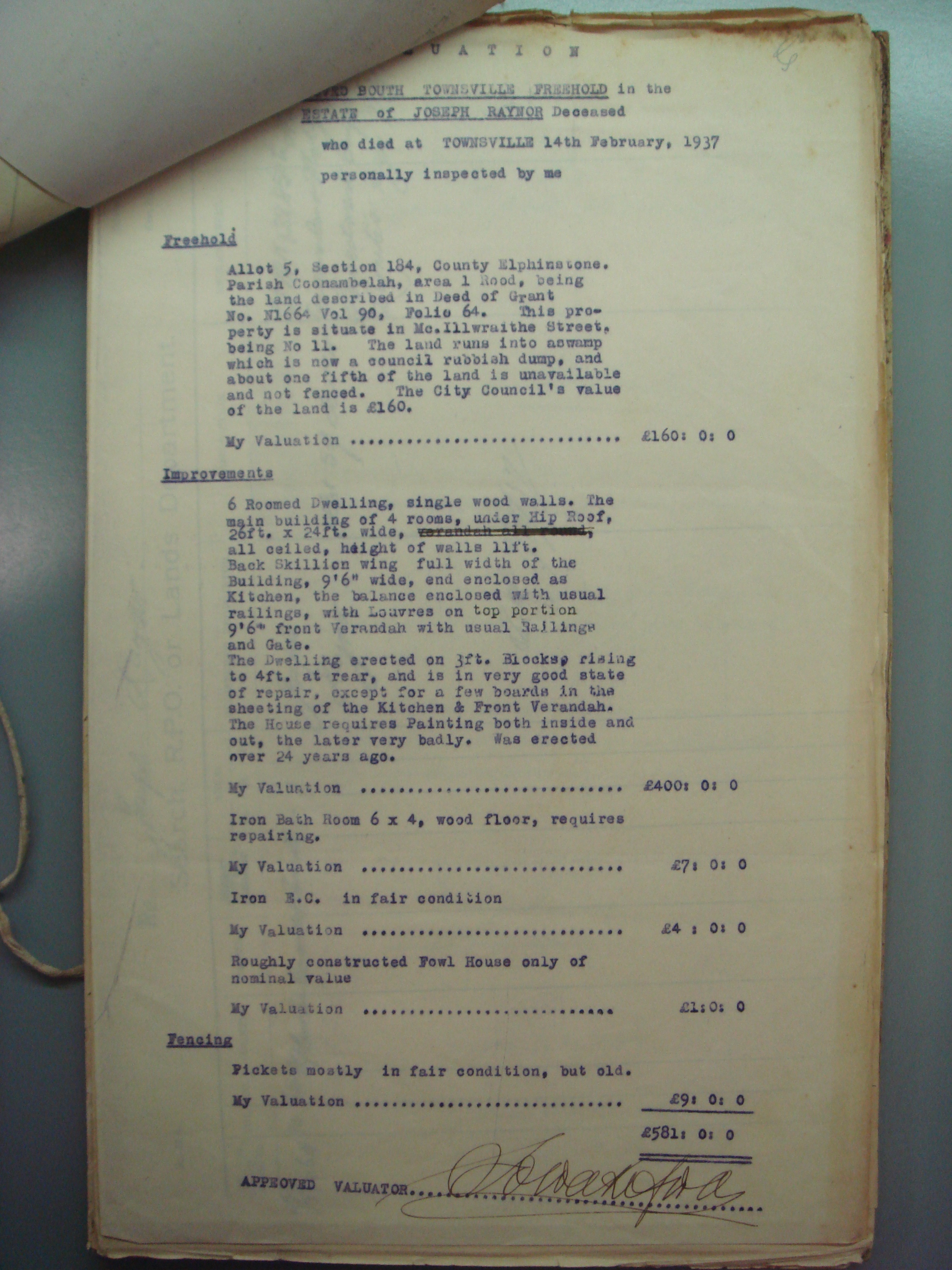
Estate docs - house & land valuation

So what was the property worth in 1937?

The land valuation was the same as the Townsville City Council valuation – 160 pounds.

The house itself was described as being built 24 years earlier (1913?), and was a 6 room dwelling with single wood walls.  The house was considered in good condition but badly in need of a paint, inside and outside.  There were also some minor repairs needed in the bathroom.  And the picket fence was described as being in fair condition, but old.  The overall valuation of the house was 460 pounds.

Together with the land, the total value of the property was 580 pounds.

And a ‘roughly constructed Fowl House’ was given a nominal valuation of 1 (one) pound.

(Dad was sitting with me viewing the document said, ‘yep I remember the chook shed’.  He was less than a year old at the time of Joseph’s death)

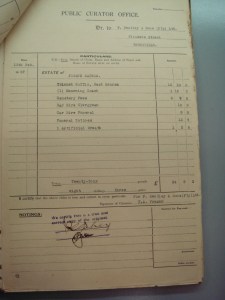
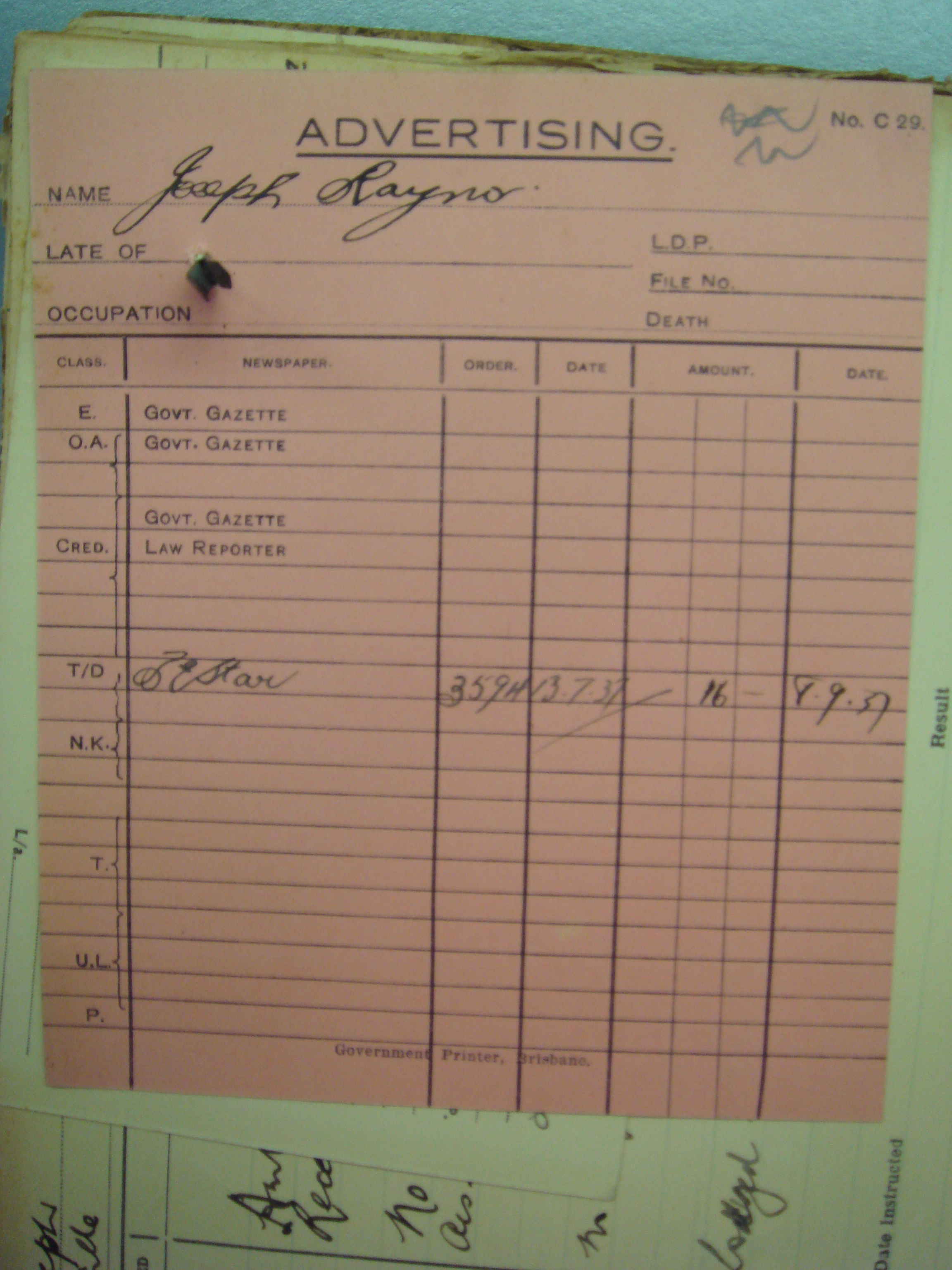
The Public curator kept records of all the estate expenses:
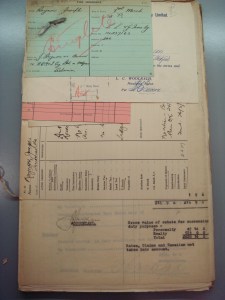
Estate documents file

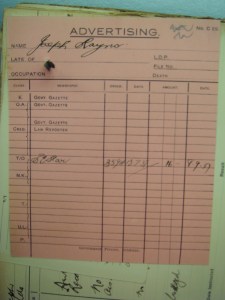
Including the funeral and advertising costs:
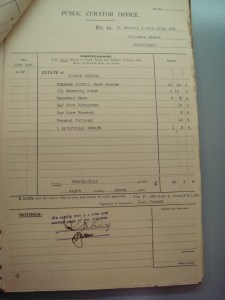
Estate docs - funeral costs

Estate docs - advertising costs

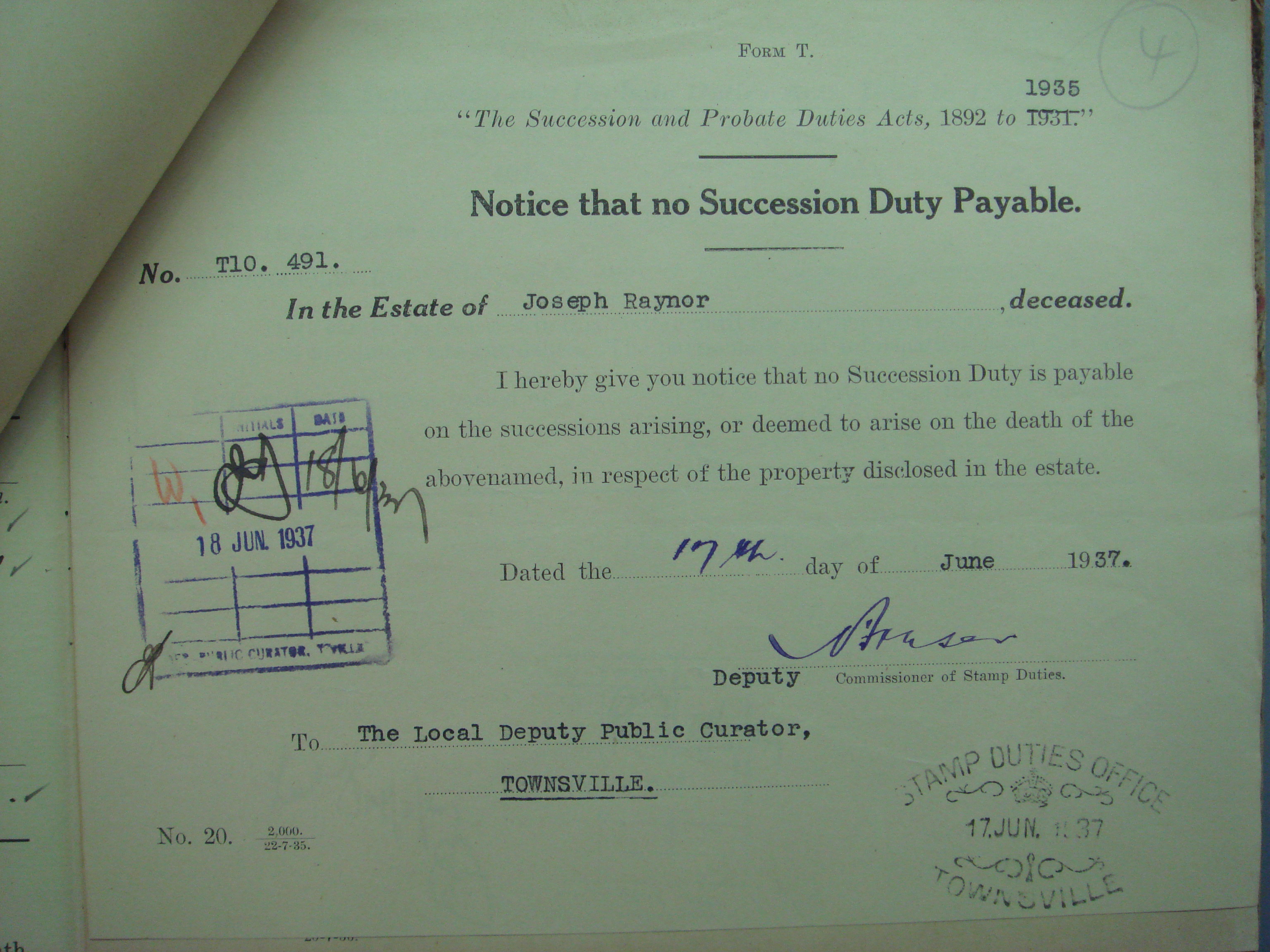
Succession duty was not charged to the estate:
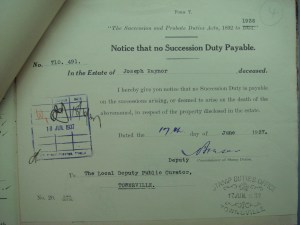
Estate docs - succession duty not payable

The Estate checklist for what needed to be completed in order to transfer the Joseph’s estate to Mary Jane:
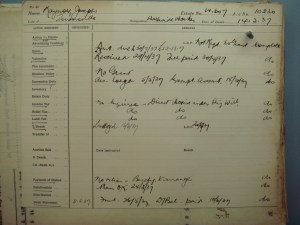
Estate docs - checklist

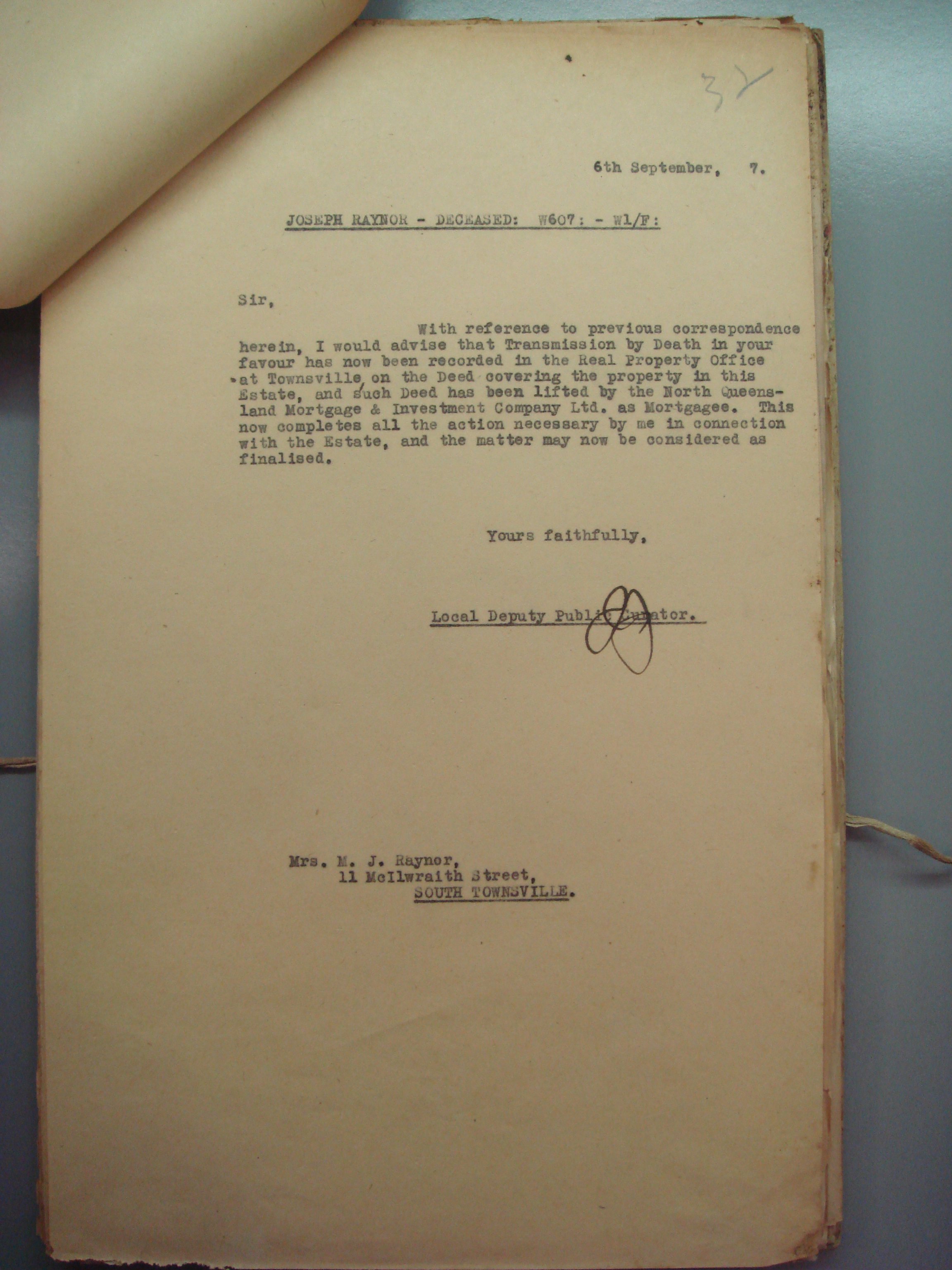
Finally in September 1937 the transfer of the property was completed
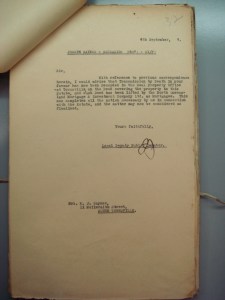
Folio 32

(note:  the public curator addressed Mrs Raynor as ‘Sir’ instead of ‘Madam’, a typist mistake probably)

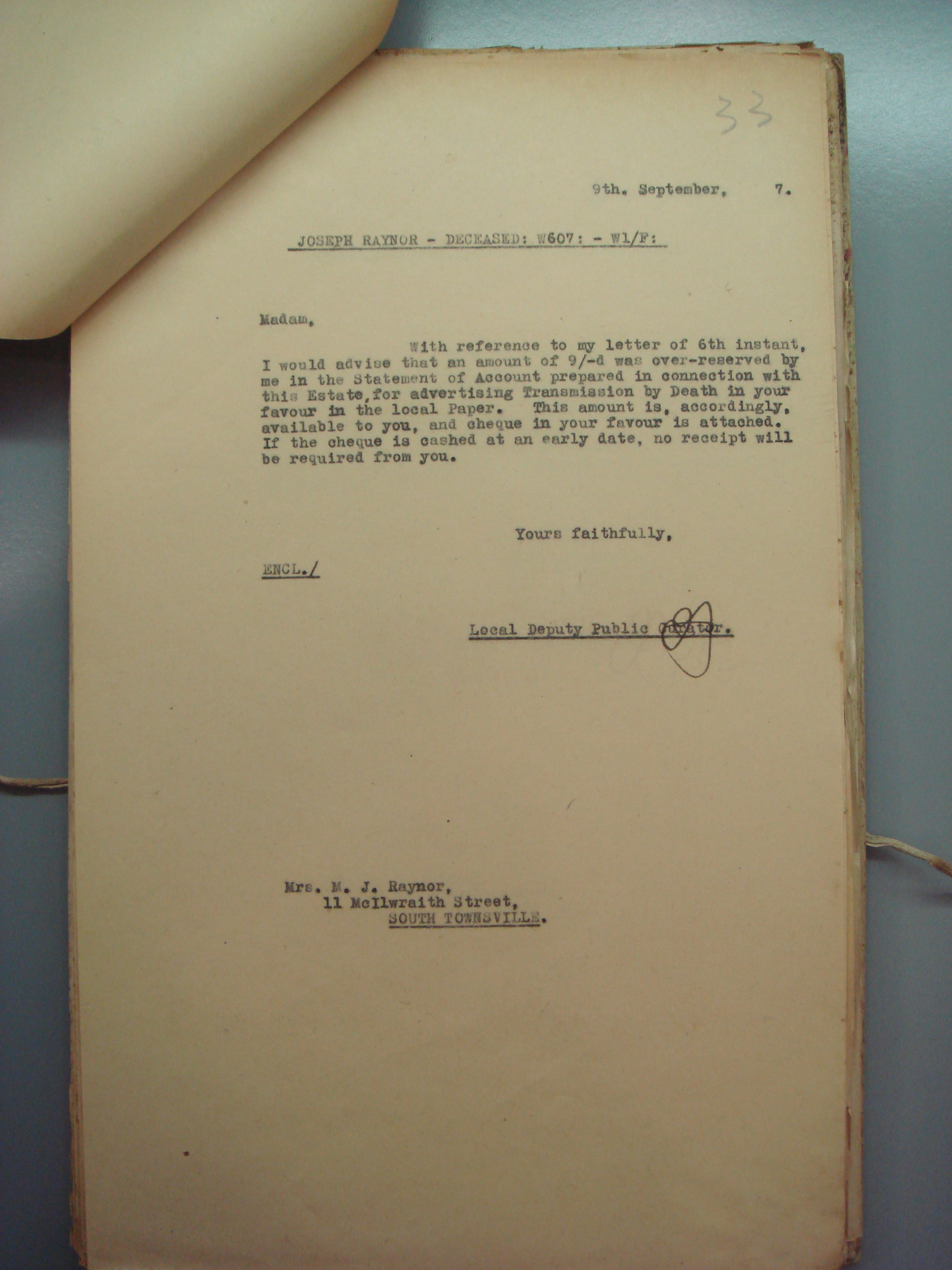
Then the public curator found some ‘change’ left over in the funds he’d made Mary Jane pay in order to finalise the estate, which he duly handed back:
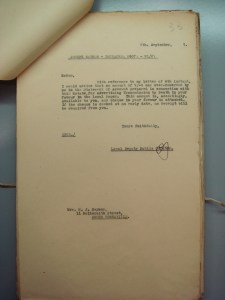
Folio 33


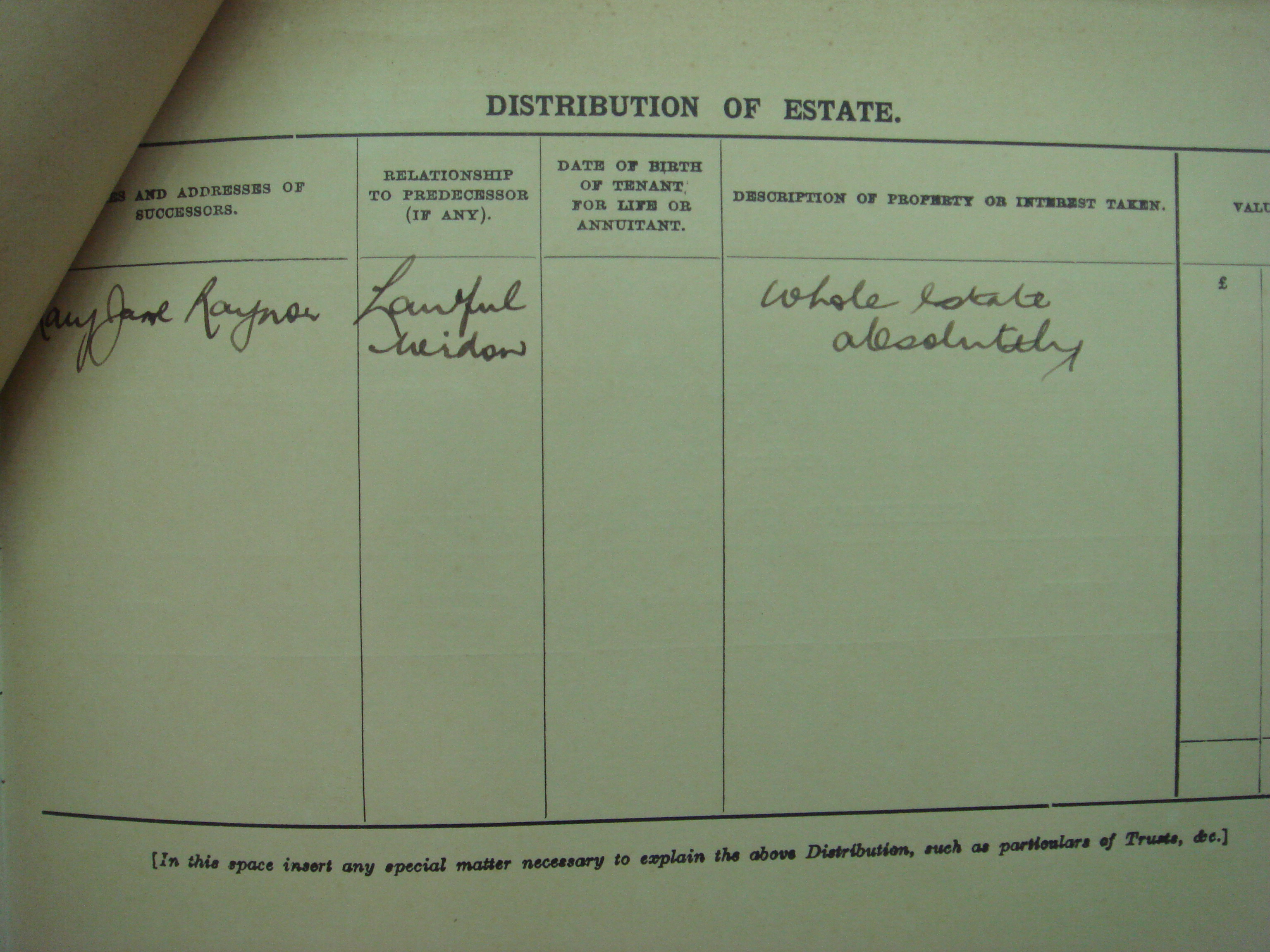
And the distribution of the estate, in accordance with Joseph’s Will:
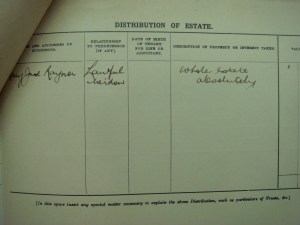
Estate docs - distribution of estate

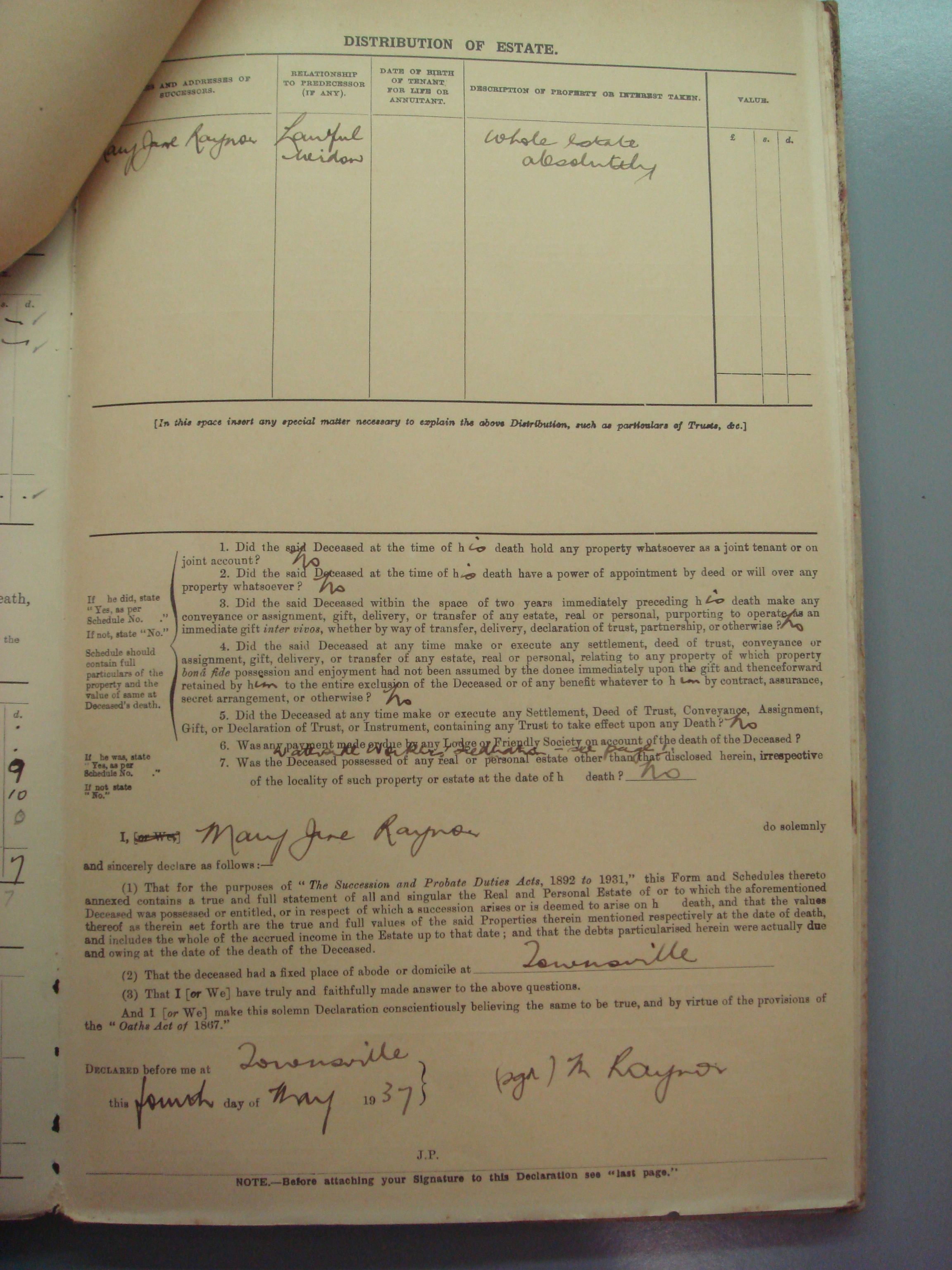
And Mary Jane signed a form which completed transfer of the Estate (the family home) into her name:
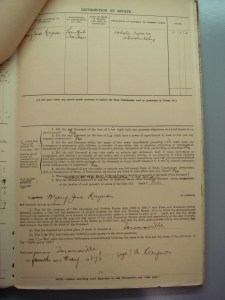
Estate docs - distribution statement

Having seen the will and estate file, there was no information or clues relating to Joseph’s sicilian family or past.  Also, there is no mention of Joseph’s brother – if he was living in Australia then, surely he would have contacted Mary Jane?  Still a mystery….

 

Naturalisation – Joseph Raynor

Joseph Raynor was naturalised 11 January 1899.  I visited Queensland Archives hoping to get a copy of his naturalisation application, however it is missing.  There is however a line in a naturalisation register confirming Joseph was naturalised at the Townsville Supreme Court on 11 Jan 1899.

Did Joseph change his name to Joseph Raynor when he was naturalised?  According to Queensland Archives staff, it would have been simple for Joseph to change his name – he just declared his new name and that was it.  The naturalisation process did not apparently require a strict identification process.

Why did Joseph apply for naturalisation?  Did he need to have it to be in Australia?

I did a search of NLA Newspapers online and did a search of Naturalisations in Townsville, as reported in the Townsville Daily Bulletin.  I came across this interesting article appearing in the Newspaper 13 January 1940:

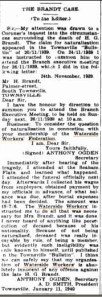
TDB 13Jan1940 - Brandt Case

The above reads:


So what happened?  A Coroner’s inquest had been reported in the Townsville Daily Bulletin 11 Jan 1940 (Page 3)

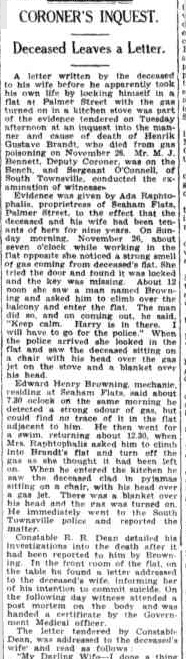
TBD 11JAN40 - P3 - BRANDT (PT 1)

CORONER’S INQUEST.

Deceased Leaves a Letter.

A letter written by the deceased to his wife before he apparently took his own life by locking himself in a flat at Palmer Street with the gas turned on in a kitchen stove was part of the evidence tendered on Tuesday afternoon at an inquest into the manner and cause of death of Henrik Gustave Brandt, who died from gas poisoning on November 26. Mr. M. J. Bennett, Deputy Coroner, was on the Bench, and Sergeant O’Connell, of South Townsville, conducted the examination of witnesses.  

Evidence was given by Ada Raphtophalls, proprietress of Seaham Flats, Palmer Street, to the effect that the deceased and his wife had been tenants of hers for nine years. On Sunday morning, November 26, about seven o’clock while working in the flat opposite she noticed a strong smell of gas coming from the deceased’s flat. She tried the door and found it was locked and the key was missing. About 12 noon she saw a man named Browning and asked him to climb over the balcony and enter the flat. The man did so, and on coming out, he said, ‘Keep calm. Harry is in there. I will have to go for the police.’

When the police arrived she looked in the flat and saw the deceased sitting on a chair with his head over the gas jet on the stove and a blanket over his head. Edward Henry Browning, mechanic, residing at Seaham Flats, said about 7.30 oclock on the same morning he detected a strong odour of gas. but could find no trace of it in the flat adjacent to him. He then went for a swim, returning about 12.30, when Mrs. Raphtophalls asked him to climb into Brandt’s flat and turn off the gas as she thought it had been left on. When he entered the kitchen he saw the deceased clad In pyjamas sitting on a chair, with his head over a gas jet.   There was a blanket over his head and the gas was turned on. He immediately went to the South Townsville police and reported the matter.

Constable R. R. Dean detailed his investigations into the death after it had been reported to him by Browning.  In the front room of the flat, on the table he  found a letter addressed to the deceased’s wife, informing her of his intention to commit suicide. On the following day witness attended a post mortem on the body and was handed a certificate by the Government Medical officer.

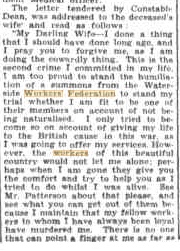
TBD 11JAN1940 - P3 - Brandt PT2

What did the letter say?

‘My Darling Wife— I done a thing that I should have done long ago, and I pray you to forgive me, as I am doing the cowardly thing. This is the second crime I committed in my life. I am too proud to stand the humiliation of a summons from the Waterside Workers’ Federation to stand my trial whether I am fit to be one or their members on account of not being naturalised. I only tried to become so on account of giving my life to the British cause in this war, as I was going to offer my services. However, the workers of this beautiful country would not let me alone; perhaps when I am gone they give you the comfort and try to help you as I tried to do whilst I was alive. See Mr. Patterson about that please, and see what you can get out of them because I maintain that my fellow workers to whom I have always been loyal have murdered me. There is no one that can point a finger at me at far as (continued next page)…….
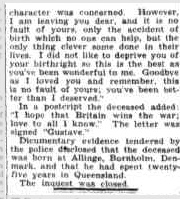
TBD 11JAN40 - P3 - BRANDT PT3

character was concerned. However, I am leaving you dear, and it is no fault of yours, only the accident of birth which no one can help, but the only thing clever some done in their lives. I did not like to deprive you of your birthright so this is the best as you’ve been wonderful to me. Goodbye as I loved you and remember, this is no fault of yours: you’ve been better than I deserved.’ In a postcript the deceased added: ‘I hope that Britain wins the war; love to all I know.’ The letter was signed ‘Gustave.’ Documentary evidence tendered by the police disclosed that the deceased was born at Allinge, Bornholm, Denmark, and that he had spent twenty five years in Queensland. The inquest was closed.