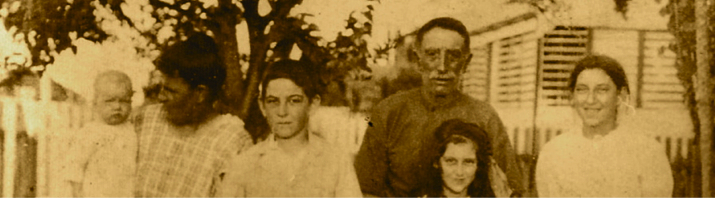
Cyclone Sigma


From the Newspaper ‘The Queenslander’ dated 14 Mar 1903.

Cyclone Sigma hit Townsville 26 January 1896, with devastating effect.  Below is a recount, quoted from ‘The Queenslander’ Newspaper:

The cyclone “Sigma” broke over Townsville with most disastrous effects on Sun-day, 26th January, 1896. Timely warning was given by the meteorological office ofthe advent of violent disturbances, and most of the townspeople were prepared for something unusual, when the wind, which had been blowing strongly for a couple of days, gradually increased in strength, till at midnight on Saturday, 25tJanuary, it advanced in cyclonic form. The wind blew persistently from the south, be ing accompanied at times with heavy rain, which, under the influence of the gale, found its way into houses hitherto considered absolutely weatherproof. A very heavy sea was running, waves broke over the eastern end of the jetty, and even inside the harbour the waves were of a dangerous size and strength. Even these conditions were light, when compared with those of Sunday and Monday. Between 6 and 7 o’clock on Sunday morning the Bay presented an alarming appearance, high waves beat upon the beach, and frequently overwhelmed 500ft. to 600ft. of the eastern jetty, pouring over the structure into the harbour in irresistible volume. The intervals between the gusts became less frequent, and the rain was almost continuous. Every gully and watercourse carried a roaring torrent. In the early morning Cape Cleveland advised that the
velocity of the wind registered 11, but a higher velocity was reached in the afternoon.

The harbour works suffered severely. The mischief to the eastern jetty was most extensive, and along about 1600 ft. of it, the height was reduced by 5ft. or 6ft., the cement coping and portions of the base being demolished. Four gaps were made  on the seaward side of the jetty, between the wharf and the shore. On the outer arm there was a large gap near the bend beyond the end of the concrete parapet. The jetty was levelled down for several feet, and the lighthouse end swept away. The western breakwater was damaged in several places, and about 200 ft. at the end was levelled to about low-water mark. The vessels wrecked were the Alexandra, Ada Dent, Star of Hope, Lalla Rookh, Nebo, Florence Elliott, Heather Belle,Presto, Dugong, Nautilus, two barges, and the steamer Ellen. The Leura was washed broadside on to the breakwater, and the Aramac was grounded for ten hours on Bramble Reef.

The town presented a wrecked appearance, houses being unroofed, and in some cases lifted bodily off the blocks. In many instances there was a total collapse. The School of Arts was wrecked, and the baths completely swept away. The Imperial and  Criterion Hotels were unroofed, and hardly a house escaped damage. The streets were strewn with galvanised iron from the roofs of the houses. The lighthouses on both jetties disappeared. Ross Creek was in strong flood, and Hermit Park and neighbourhood were flooded. The railway goods shed was unroofed, and the line was under water as far as the eye could reach. The gas works were flooded. The hospital was much damaged, and had hardly a dry corner. On Ross Island the Church of England was completely wrecked, the Oddfellows Hall was utterly demolished and scores of cottages were shifted and unroofed .Thirteen lives were lost during the gale, including those of Mrs. Hunt and  infant, Mrs. Grimman, and the Misses Rowe  (2), who were drowned in Ross Creek bythe upsetting of a boat. One section of Ross Creek Bridge sank 3ft .

The rainfall between 9 a.m. and 9.50 p.m.on the 26th was 7.7 in., and between the24th and 28th totalled 26.72 in. The barometer fell to 29.19 in. The damage to Townsville was estimated at half-a-million sterling.
 

Christopher Wilson – Irish Freeholder Records

I searched the  PRONI Freeholder Records, and was surprised to find a likely match for Christopher Wilson:

Christopher Wilson was listed as the leaser of some land in the town of Derryenver, County of Armagh.

How do I know he is the likely ancestor of Christopher Wilson (father of Abraham Wilson)?

I have previously searched the marriage records held on PRONI, and found Christopher and Catherine’s marriage certificate.  On the Certificate, Christopher’s place of residence at the time of marriage is ‘Derryinver’.  This is not a big town, in fact it is a very small village, so there is unlikely to be another Christopher Wilson living there.

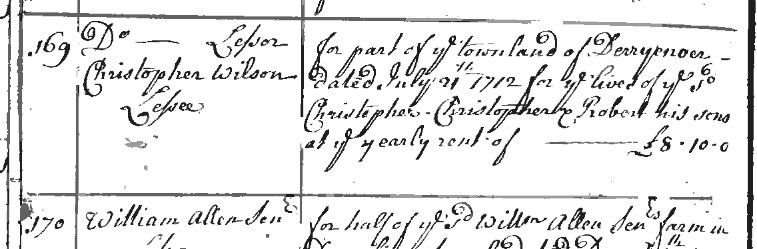
The Freeholder record lists the landlord as being William Brownlowe, and date of registry is 1712.  The lease was listed as being held for Christopher’s life and also the lives of his sons Christopher and Robert:

Christopher Wilson land lease1712

The above is the extract of the lease agreement (paid yearly)

It reads:

Christopher Wilson 

In part of town land of Derryenver

dated July 21 1712 for (the) lives of ye (?)

Christopher, Christopher, Robert, his sons

at (?) yearly rent of –  (Pounds) 8-10-0

William Brownlowe was a prominent figure in Lurgan (Armagh) history.  He was landlord over much of the land in the Lurgan area, including the towns Derryadd (where Abraham was born) and Derryinver (likely where Christopher was born).  More information about Lurgan freeholder  land history can  be found here.

Armistice Day 11 November 1918 – Townsville celebrations

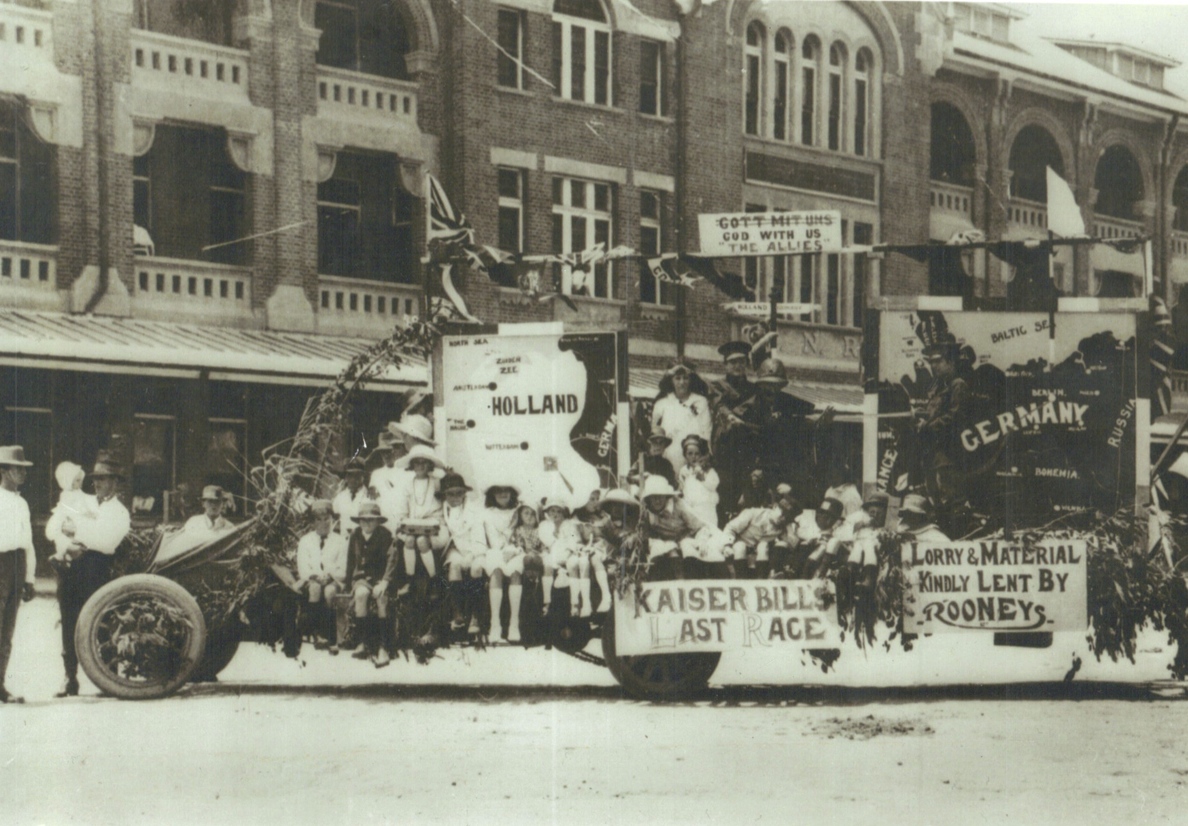
Below is a photograph I found in the Townsville Bulletin 11 Nov 2000, when a news story appeared recalling the end of World War I.  Abraham Wilson was involved in the celebrations, dressing up as the Kaiser in the photograph below.

Armistace Day 1918 - Tvl

Contrary to popular belief in the family, Abraham’s son Henry is not in the photograph above (confirmed by Henry himself).


Note:   The above photograph is now kept in Archives held at James Cook University, and copies can be purchased from the University.  I cannot provide copies of this photo, I don’t own the copyright, and I include it on this website purely as part of documenting family history research.

PRONI records – missing deceased records for the Wilson family

I’ve searched and searched and tried every option I can think of, but I cannot located the deceased records for Christopher Wilson and three of his children – Edward, Mary and Emily.

Christopher died in a shipyard accident (probably in Belfast) sometime in the late 1880s-1891 (when Catherine emigrated).  I’ve searched on every name variation I can think of, but he is not coming up.

I thought perhaps he used a different surname or first name.  So I did a search for the children’s deaths – I’m almost certain the three were deceased at the time Catherine left Ireland, otherwise she would have taken them with her too?

None of the children’s death records are on PRONI either.

So I give up – for the time being.


The Wilson family were Scottish in origin

While researching my family’s history, I realised the Wilsons were not Catholic and did not have typical Irish names (eg. Patrick, Michael, Bridget etc).  When analysing further, I noted the Wilsons’ religion was  Methodist, a Scottish Christian religion (or possibly Presbyterian?).  Also, some of the male family names are of Scottish origin – Christopher, Thomas Andrew, Robert.  Initially I thought this was unusual, to have a Scottish family living in Ireland, but some historical research provided the answer.

The first King of England and Scotland was James I.  Elizabeth I Queen of England did not marry or have kids, so her half-sister’s son, James I, got the inheritance – England.  Her half-sister Queen Mary (mother of James) was Queen of Scotland.   So James I, got England and Scotland together.  While having all the mainland real estate, James also wanted the nearby Island – Ireland.  His plan was to send Scottish ‘low landers’ to Ireland and settle them there.  He thought this would help keep the Irish under control.  The plan worked, but in many ways it didn’t work.

So the Wilson family were probably  lowlander Scots in origin.

Some history is below:

Scottish emigration to Ulster

Ulster ancestry

Christopher Wilson – home address at the time of his marriage

Christopher Wilson (married to Catherine) , father of Abraham, lived in Derryinver on marriage to Catherine.  This was within the Montiaghs district within the county of Armagh.

Catherine was listed as living  at Derrytrasma, Montiaghs.  Catherine’s stepfather, Thomas Bunton, was listed as living at Ardmore Montiaghs, also within the county of Armagh.   All of these locations were within a few miles of each other.

Both locations are also near Derryadd (also within Montiaghs), where Abraham was born.

The marriage location was listed as ‘Ardmore’ Montiaghs, Armargh.  I believe this is because the marriage took place in the ‘Ardmore’ parish Church of Ireland, which is located in Derryadd (where Abraham was born).

Christopher, his father, Catherine and Thomas all had ‘weaver’ listed as occupation  – so they probably worked together?

Did Christopher’s father own the land at Derryinver, or was he renting?


Links below:

Family places in Montiaghs, Armagh

Christopher Wilson – PRONI record of date of death?

I’ve been searching for Christopher Wilson’s death certificate.  It is not easy.  Ireland have civil records dating back to 1864, and also have non-Catholic marriages recorded from 1845 onwards.   Records are stored by the Public Records Office Northern Ireland (PRONI). So I should be able to type in Christopher’s name with a range of years for his death (I don’t know what date or year he died), and his name should pop up with a year of death and age.  I understand 1800s records are not completely accurate, but a record of Christopher’s death should be stored somewhere?

Well, I’ve tried typing in ‘Wilson’ ‘Christopher’ and various date ranges up until 1891 (When Catherine, Abraham and Robert left Ireland to emigrate to Australia).  Nothing has turned up so far.  I’ve found just three ‘Christopher Wilsons’ who died between 1880 and 1891.  I’ve also searched on ‘Chris’, ‘Christy’, ‘Christie’, ‘Kris’ and I’ve left the forename blank altogether.  I’ve also looked at various entries for other names which might be his middle name eg. ‘Robert’, ‘James’, ‘William’. And some odd looking names like ‘Reid’ (just in case the transcriber read the name wrong) and ‘Charles’ (just in case the transcriber thought the name read ‘Chas’).  No luck.

Curious, I thought I’d also look up the dates of death for three of his children who probably died in childhood, and before Catherine emigrated (as I couldn’t imagine she would leave children behind in Ireland).  None of the children came up in the search for date of death.  The three children are:  Edward (b. 1869), Emily (b. 1871) and Mary (b. 1875).  I also checked if perhaps Emily and Mary might have got married before Catherine left Ireland (as I don’t think she would leave them behind as young single women).  No marriages.  So why are there no records of death for Christopher, Emily, Mary and Edward?  No idea.

Perhaps Catherine left the reporting of death to her local Church – all the births were recorded, but none of the deaths.  Why?

Christopher Wilson (father of Abraham) – why did he switch from Weaver to Shipyard worker?

On Abraham’s birth certificate, Christopher is listed as being a weaver.   However, Christopher died in an accident while working in a shipyard in Belfast, which prompted his widow Catherine, and their sons Abraham and Robert, to emigrate to Australia.  Why did Christopher switch jobs from weaver to Shipyard worker?

Irish Linen, up until the late 1800s, was handmade, and highly sought after.  There was plenty of employment as a weaver in Ireland (and in England too, in places such as Manchester).  The Industrial Revolution eventually introduced machinery to replace the weavers.  Initially Irish weavers working in Ireland (as opposed to working in England) were unaffected by such machinery, because their wages were so low – Irish weavers working in Ireland remained cheaper to use than the new-fangled weaving machines.  Eventually though, this changed, with weaving machinery and factories set up, which replaced most of the weavers.   The Linen industry  in the  town of Lurgan, where Christopher most likely was employed as a weaver, was also affected.   Christopher was obviously affected, and needed to seek employment elsewhere.

In nearby Belfast, the Ship building industry was booming.   Railway now linked Lurgan to Belfast, meaning it was possible to commute each day to a Shipyard from Lurgan.

It is likely Christopher made the decision to get a job in the shipyard  as it was probably his only chance of employment, once he knew he could no longer work as a weaver.    Christopher was still a weaver when Abraham was born (1876), and he was then about 41-45 years old, a relatively late age to be making a career change.  But Christopher did change careers (no choice though), and eventually died in the accident at the Shipyard, an occurrence which was not uncommon.   I suspect as a newcomer to the shipyard, Christopher was given the menial jobs,  as well as the high risk jobs the more experienced workers would avoid at every opportunity.  Its a shame Christopher didn’t consider emigration to Australia, or the USA, as his sons eventually did.

Further information about the impact of the Industrial Revolution on the Irish linen and Ship building industries, via the following links:

A brief history of Irish Linen

Belfast History of Ship Building

Isabella Shiels – how she earned a living in Townsville

I’ve been wondering how Isabella earned a living when John died.  It turns out she worked as a Laundress.

I found the information on the QLD State Archives website (I searched under Images) and was looking at old photos when I came across the Townsville Orphanage Register files – which are scanned in as images.  isabella admitted two of her daughters, Annabella and Eliza, to the Orphanage in 16 Oct1886 (following her earlier admission of daughters Margaret and Annabella 6 Aug 1884 – 16 Apr 1886).  On the admission form, Isabella’s occupation is listed as ‘Laundress’.  So that’s it then – that is how she made a living -obviously not enough to support 5 daughters.

Jacob Wiltshire (1808 -1839) – Australian Convict

I had a surprise find the other day.  One of Emily Jane’s great-uncles was a Convict!

Details:

Jacob Wiltshire – Parents James and Jane Wiltshire (nee Evard).  Jacob was the brother of Michael Wiltshire, father of Jane Coleman (nee Wiltshire) ie. Jane’s Uncle.

Born:  1808  (Christened 13 March 1808 at Vernham Dean)

Convicted:  18 December 1830, at Southampton Gaol,  for ‘Riotous Assembly and sending threatening letters to Farmers’

Sentence:  Death, later commuted to transportation to Australia for the term of his natural life.

Departure:   2 May 1833 on the Sailing Ship ‘Captain Cook’.

Estimated arrival date in Sydney, NSW:  2 Jan 1834 (based on an estimated 8 month voyage)

Died:  15 Jan 1839, still a convict.  [Archives citation: 4/4549; Reel 690 page 227]   Aged 30 years.

Location:  District/Parish:   Bathurst, NSW.

Source of above information:  Australian Joint Copying Project.


The background to Jacob’s conviction can be found at:

The Swing Riots of 1830


From a brief internet search so far, it appears Jacob had requested a pardon, as many of the swing rioters transported to Australia had received pardons.  Unfortunately Jacob passed away before such a pardon was granted.